
Lynx Software Technologies will feature advanced MOSA and edge AI demonstrations at booth 423 during the 2026 MOSA Industry and Government Summit, running through September 22, 2026, at the Gaylord National Resort & Convention Center near Washington, D.C. The company also confirmed it will lead an industry panel on cyber resilience through open systems architecture, according to a company announcement distributed September 16, 2026.
The booth demos cover cockpit displays, camera systems, and an AI safety workflow built with Ansys, all running on Intel Tiger Lake hardware. Separately, Collins Aerospace will run its own MOSA demo at booth 523, built around a Lynx-based avionics computer it already ships.
This is company-sourced news. There's no independent report to check it against yet, since it's an announcement of a trade-show presence rather than a launch with outside reaction. What I can do is separate what's confirmed in the release from what's Lynx marketing language, and add the background that actually explains why this company's safety claims carry more weight than a typical edge AI pitch.
The Details
Four demonstrations anchor the Lynx booth, according to the company's announcement:
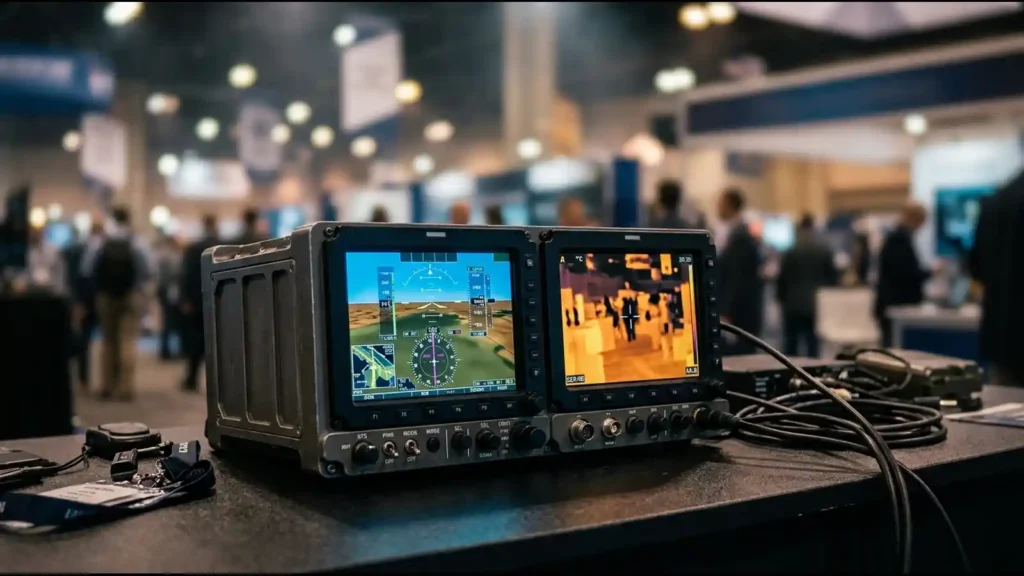
- Synthetic Primary Flight Display Demo: Consolidates cockpit workloads on Intel Tiger Lake hardware, described as letting engineers deploy across CPUs, GPUs, or both on a single ruggedized unit.
- EO/IR Camera Control Demo: Combines live video, thermal imaging, and AI processing into one mission display, also on Intel Tiger Lake.
- Helicopter Emergency Stopping Demo: Built with Ansys, this one simulates and verifies an AI-driven control system before deployment, aimed at catching failures in simulation rather than in the field.
- Collins Aerospace's separate demo (booth 523): Fifteen MOSA use cases built on Collins' own open-systems components, including ARINC661 and the FACE Technical Standard. The release states LynxOS-178 is a foundational element of Collins avionics products, including its air vehicle computer and the MFD-268 display.
The demos also feature Lynx RenderCore, a CPU rendering addition the company introduced on September 9, 2026, which it announced separately. Lynx's own materials describe it as part of the "most complete edge safety-critical graphics portfolio," a company claim, not an independently benchmarked one.
The cyber resilience panel runs September 22, 2026, at 2:30 p.m. ET in the Gaylord National's Baltimore 5 Room. Confirmed panelists are Ethan Salehi of Lynx (moderator), Guilherme Goretkin of Ansys (part of Synopsys), Trey Franklin of DESE Research, Mohamed Eladl of Metavonics, and Doug Britton of RunSafe Security.
Why It Matters
Edge AI announcements tied to trade shows are common enough that most are safe to skim past. Lynx's underlying safety credentials are the part worth actually noting. LynxOS-178, the real-time operating system at the base of this stack, dates to 2003 and holds an FAA Reusable Software Component certificate for DO-178C Design Assurance Level A, the highest civil avionics safety tier there is. That's a real, checkable credential, not a marketing line, and it's why a defense-adjacent AI pitch from Lynx reads differently than one from a startup with no certification history.
This also isn't an isolated announcement. It's the third Lynx release in about a week: the AI Deployment Gap Initiative and the RenderCore launch both landed September 9, 2026, ahead of this summit announcement. Stacking releases in front of a major industry event is a standard PR pattern, not a red flag on its own, but it's worth naming so the summit coverage doesn't read like three separate breakthroughs instead of one coordinated push.
The broader theme, getting AI workloads to run safely alongside certified, mission-critical systems without breaking that certification, is a real and unresolved problem in aerospace and defense software. It's the same space MIT researchers have been working on from a different angle with their HardFlow method for safety-critical AI, which lets pretrained models satisfy safety constraints without retraining.
What's Confirmed vs. What's a Company Claim
Confirmed by the release: the booth number, summit dates, panel time and location, panelist names and titles, and the four demo descriptions. Company claims, stated as Lynx's own framing rather than independently verified performance data, include phrases like "superior next-generation cockpit display performance" and "dramatically accelerate time-to-market." None of those come with benchmark numbers attached, so they're presented here as what Lynx says its software does, not as measured results.
What to Watch
Watch for whether Lynx or Collins Aerospace publish any benchmark data from these demos after the summit wraps, and whether Ansys or the other panelists put out their own accounts of the cyber resilience session. The AI Deployment Gap Initiative's manifesto, published alongside its September 9 launch, is also worth checking again in a few months to see whether the founding companies (Critical Software, Edera, Metavonics, OmniTrust, PACE, RunSafe Security, and TASKING) actually coordinate around it or whether it quietly fades, which is the more common outcome for multi-vendor industry initiatives like this one.
Key Takeaways
- Lynx will run interactive MOSA and edge AI demos at booth 423 and lead a cyber resilience panel on September 22, 2026, at the MOSA Industry and Government Summit.
- The demos, including a cockpit display, camera control system, and an Ansys-built AI safety workflow, run on Intel Tiger Lake hardware.
- Lynx's LynxOS-178 dates to 2003 and holds FAA certification for reuse in DO-178C DAL A safety-critical avionics software, real credentials behind the AI pitch.
- This is the third Lynx announcement in about a week, following the AI Deployment Gap Initiative and the RenderCore launch on September 9, 2026.
FAQ
What is Lynx MOSA.ic?
MOSA.ic is Lynx Software Technologies' modular software framework, built on its LynxSecure separation kernel, that lets safety-critical, security-critical, and general-purpose applications run on the same processor while staying isolated from each other. It supports LynxOS-178, Linux, and other operating systems, and is designed around the U.S. Department of Defense's Modular Open Systems Approach.
What is MOSA and why does it matter for defense systems?
MOSA, the Modular Open Systems Approach, is a Pentagon strategy for building defense systems out of interchangeable, standards-based components instead of proprietary, single-vendor architectures. It's meant to cut vendor lock-in and make it faster to patch, upgrade, or swap components without redesigning an entire system, which is the exact topic of the cyber resilience panel Lynx is leading at the summit.
How long has Lynx Software Technologies been building avionics systems?
Lynx introduced LynxOS-178, its real-time operating system for avionics, in 2003. It's certified to FAA DO-178C Design Assurance Level A, the highest civil aviation safety standard, and holds a Reusable Software Component certificate from the FAA, meaning certified code built on it can be reused across certification projects rather than recertified from scratch.