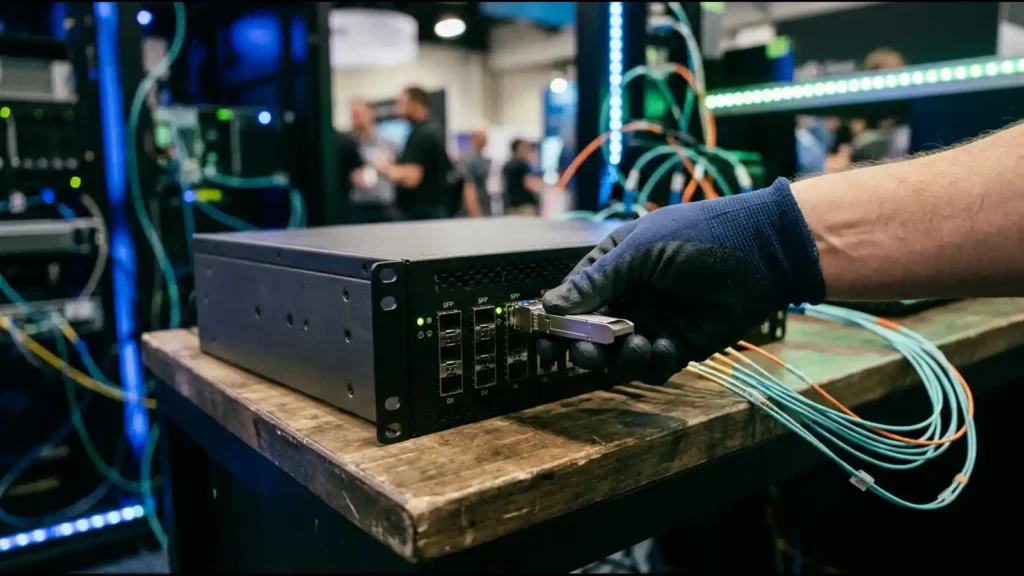
CUbIQ Technologies and Coherent Corp. showed a working proof of concept at ECOC 2026 in Malaga today: a continuous variable quantum key distribution (CV-QKD) transceiver built into a standard QSFP-28 pluggable, running on an NVIDIA DGX Spark host over its ConnectX-7 interface, alongside Coherent's 200G FR4 optics.
It's the same pluggable form factor CUbIQ has been showing for about a year, but this is the first time the target has explicitly been AI infrastructure rather than a telecom operator's network. No customer or commercial deployment has been named in the announcement.
Quick Take
- CUbIQ and Coherent demonstrated a CV-QKD transceiver in a QSFP-28 pluggable, tested on an NVIDIA DGX Spark via ConnectX-7 with Coherent 200G FR4 optics, live at ECOC 2026 in Malaga (September 21 to 23, Dutch Pavilion, booth 1051).
- This targets operators whose AI clusters have outgrown a single building, since the fiber now running between sites carries model weights and training data and can be tapped without either end noticing.
- It's CUbIQ's third public demonstration with Coherent in about a year, and the first one framed around AI infrastructure instead of telecom carrier networks. No customer or deployment has been named.
The Details
CUbIQ's CTO, Chigo Okonkwo, wrote up the demo on the company's own blog, published the same day as the release. The setup: a CV-QKD pluggable generates quantum keys and feeds them to NVIDIA's ConnectX-7 NIC over the standard CMIS management interface, where the NIC's hardware crypto engine handles AES-GCM-256 encryption at line rate. The quantum-derived key is combined with a post-quantum-cryptography key negotiated separately, so the system doesn't rely on QKD alone.
During the walkthrough, throughput held near 100 Gbps, using one of the two host interfaces a single QSFP port exposes on a DGX Spark (both together could approach the port's full 200 Gbps). CUbIQ says a typical three-minute key session encrypted between one and two terabytes of traffic. For the live eavesdropping demonstration, the team split 50 percent of the optical signal off the channel. The dashboard's channel status moved from secure to undefined, ran a second verification pass, then flagged insecure, which CUbIQ says typically takes a few seconds. Keys generated during that window get discarded rather than used.
One caveat worth stating plainly, because CUbIQ states it too: this ran over a short bench link, not the tens of kilometers of inter site distance the module is actually built for. Results at real deployment range are described as still to come.
What the CEO Said
"CUbIQ's mission is to show practical, accessible physical layer security that can extend across AI infrastructure," said CEO Aaron Albores Mejia. "This work with Coherent Corp., running on NVIDIA's AI Supercomputer systems via the ConnectX interface, proves that quantum-safe networking can be demonstrated on the AI infrastructure that operators are already deploying."
Why It Matters
I've now watched CUbIQ stage three of these demos in roughly twelve months. In September 2025, it was HPE Juniper PTX routers, Coherent 400G ZR optics, and Liberty Global validating the telecom use case at ECOC 2025. Around OFC 2026 this spring, a CUbIQ collaborator posted on LinkedIn about a version running Coherent 800G ZR modules inside Liberty Global's own datacenters. Today's version drops the router vendor and the telecom operator entirely and plugs straight into NVIDIA hardware instead. That's not necessarily a bad sign, companies are allowed to iterate, but it does mean CUbIQ has repositioned its pitch three times without a named paying customer showing up in any of the announcements.
It's also worth knowing that the NSA and NIST have spent several years steering national security systems toward post quantum cryptography over QKD specifically, citing QKD's distance limits, specialized hardware, and cost. CUbIQ's own architecture quietly concedes the point: it never relies on the quantum derived key by itself, it always pairs it with a PQC negotiated key. That's a reasonable engineering hedge, but it's also CUbIQ building around the exact objection regulators have been raising.
What to Watch
The real test is whether CUbIQ publishes results at actual inter site distance rather than a show floor bench link, and whether a named AI infrastructure operator, not just an optics or router partner, signs on as a customer. Given the roughly twice a year cadence so far, the next data point is likely another trade show demo around OFC 2027 rather than a shipping product announcement.
What Is CUbIQ Technologies?
CUbIQ Technologies is a Dutch startup based in Eindhoven, spun out of TU Eindhoven in 2021 by CEO Aaron Albores-Mejia and CTO Chigo Okonkwo. It builds continuous variable quantum key distribution transceivers packaged as standard pluggable optical modules, aimed at adding physical layer security to fiber networks without new rack mounted appliances.
Key Takeaways
- CUbIQ and Coherent showed a CV-QKD pluggable running on an NVIDIA DGX Spark via ConnectX-7 at ECOC 2026 in Malaga, paired with Coherent 200G FR4 optics.
- Live testing showed roughly 100 Gbps throughput on one host interface, 1 to 2 terabytes encrypted per typical key session, and eavesdrop detection resolving to 'insecure' within seconds of a tap.
- The demo ran over a short bench link, not the tens-of-kilometers inter-site distance the module targets; CUbIQ says results at real distance are still to come.
- This is CUbIQ's third public demo with Coherent in about a year, and the first framed around AI infrastructure rather than telecom operator networks; no customer has been named.
FAQ
What is CUbIQ?
CUbIQ Technologies is a Dutch startup based in Eindhoven, spun out of TU Eindhoven in 2021 by CEO Aaron Albores-Mejia and CTO Chigo Okonkwo. It builds continuous variable quantum key distribution (CV-QKD) transceivers packaged as standard pluggable optical modules, aimed at adding physical-layer security to fiber networks without new rack-mounted appliances.
What is quantum communication technology?
In the context of this story, it refers to quantum key distribution (QKD), which uses the quantum properties of light to generate and share an encryption key between two parties. Because measuring a quantum signal disturbs it, any attempt to intercept the key exchange leaves a detectable trace, letting the system discard a compromised key before it is used to encrypt data. This differs from post-quantum cryptography, which instead relies on new classical math problems believed to resist quantum computers.