
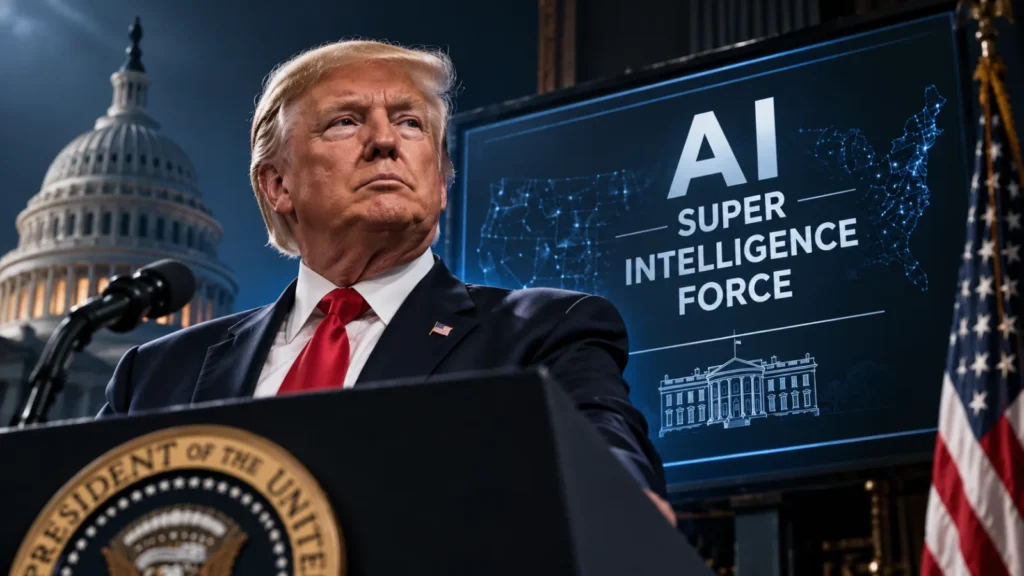
President Trump has announced the formation of an AI ‘Super Intelligence Force’, according to a report. That is all BriefFlash can report about the Trump AI Super Intelligence Force so far: a name and an announcement, with nothing else on the record.
The reporting available so far carries no detail on the body’s legal basis, funding, membership or mandate, so readers should not assume it is an agency, a military branch or the product of an executive order. A government body devoted to advanced AI could affect procurement, research priorities and regulation, but only with authority and funding. Until those are stated, this is a headline, not a policy change.
What has been reported about the Trump AI Super Intelligence Force?
The evidence is one report and one name. The name ‘Super Intelligence Force’ appears in quotation marks in the report’s headline, and BriefFlash does not know whether it is the official title. It may change once details are published.
The report’s web address also references Jay Clayton, which suggests a connection to the announcement. The available reporting does not say what his role is, and BriefFlash is not assigning him a title. A web address is thin evidence, so treat the reference as a possible link and nothing more.
Because everything rests on a single report, even the framing could shift. An announcement is not an operating body, and the distance between the two is where most of the open questions sit.
What is reported and what is still missing?
The reported part is short: Trump announced an AI body with that name. Everything that would define the body is absent from the reporting, and the graphic below sets the two side by side.
What could a ‘force’ turn out to be?
The word ‘force’ fits several kinds of body, and the reporting does not say which applies. The table is BriefFlash’s reading of the general possibilities; none is established.
| Possible form | What it would usually mean | What would reveal it |
|---|---|---|
| Task force | Coordinates existing offices, often for a limited period | A founding memo naming participants and a reporting deadline |
| Advisory group | Makes recommendations without binding power | A charter and named outside members |
| Agency unit | Sits inside an existing agency with staff and budget | An agency announcement or a funding line |
| Formal program | Funds defined activity toward stated goals | A budget document with objectives |
We think the name alone fits all four, so the details, not the label, will decide how much weight the announcement carries. We have no basis to pick one of them.
What does ‘superintelligence’ mean, and why does an official body using it matter?
The term usually refers to AI that would exceed human ability across a broad range of tasks, but there is no agreed definition or test for it. That is why a government body adopting the word matters: a precise definition would set a clear scope, while an undefined one lets different audiences read different ambitions into the same name.
We think the practical test is whether any formal document defines the term or ties the body to specific systems. If none does, the name is more likely to work as a signal than as a scope. That is an inference, not a reported fact.
What would show what actually changes?
Five things would turn the announcement into something readers can check.
- An executive order or other formal document that creates the body and states its legal basis.
- A stated budget or funding source.
- Named members and a named leader.
- A defined mandate saying what the body is meant to do.
- Reporting lines showing who it answers to and how it relates to existing government AI work.
A body’s effect depends on its legal authority and budget, not its name. For AI companies the consequence is conditional: if it influences procurement, research priorities or regulation, they will need to track it; if it is advisory and unfunded, little may change. No reaction from industry, Congress or researchers has been reported, and BriefFlash will not guess at any.
What we do not know yet
Who leads the body and who sits on it, how it relates to existing government AI work, what ‘super intelligence’ is meant to cover, what Jay Clayton’s role is, if any, and how it will be funded and timed are all unanswered. A formal document would settle most of them, and none has been identified.
The attention itself is measurable. In the headlines BriefFlash tracks, mentions of Trump ran at about 17.1 times their usual rate, with 6 mentions against a normal 0.17 per day, across 6 sources. That explains why readers are searching, but it says nothing about what this announcement contains. Other outlets have run separate pieces on related Trump AI headlines, and BriefFlash has published a separate piece on another recent Trump AI headline. This article relies on neither.
What happens next?
The development to watch is a formal document that creates or describes the body. Also watch whether the name ‘Super Intelligence Force’ survives, whether a leader and members are named, and whether funding is attached. No date for any of these has been stated.
Frequently asked questions
What is the Trump AI ‘Super Intelligence Force’?
It is a body President Trump has reportedly announced, with a name that appears in quotation marks in a headline. Its legal basis, funding, members and mandate have not been stated in the reporting available so far, so it is not yet clear whether the name is official or what kind of body it is.
Is the ‘Super Intelligence Force’ an official government agency?
That is not established. The announcement has been reported, but no executive order, agency action or other formal document has been identified that creates it. A name alone does not show whether it is an agency, task force, advisory group or program, so it should not be described as any of them yet.
What does superintelligence mean?
The term usually refers to AI that would exceed human ability across a broad range of tasks. There is no agreed definition or test for it, so different audiences use it differently. That is why an official body adopting the word matters: until the body defines it, its scope cannot be judged.
Who is Jay Clayton in this story?
That is not known. The web address of the report references Jay Clayton, which suggests some connection to the announcement, but the available reporting does not state his role or title. Until a source describes what he is doing, the reference should be read as a possible link and nothing more.
How will the Trump AI Super Intelligence Force affect AI companies?
It is too early to say. A government body’s effect depends on its legal authority and budget, and neither has been stated. If it influences procurement, research priorities or regulation, companies could be affected; if it is advisory or unfunded, direct change may be small. No industry reaction has been reported.