
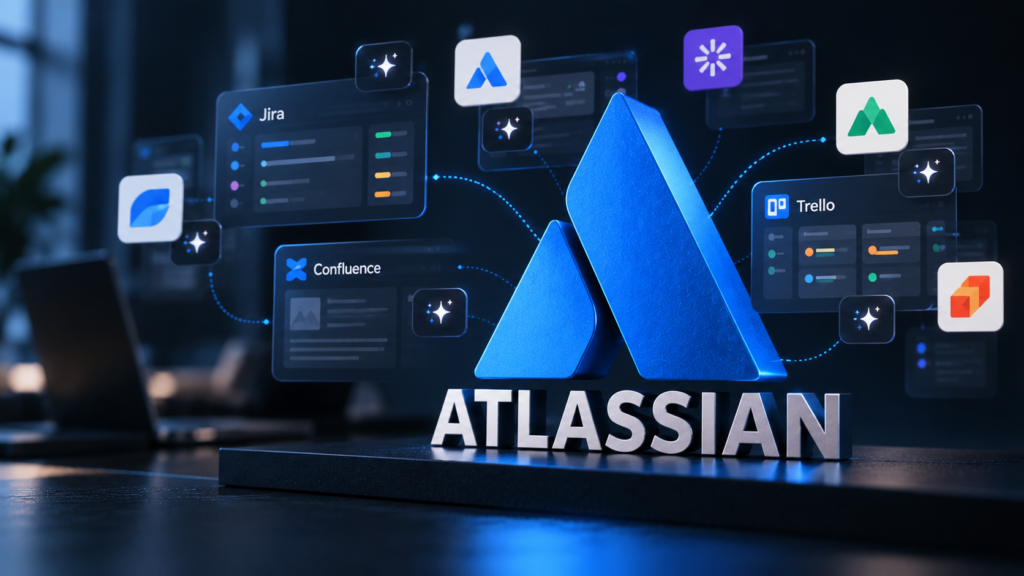
Sherif Mansour has reportedly spent 17 years at Atlassian, and he now runs AI across its product portfolio. In a conference session aimed at SaaS founders, the Atlassian head of AI described how the company added AI to more than 20 apps, according to a single report of the talk.
The headline figure is more than 5 million people who now use those apps regularly for the AI capabilities. It is a company claim, and it arrives without a denominator, a time window or a definition of regular. Two other claims, that chat nearly did not ship and that hiring flipped toward juniors, appear only in the session’s title.
What did the Atlassian head of AI say about its 20-plus apps?
Atlassian reportedly has more than 20 apps, of which 6 were built in the gen AI era and the rest are years old. Atlassian is best known for work-management and collaboration software such as Jira and Confluence, so the older apps are the established core of the business.
Mansour is also reported to own the product management craft, which means 450 product managers. We read that as a sign of scale: an AI effort across a portfolio this size is a coordination problem across many teams, not a single lab. That is our inference, not something the report states.
The session was reportedly built around a problem facing every founder with an existing product, namely confident claims about building AI into B2B software. Because Mansour is describing his own company’s results, everything here is a company claim relayed from a talk, not an independent measurement.
Does ‘bolted on’ describe all of Atlassian’s apps?
No. The session’s title reportedly uses bolted-on language, but 6 of the apps were built in the gen AI era, so the description can fit only the older ones. That split matters for anyone judging the retrofit story.
| Group | What is reported | What is not stated |
|---|---|---|
| Apps built in the gen AI era | 6 apps | Their usage, pricing or how they differ from older apps |
| Older apps with AI added | The rest of the 20-plus, described as years old | Which apps, and how AI was added to each |
| All apps combined | More than 5 million regular users of the AI capabilities | Which apps the figure covers, and any comparison between the two groups |
The missing comparison is the interesting one. If the six newer apps account for most of the usage, the story is about new products. If the older apps carry it, the retrofit worked. The report does not say.
What does the 5 million figure not tell you?
On its own, very little. A count of users only means something against a base, and the report gives none. We also do not have, and will not estimate, Atlassian’s total user count, so the figure cannot be turned into a share.
Three terms need defining before the number can be judged. ‘Regularly’ could mean daily, weekly or monthly use. ‘AI capabilities’ could mean a single summarising button or a full workflow. And it is unclear whether the figure counts each person once across all apps or adds up users app by app.
Even a well-defined count would show usage, not value. Regular use of AI features does not by itself show that the work improved or that revenue followed. Pricing, packaging and revenue effects are not mentioned in the report.
What do the chat and junior hiring claims add?
Very little can be said yet, because both claims reportedly appear only in the session’s title. Nothing available explains why chat nearly did not ship, who argued against it or what changed the decision.
The same applies to the hiring claim. There are no figures, roles or reasoning behind ‘flipped toward juniors’, and any explanation we offered would be speculation. For the technical side of the chat question, BriefFlash has covered how developers can build multi-tenant agentic chat apps on Bedrock, which is separate from whatever Atlassian did.
Why does an incumbent’s AI retrofit matter to founders and buyers?
Because most established software companies face the choice Mansour’s session reportedly centres on: add AI to products customers already use, or build new AI-native ones. An incumbent has existing customers and workflows to protect. A startup starts with neither.
A portfolio with 6 AI-era apps alongside years-old ones suggests Atlassian is doing both. We hold that view with moderate confidence, since the report does not describe strategy directly. Founders with an existing product can use it as a reference for the trade-off, while buyers should treat the adoption number as a claim to test.
Five questions to ask of any incumbent’s AI adoption number
- Out of how many? Ask for the base: all users, paying users or active users.
- What counts as regular, and over what period?
- Which apps does it cover, and is each person counted once or once per app?
- What counts as an AI capability? A single button is not a workflow.
- What changed for the customer? Look for output quality, retention, pricing or time saved.
What we do not know yet is considerable: the base behind the 5 million, the split between new and older apps, the reasoning behind chat and hiring, and any revenue effect. A primary source, such as an Atlassian post or the session recording, would settle some of it.
Frequently asked questions
Who is Sherif Mansour?
Sherif Mansour has reportedly been at Atlassian for 17 years. He runs AI across the company’s product portfolio and owns the product management craft, which covers 450 product managers. These details come from a single report of a conference session and have not been confirmed by a company statement.
How many apps does Atlassian have, and how many were built for AI?
According to the report, Atlassian has more than 20 apps. Six of them were built in the gen AI era, and the rest are years old. The report does not name the apps or say how AI was added to the older ones, so the split cannot be checked.
How many people use Atlassian’s AI features?
Reportedly, more than 5 million users now use Atlassian’s apps regularly for the AI capabilities. This is a company claim with no stated base, time window or definition of regular use. It should not be read as a share of Atlassian’s total users, which is not known here.
Why would a company shift hiring toward junior staff in the AI era?
The reasons behind Atlassian’s reported shift toward junior hiring are not known. The session title mentions it, but no figures, roles or explanations are available. Any reason offered would be speculation, so the honest answer is that the company would have to explain it.