

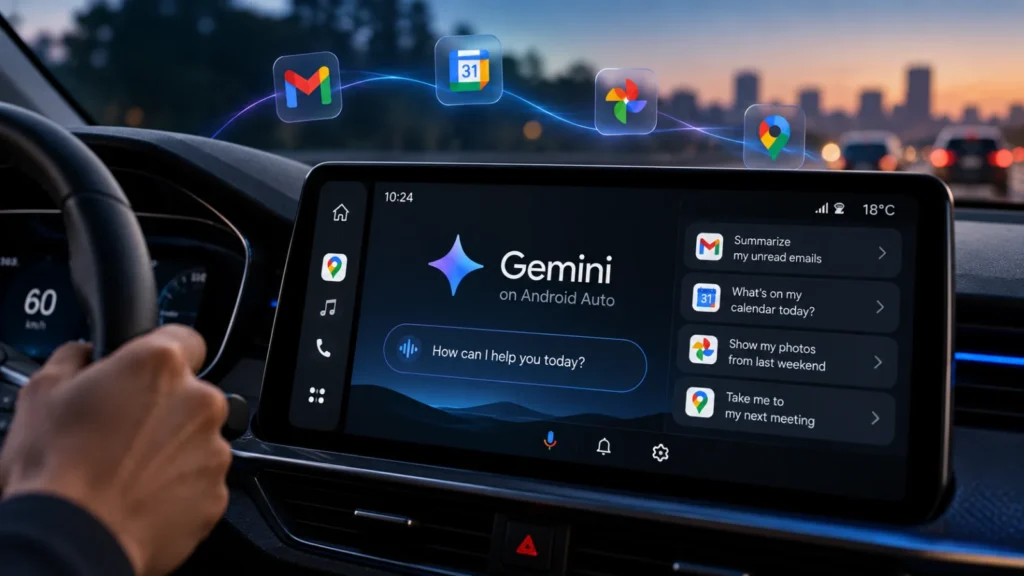
Google is letting drivers ask Gemini questions that draw on their own email, calendar and photos. The Gemini Personal Intelligence Android Auto rollout began on Oct 20, 2026, according to Google’s announcement, and it is opt-in. One of Google’s own examples is asking for a flight’s gate and on-time status in a single request.
Gemini itself is now available globally on Android Auto and on cars with Google built-in. The personal feature has exclusions by region and account type, and built-in cars get it later. The details are spread across Google’s post, its Gemini page and press coverage, so this piece collects them.
What does Gemini Personal Intelligence do on Android Auto?
It lets Gemini answer using apps the user connects. Google lists Workspace (including Gmail and Google Calendar), Google Photos, Google Maps, YouTube and Search. Its other example prompts include finding an indoor restaurant along the route that matches usual preferences, navigating to a doctor’s appointment and finding a car wash from a recent photo. Those are Google’s illustrations, not tested results.
Outlets differ slightly on the app list. TechCrunch’s report names Gmail, Calendar, YouTube, Maps and Search history without Photos, while Google’s post and Android Authority include Google Photos. We follow Google’s list. BriefFlash has covered Gemini Spark managing your Google Photos library separately.
Who gets Personal Intelligence, and who is left out?
Adults with personal Google accounts, outside four excluded regions. These terms come from the eligibility footnote in Google’s post.
| Question | Answer |
|---|---|
| Account type | Eligible personal Google accounts |
| Minimum age | 18 and older |
| Excluded regions | European Economic Area, Switzerland, United Kingdom, Nigeria |
| Excluded accounts | Workspace business, enterprise and education accounts |
| Android Auto | Rolling out from Oct 20, 2026 |
| Cars with Google built-in | In the coming months; no vehicle list published |
Google calls this a rollout, so some eligible users may not see it immediately. TechCrunch reports that Personal Intelligence reached the U.S. in March and is now in beta in global markets, and that Gemini arrived in Android Auto last November.
How do you turn it on or off?
Nothing is connected by default. Google says apps stay disconnected until the user turns the feature on, and that it can be switched off at any time in Gemini settings. TechCrunch reports that drivers can choose apps selectively, and Android Authority reports that a setting already enabled in the Gemini app carries into the car.
Google’s Gemini page adds that Gemini will try to reference or explain the information it used so users can verify it. That is Google’s stated intent, and none of the sources we read show how it works in a spoken, hands-free answer.
How does Google built-in differ from Android Auto?
TechCrunch describes Android Auto as running on the phone and projecting to the car’s screen, and Google built-in as software integrated into the vehicle. Google says built-in cars share personal responses only when the user is in the car with their phone connected. Without Personal Intelligence, navigation, music, calls and questions still work, but answers are not tailored.
Our reading, which is BriefFlash analysis and not Google’s statement, is that a rental or shared car should behave like an ordinary car for the next driver unless that person’s phone is connected. Google does not walk through that case, so treat it as inference.
What has Google not said about in-car use?
- Where data is processed in the car, and how long anything is retained.
- Whether a spoken answer names the email or photo it came from.
- What happens when passengers hear answers drawn from private data, or how driver distraction is handled. No source we read covers this.