
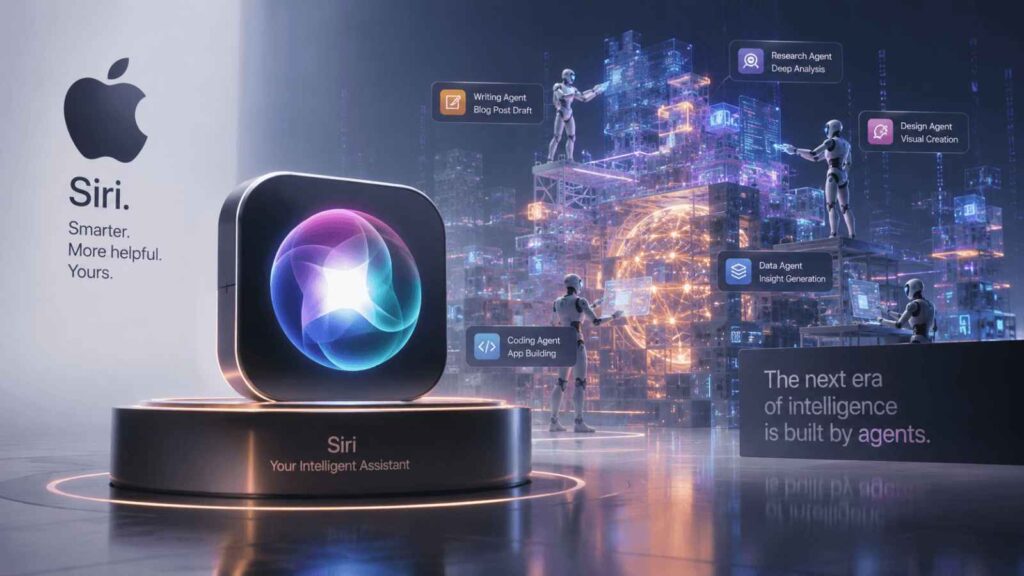
After years of stagnation and unfulfilled promises, Apple finally fixed Siri. The tech giant’s long-awaited AI overhaul transforms its virtual assistant into the capable, context-aware tool users always envisioned. The upgrade equips Siri with advanced generative AI models, enabling it to understand complex conversational threads and execute multi-step commands across native iOS applications.
However, the announcement arrives at a peculiar moment in technological history. Today’s AI software environment has rapidly evolved past basic voice commands. Chatbots have morphed into autonomous agents capable of writing code, reasoning through intricate logic puzzles, generating multimedia content, and executing complex workflows without human intervention.
As a result, the updated Siri AI is genuinely useful for daily device management, yet its launch carries a distinct sense of anticlimax. Simply being a functional AI assistant is no longer a differentiator in a market where competitors are pushing the boundaries of autonomous task completion.
The Technical Reality of the Siri Overhaul
When assessing the recent updates, it is clear that Apple finally fixed the foundational flaws that plagued Siri for over a decade. The previous iteration struggled with contextual retention and often failed to recognize basic follow-up questions. The new architecture integrates large language models directly into the operating system, allowing the assistant to maintain conversational state and understand references to prior prompts.
According to reporting by Sarah Perez for TechCrunch, the updated assistant can now perform tasks that users have been requesting since the early days of the iPhone. This includes deep app integrations, where Siri can open specific files, format text, and chain commands across different applications without requiring the user to repeat the wake word.
Siri AI Capabilities vs. Modern Demands
While the technical improvements are substantial, the market has shifted dramatically. The current benchmark for artificial intelligence is no longer just setting timers and sending texts. Users now compare Siri to advanced systems like OpenAI’s GPT-4 and Anthropic’s Claude, which function as autonomous agents rather than simple voice triggers.
| Capability | Traditional Siri | Upgraded Siri AI | Modern AI Agents |
|---|---|---|---|
| Contextual Memory | None | Session-based | Long-term persistent |
| Task Execution | Single-step commands | Multi-step native apps | Complex, cross-platform workflows |
| Content Generation | None | Basic text summaries | Code generation, multimedia creation |
| Reasoning | Pattern matching | Improved intent recognition | Multi-step logical reasoning |
The table highlights the core issue: Apple finally fixed its assistant to compete with the previous generation of AI, but the industry has already moved on to the next.
Market Timing and the Anticlimax
The sentiment surrounding this launch underscores a strange technological anticlimax. For years, Apple enthusiasts hoped that the company would leverage its massive silicon advantage—specifically the Neural Engine in the M-series and A-series chips—to dominate the AI space. Instead, the company remained conservative, focusing on privacy and on-device processing.
By the time Apple finally fixed the assistant’s core limitations, the definition of a “capable assistant” had fundamentally changed. Competing platforms can now write functional code, debug software, and create digital media from text prompts. As Perez notes, the launch lands in a period where chatbots have evolved into agents that can reason and complete complex tasks.
This timing mismatch creates a strange paradox. The new Siri AI is arguably the most robust and reliable it has ever been, offering genuine utility for iOS users. Yet, because it merely catches up to baseline expectations rather than exceeding them, the announcement lacks the awe-inspiring impact of earlier Apple product reveals.
Industry Impact and Developer Implications
For the developer ecosystem, the upgraded assistant presents new opportunities and constraints. The new API allows developers to expose their apps’ core functionalities to Siri without surrendering control to a cloud-based third-party model. This is a significant win for privacy advocates and enterprise developers who handle sensitive data.
However, developers looking to build autonomous agents will still need to look elsewhere. Apple’s strict walled garden and emphasis on on-device processing limit the scope of what can be built natively. The company has prioritized stability and privacy over the raw, generative power required for complex task automation.
Ultimately, Apple finally fixed a broken product, but the market may simply shrug. The utility is there, but the magic of true innovation is currently being chased by others.
Related coverage: Apple Shares 'Shocking Evidence' in Trade Secrets Case Against OpenAI · Tim Cook Steps Down as Apple CEO, John Ternus Takes Over Amid Nvidia's AI Stack Push
Key Takeaways
- Apple finally fixed Siri by integrating large language models, enabling contextual awareness and multi-step command execution across native apps.
- The launch feels anticlimactic because modern AI chatbots have already evolved into autonomous agents capable of coding, reasoning, and creating media.
- While the new Siri AI is genuinely useful for daily device management, it catches up to baseline expectations rather than introducing revolutionary capabilities.
- The upgrade emphasizes privacy and on-device processing, benefiting enterprise developers but limiting the scope of autonomous agent creation.
FAQ
What did Apple finally fix with Siri?
Apple finally fixed Siri’s inability to maintain context and execute complex commands. The overhaul integrates large language models to allow multi-step task execution, contextual understanding across conversations, and deeper integration with native iOS applications.
Why does the Siri AI overhaul feel anticlimactic?
The launch feels anticlimactic because the broader AI market has evolved past basic voice commands. Competitors now offer AI agents that can write code, reason through complex logic, and generate media. Siri’s upgrade, while useful, simply catches up to older expectations rather than pushing current boundaries.
Can the new Siri AI write code or generate media?
No, the new Siri AI is primarily focused on device management, app integration, and basic text summaries. It does not possess the advanced generative capabilities of dedicated AI agents like GPT-4 or Claude, which can write functional code or create multimedia content.