
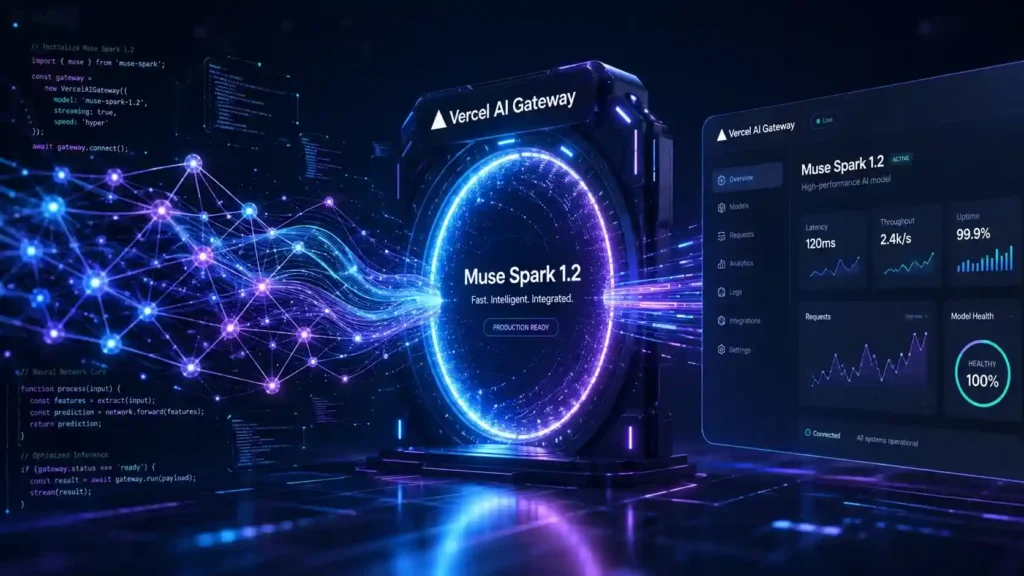
Meta’s latest coding-focused artificial intelligence model, Muse Spark 1.2, is now officially available on the Vercel AI Gateway. Announced on August 5, 2026, this updated iteration retains the general-purpose capabilities of its predecessor while shipping with significant improvements to code generation, complex debugging, and codebase understanding. The release provides developers with a powerful new tool for end-to-end developer workflows directly within the Vercel ecosystem.
The model is specifically engineered for long-horizon work, a distinguishing feature that allows it to generate whole repositories, build out large projects from start to finish, and sustain iterative loops. During these loops, the AI writes, compiles, profiles, and improves code over many rounds. With Muse Spark available through the AI Gateway, developers can seamlessly integrate this advanced reasoning capability into their existing infrastructure.
Vercel’s AI Gateway acts as a unified API for calling various models, tracking usage and costs, and configuring performance optimizations. By hosting Muse Spark 1.2 on this platform, Vercel ensures that developers can access the model with higher-than-provider uptime, featuring built-in retries, failover mechanisms, and custom reporting. Crucially, the Gateway reflects provider pricing with no markup and does not charge a platform fee on inference, including for Bring Your Own Key (BYOK) requests.
Muse Spark 1.2 Arrives on Vercel AI Gateway for Advanced Coding Workflows
The latest coding-focused artificial intelligence model from Meta, Muse Spark 1.2, is now officially muse spark available on the Vercel AI Gateway. Announced on August 5, 2026, this update retains the general-purpose capabilities of its predecessor while shipping with significant improvements to code generation, complex debugging, and codebase understanding. The release provides developers with a powerful new tool for end-to-end developer workflows directly within the Vercel ecosystem.
The model is specifically engineered for long-horizon work, a distinguishing feature that allows it to generate whole repositories, build out large projects from start to finish, and sustain iterative loops. During these loops, the AI writes, compiles, profiles, and improves code over many rounds. With muse spark available through the AI Gateway, developers can seamlessly integrate this advanced reasoning capability into their existing infrastructure.
Vercel’s AI Gateway acts as a unified API for calling various models, tracking usage and costs, and configuring performance optimizations. By hosting Muse Spark 1.2 on this platform, Vercel ensures that developers can access the model with higher-than-provider uptime, featuring built-in retries, failover mechanisms, and custom reporting. Crucially, the Gateway reflects provider pricing with no markup and does not charge a platform fee on inference, including for Bring Your Own Key (BYOK) requests.
Related coverage: Meta Debuts Muse, and Asks for More Trust Than It's Ever Needed Before · Meta Reverses Course: Embracing Open-Weights with Muse Glimmer
Key Takeaways
- Muse Spark 1.2 is now available on the Vercel AI Gateway, offering enhanced code generation, complex debugging, and codebase understanding.
- The model is optimized for long-horizon tasks, capable of generating entire repositories and sustaining iterative write-compile-profile-improve loops.
- Developers can access the model via the AI SDK or coding agents like Claude Code, Codex, OpenCode, and Pi without platform inference fees.
- The Gateway provides enterprise-grade features including Zero Data Retention support, custom reporting, and API key budgets.
Technical Enhancements and Long-Horizon Capabilities
According to the official changelog released by Vercel, Muse Spark 1.2 is a coding-focused update designed to handle complex developer workflows. While maintaining its foundational general capabilities, version 1.2 introduces measurable improvements in generating functional code and understanding the broader context of a codebase.
The architecture is specifically built for long-horizon work. Unlike standard models that excel at single-shot code completion, Muse Spark 1.2 can generate whole repositories and build out large projects end to end. It achieves this by sustaining iterative loops where it writes, compiles, profiles, and autonomously improves code over multiple rounds. This makes the model particularly suited for complex debugging tasks that require deep contextual understanding and sequential problem-solving.
Integration and API Configuration
With muse spark available on the Gateway, developers have multiple pathways for integration. To use the model via the AI SDK, developers simply need to set the model parameter to meta/muse-spark-1.2.
For developers utilizing AI coding agents, the setup process is straightforward. By running vercel ai-gateway coding-agents setup, users can connect popular coding agents such as Claude Code, Codex, OpenCode, or Pi. Once connected, users select meta/muse-spark-1.2 inside the agent interface to begin routing requests through the Gateway.
Muse Spark 1.2 Integration Specifications
| Feature | Specification |
|---|---|
| Model ID | meta/muse-spark-1.2 |
| Primary Use Case | Code generation, complex debugging, long-horizon project building |
| Supported Agents | Claude Code, Codex, OpenCode, Pi |
| Integration Method | Vercel AI SDK or vercel ai-gateway coding-agents setup |
| Pricing Model | Provider pricing with zero markup, no platform fee on inference |
Enterprise Features and Vercel AI Gateway Benefits
The deployment of Muse Spark 1.2 via the Vercel AI Gateway highlights several enterprise-grade benefits. The Gateway provides a unified API that abstracts the complexities of calling different models while tracking usage and cost. According to Vercel’s documentation, the platform is designed for higher-than-provider uptime through performance optimizations, routing rules, and automated failover mechanisms.
Key administrative features include:
- Zero Data Retention support: Crucial for enterprises with strict data privacy and compliance requirements.
- Custom reporting: Allowing teams to monitor usage metrics and optimize their AI workflows.
- Budgets for API keys: Enabling strict cost control and resource allocation across different development teams.
- Routing rules: Facilitating intelligent traffic distribution and load balancing.
Furthermore, the Gateway operates on a transparent pricing model. AI Gateway reflects provider pricing with no markup and does not charge a platform fee on inference, including on Bring Your Own Key (BYOK) requests. This approach ensures that organizations can scale their AI-driven development workflows without incurring hidden infrastructure costs. Developers can also try Muse Spark 1.2 directly in the Vercel model playground before committing to full integration.
Industry Impact and Developer Implications
The availability of Muse Spark 1.2 on Vercel’s infrastructure signals a continued shift toward long-context, agentic AI workflows in software development. By supporting models that can maintain state and improve code over iterative loops, Vercel is positioning the AI Gateway as a central hub for autonomous coding agents.
For enterprise development teams, the combination of Meta’s advanced coding model and Vercel’s zero-markup, high-uptime Gateway removes significant barriers to large-scale AI adoption. The inclusion of Zero Data Retention support ensures that organizations in highly regulated industries can leverage these advanced coding models without compromising proprietary codebase security. As AI models increasingly move from simple autocomplete tools to full-scale repository generators, infrastructure that supports robust failover and usage tracking will become a critical requirement.
Key Takeaways
- Muse Spark 1.2 from Meta is now available on the Vercel AI Gateway, featuring enhanced code generation and complex debugging capabilities.
- The model is optimized for long-horizon tasks, capable of generating entire repositories and sustaining iterative write-compile-profile-improve loops.
- Developers can access the model via the AI SDK or coding agents like Claude Code, Codex, OpenCode, and Pi without platform inference fees.
- The Gateway provides enterprise-grade features including Zero Data Retention support, custom reporting, and API key budgets.