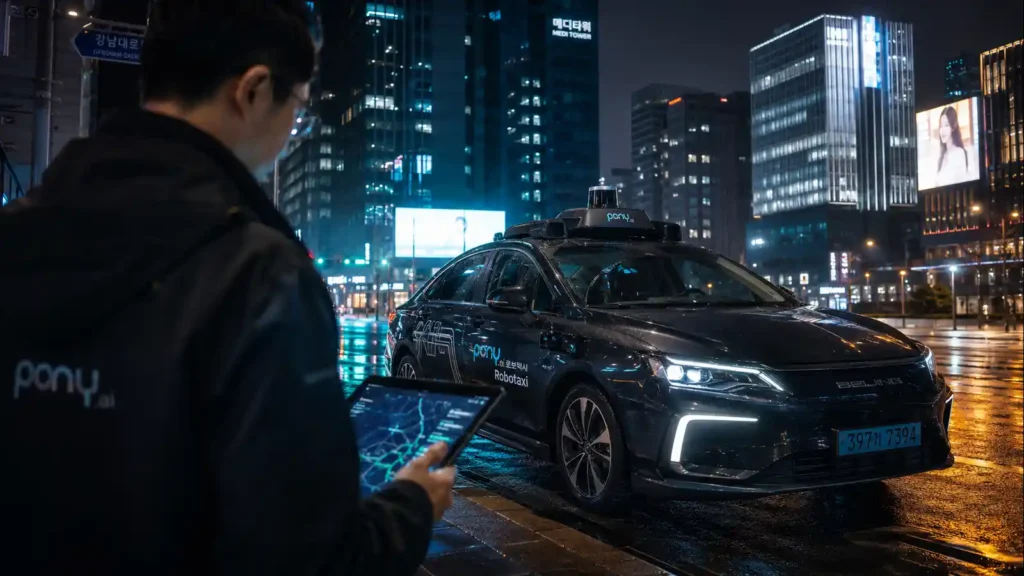
Chinese autonomous driving company Pony.ai signed a strategic partnership with Korean mobility firm FutureLink on Friday, Aug. 28, in Seoul, committing to bring 200 Level 4 robotaxis to Korea by 2028. The rollout starts small: 10 vehicles for domestic certification, with the remaining 190 added once that process clears, according to a Korea Times report published Aug. 30, 2026.
This isn't Pony.ai's first move in Korea. FutureLink has already logged roughly 80,000 accident free kilometers testing Pony.ai's autonomous driving kit on Kona Electric based vehicles in Seoul's Gangnam pilot zone, per the same report. FutureLink will own certification, market entry, operations, data management and localization. Pony.ai supplies the seventh generation autonomous driving vehicles and technology. A joint venture between the two companies is reportedly still under discussion, though, as detailed below, that framing is a little more complicated than it sounds.
Neither company has set a date for when certification will finish or when paying riders will actually get in one of these cars.
The Partnership, In Detail
The robotaxis will be built on a vehicle from Chinese automaker BAIC Group, with Pony.ai's seventh generation autonomous driving system integrated on the production line rather than retrofitted afterward, according to Korea Times. Pony.ai says the vehicle carries redundant systems for braking, steering and power, and that the kit itself uses automotive grade components.
The rollout sequence is specific: 10 vehicles first, for domestic certification, then 190 more once that process is complete. Service is planned to start in Gangnam's autonomous driving pilot zone before expanding across Seoul, the wider metro area and other major cities. What isn't specific is timing. Korea Times reports that the certification and commercial launch schedule has not been finalized.
Testing Has Already Been Underway in Gangnam
FutureLink says its Gangnam test fleet, running on Hyundai Kona Electric based vehicles fitted with Pony.ai's autonomous driving kit, has covered about 80,000 kilometers without an accident, per the Aug. 30 report. That figure has real history behind it. A December 2025 report from Asia Economic Daily put FutureLink's accident free total at 40,000 kilometers at that point, with FutureLink CEO Cha Duwon saying at the time, "We have ensured safety through system redundancy." That means the accident free distance roughly doubled over about eight months, a reasonable trajectory for a testing program scaling up rather than a number invented for this announcement.
Is a Korea Joint Venture Actually New?
Here's where the framing gets murky. Korea Times describes Pony.ai and FutureLink as "considering" a joint venture in Korea, which reads like a future step. But separate Korean reporting from December 2025 and January 2026 already described FutureLink as a subsidiary of PonyLink, described as an existing joint venture between Pony.ai and a partner called Gembex Link. A January 2026 Seoul Economic Daily report on a separate Humax Mobility tie up describes FutureLink the same way.
So either the new joint venture under discussion is a distinct, expanded structure beyond PonyLink, or the language in Friday's announcement is looser than the underlying corporate reality. Neither the Korea Times report nor the earlier Korean coverage spells out the difference, and that's a gap worth watching rather than assuming away.
The Cost Numbers Behind the Push
Pony.ai says its seventh generation autonomous driving kit costs 70% less to produce than its predecessor, and the company plans to cut production costs by another 20% in 2026. The target: getting the combined cost of the autonomous driving kit and base vehicle below 230,000 yuan, or about $34,000, by mid-2027.
One caveat worth stating plainly, since it's easy to skim past: that cost target is specific to China production, not a confirmed Korea market price. Nothing in the current reporting ties that figure directly to what the Korea deployment will cost.
Where Pony.ai Stands Globally
Pony.ai already runs fully driverless Level 4 robotaxi service in Beijing, Shanghai, Guangzhou and Shenzhen, where its vehicles averaged 23 paid orders per vehicle per day in February, according to Korea Times. A May 2026 Seoul Economic Daily report put the company's operating fleet above 1,400 vehicles at that point, with a stated target of more than 3,000 by the end of 2026 and expansion to over 20 operating cities, roughly half of them overseas, including planned service in Zagreb, Croatia with Uber, plus Doha, Dubai and Singapore. Pony.ai trades on Nasdaq under the ticker PONY.
Korea fits a broader pattern of Chinese automakers and autonomous driving companies pushing into the domestic market. BYD is already Korea's fourth largest imported vehicle brand by sales. Geely's premium EV brand Zeekr is preparing to launch its 7X SUV in Korea in September or October. XPeng, Chery and Xiaomi Auto are each weighing or pursuing entry.
Hyundai Motor's response is a vehicle foundry strategy: supply robotaxi hardware to autonomous driving companies while building its own Level 2+ through Level 4 technology in house. The group plans a full scale software defined vehicle production system in 2028 and vehicles running its Atria AI autonomous driving technology in 2029, per Korea Times.
Why It Matters
A robotaxi deal with a 2028 target and no certification timeline is a statement of intent more than a launch date. What makes it worth tracking is the testing record behind it. Eighty thousand accident free kilometers in one of Seoul's densest districts is a real operational data point, not a projection. The unresolved joint venture question matters too. If PonyLink already functions as the Pony.ai and FutureLink vehicle in Korea, then Friday's announcement is less a new entity and more a formal restatement of an existing relationship, dressed up for an expansion headline. That's a pattern worth watching for in how Chinese AV companies announce international deals generally: real testing progress paired with corporate structure language that outruns what's actually been finalized.
What to Watch
The things that would confirm or undercut this: whether Korean regulators actually grant certification for the initial 10 vehicles on any disclosed timeline, whether Pony.ai and FutureLink clarify what the new joint venture adds beyond the existing PonyLink structure, and whether the Gangnam test fleet's accident free run holds as vehicle count and mileage scale up. Hyundai's own Atria timeline, still three years out, is the domestic counterweight to watch in parallel.
Key Takeaways
- Pony.ai and FutureLink signed a strategic partnership Aug. 28 in Seoul to deploy 200 Level 4 robotaxis in Korea by 2028, starting with a 10 vehicle certification fleet.
- The robotaxis will be built on a BAIC Group vehicle with Pony.ai's seventh generation autonomous driving system integrated at the factory rather than retrofitted.
- FutureLink's Gangnam test fleet has logged about 80,000 accident free kilometers, roughly double the 40,000 kilometers reported in December 2025.
- Neither company has set a certification or commercial launch date, and the announcement's joint venture language sits oddly next to earlier reporting describing an existing Pony.ai and FutureLink joint structure called PonyLink.
FAQ
Is Pony.ai a Chinese company?
Coverage of this deal, including the original Korea Times report, describes Pony.ai as a Chinese autonomous driving company. Pony.ai trades on Nasdaq under the ticker PONY.
What is a Level 4 robotaxi?
Level 4 is an SAE autonomy classification where the vehicle handles all driving tasks within a defined operating area without needing a human backup driver, though it can still have geographic or weather based limits. It's a step below Level 5, which would mean no limits at all.
When will Pony.ai's robotaxis actually start running in Seoul?
No date has been set. Korea Times reports that the timing of both certification and commercial launch has not yet been finalized, only that the rollout starts with 10 vehicles before the remaining 190 are added.
Does Pony.ai already have a presence in South Korea?
Yes. Earlier Korean reporting from December 2025 and January 2026 describes FutureLink as a subsidiary of PonyLink, a joint venture between Pony.ai and a partner called Gembex Link, with Gangnam testing underway since at least late 2025.