
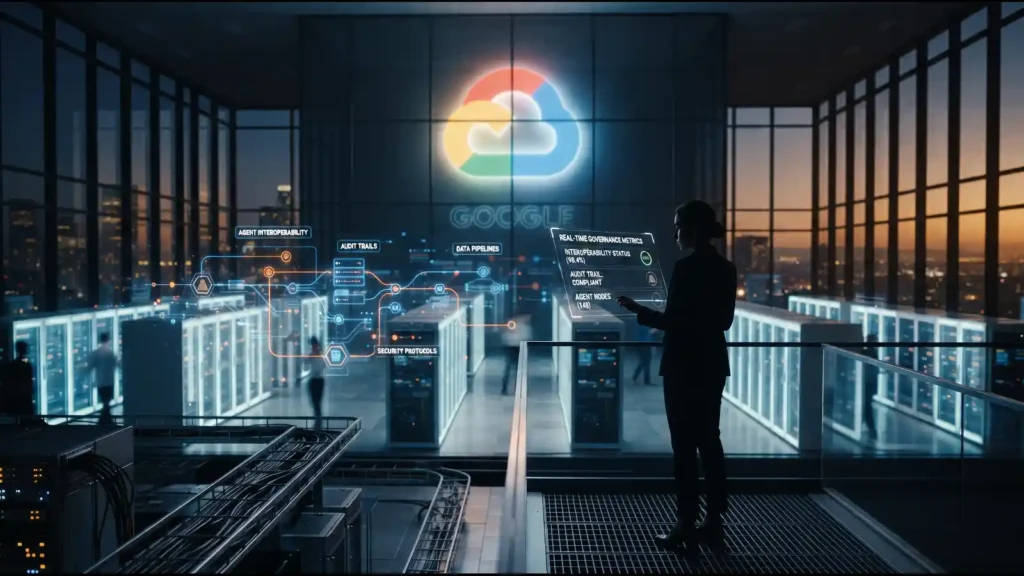
Enterprises chasing the newest AI model are missing the point, according to a Google Cloud product management director. In comments published by AI Business on September 7, 2026, Michael Clark said the businesses actually getting value out of AI are the ones building governance, transparency, and interoperability into their workflows first, not the ones swapping in whatever model launched that week. His remarks, made on AI Business's Targeting AI podcast, are the latest version of a pitch Google has been running for months: look past the hype cycle and fix the operational plumbing underneath it.
Clark's comments were not a product launch or a formal Google Cloud policy paper. They're one executive's framing of a problem AI Business says enterprises keep running into, which is that models multiply every week while businesses still don't know what to actually build with them. Clark's answer is that enterprises need to fix their own foundations first. Connect their systems, define their risk tolerance, and build in a human check before an agent acts on anything above that threshold.
Quick Take
- Google Cloud product management director Michael Clark says enterprises get real AI value from governance, transparency, and interoperability, not from constantly switching models.
- His comments, published by AI Business on September 7, 2026, target any business trying to move past pilot programs into working AI agents in production.
- The framing echoes messaging Google Cloud has repeated since its Next 2026 conference in April, which suggests this is a sustained sales pitch more than a new policy.
The Details
Clark made his comments on AI Business's Targeting AI podcast, in coverage published by reporters Esther Shittu and Shaun Sutner on September 7, 2026. His core argument is that enterprises are overwhelmed by the pace of new AI model releases, and that pace creates pressure to chase the newest tool instead of fixing the workflow underneath it.
"Interoperability and openness are two really key concepts, and transparency as well," Clark said, according to AI Business. He argued that systems capable of talking to other systems are what make agentic AI actually work in production, pointing to customer service as his example. Plenty of call centers still run on manual processes instead of APIs, he said, which limits what an AI agent can see or do when it steps in.
Clark also named context as the differentiator between agentic applications that work and ones that don't, citing audio, video, lidar, and financial streaming data as inputs agents need to make decisions. On governance, his advice was procedural rather than technical: understand your outcomes, understand your risk tolerance, and put a human in the loop for anything that crosses that line.
Why It Matters
None of this is a new Google Cloud product or policy. It's one executive's framing of a pitch the company has been building since at least its Next 2026 conference in April, when Google merged Vertex AI and Agentspace into the Gemini Enterprise Agent Platform and released version 1.2 of its Agent2Agent protocol, an interoperability standard now overseen by a dedicated Linux Foundation group, according to reporting on the conference.
Google's own State of AI Infrastructure report, published in July, states that 78% of organizations now buy their generative AI tools directly from their primary cloud provider, which Google frames as a governance win. Worth noting that's Google's own number from Google's own report, not an independently audited figure, and it's also the kind of stat a company selling a cloud platform has an obvious incentive to publish.
I've watched enough of these conference-to-podcast messaging cycles to recognize the pattern. A vendor picks a positioning, in this case "we're the open one," months ahead of a big event, then has executives repeat the same three concepts across every media appearance until it sticks. That doesn't make Clark wrong. Fragmented, manual workflows really do kill most agentic AI pilots. It just means this reads more like Google's answer to "why choose us" than neutral advice.
What to Watch
Watch whether Google backs this messaging with something concrete, like a published governance framework or independently audited adoption numbers, rather than repeating the same three words across more podcasts and keynotes. It's also worth checking whether AI can actually help CIOs reclaim the capacity that Info-Tech Research says is getting eaten by maintenance work, since that's the real test of whether "governance first" advice translates into fewer stalled AI projects. Enterprises building the kind of interoperable, agent-based systems Clark describes can see a concrete version of the pattern in AWS's guide to multi-tenant agentic chat apps on Bedrock, which runs into many of the same access and context problems Clark raises.
Key Takeaways
- Google Cloud product management director Michael Clark says real AI value comes from governance, transparency, and interoperability, not from chasing new models, per AI Business (September 7, 2026).
- Clark frames context, including audio, video, lidar, and financial streaming data, as what actually differentiates working agentic AI from AI that doesn't deliver.
- The comments closely track messaging Google Cloud has repeated since its Next 2026 conference in April, including the Agent2Agent interoperability protocol and the Gemini Enterprise Agent Platform.
- This is commentary from a single podcast appearance, not a new Google Cloud product launch or policy announcement.
FAQ
Is this a new Google Cloud product or policy announcement?
No. These are comments Michael Clark, a Google Cloud product management director, made on AI Business's Targeting AI podcast, published September 7, 2026. There's no product launch or policy document tied to the remarks.
What does Google Cloud say enterprises actually need to make AI work?
According to Clark, three things: interoperability between systems, transparency, and clear governance, meaning a defined risk tolerance with a human in the loop for decisions above that threshold.
Is this messaging new for Google Cloud?
No. It closely tracks what Google pushed at its Next 2026 conference in April, including the Agent2Agent interoperability protocol and the merged Gemini Enterprise Agent Platform, and mirrors positioning the company has used in prior years.