
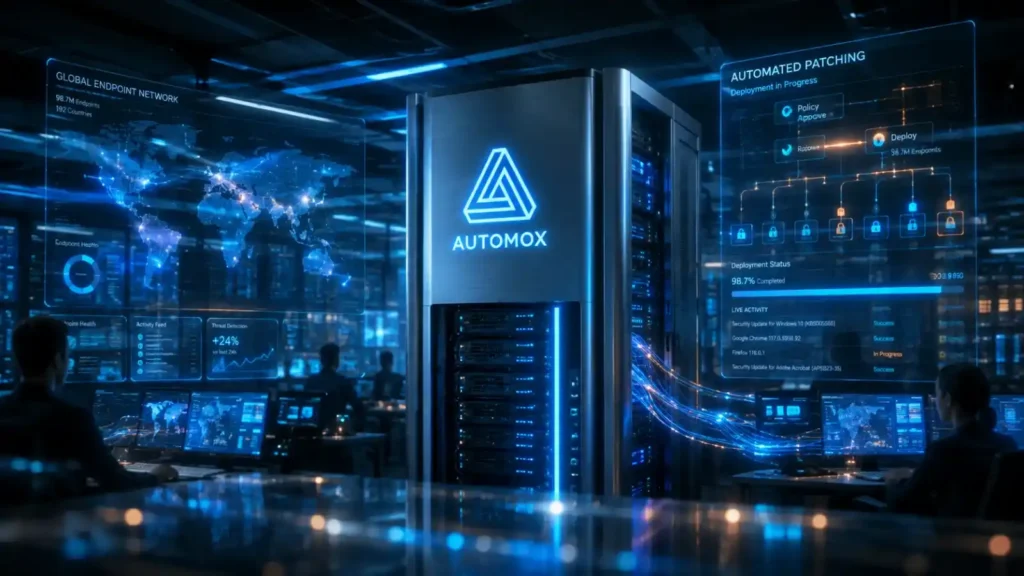
Automox launches hosted Model Context Protocol (MCP) server, enabling web-based AI assistants to directly manage endpoint devices without requiring local software installations. This architectural shift allows IT administrators to interact with endpoint data and execute management commands through cloud-hosted AI interfaces. By eliminating the need for local client deployments, Automox expands AI access to endpoint management across distributed enterprise environments. The hosted MCP server bridges the gap between conversational AI models and critical IT infrastructure, streamlining patching, logging, and policy enforcement. This development represents a major step in integrating autonomous AI agents into daily IT operations, reducing friction and accelerating response times for system administrators.
What Does the Hosted MCP Server Architecture Achieve?
The core innovation when Automox launches hosted MCP capabilities is the removal of the local installation barrier. Previously, leveraging AI assistants for endpoint management required complex local configurations. Administrators had to ensure that the AI runtime environment could securely communicate with local IT management agents. The new hosted server architecture fundamentally changes this dynamic. By hosting the MCP server in the cloud, Automox allows web-based AI assistants to communicate directly with the Automox console via standardized APIs. This means IT teams can query device states, execute Automox Worklet Community scripts, and manage policies directly from a browser-based AI chat interface. The hosted server acts as a secure intermediary, translating AI-generated natural language requests into authenticated API calls that interact with endpoint infrastructure. This architecture drastically reduces the setup time for AI-driven IT operations from hours to mere minutes.
How Does the New Architecture Compare to Legacy Solutions?
Legacy endpoint management solutions typically rely on heavily siloed architectures. Administrators must navigate complex, dedicated interfaces for patch deployment, vulnerability scanning, and script execution. The integration of a hosted MCP server fundamentally alters this workflow by introducing a conversational layer over the entire infrastructure. Instead of manually filtering devices through a traditional dashboard, an administrator can simply ask a web-based AI assistant to identify all endpoints missing a critical update from the Automox 3rd Party patching List. The AI then queries the hosted MCP server, which retrieves the exact fleet data in seconds. This conversational interface reduces the cognitive load on IT staff and accelerates mean time to resolution (MTTR). Furthermore, by centralizing these interactions through a hosted cloud server, Automox ensures that Automox logging captures every AI-initiated action, maintaining strict audit trails and compliance standards without requiring local agent modifications.
Technical Implications for Enterprise IT Deployment
The deployment of a cloud-hosted MCP server carries significant implications for enterprise IT strategy. Security teams consistently grapple with the tension between rapid AI adoption and strict access controls. Automox addresses this by maintaining the MCP server within its existing secure cloud infrastructure, ensuring that API tokens and authentication protocols are never exposed to the local client environment. This design is particularly relevant as autonomous AI agents become more prevalent in enterprise environments. Much like how developers are now able to build OpenClaw agents that transact with Amazon Bedrock AgentCore payments, IT administrators can now leverage AI agents to autonomously interact with paywalled or gated infrastructure APIs securely. The hosted MCP server ensures that AI assistants only execute actions within the predefined permission scopes established in the Automox console, preventing unauthorized configuration drift.
Key Specifications and Capabilities
The hosted MCP server introduces several distinct capabilities for endpoint management:
- Zero Local Install: Web-based AI assistants can interface with endpoints purely through cloud-hosted APIs.
- Automated Patch Management: AI can query and trigger updates across the Automox 3rd Party patching List.
- Worklet Execution: Administrators can invoke scripts from the Automox Worklet Community via natural language prompts.
- Centralized Logging: All AI-driven commands are captured in Automox logging for compliance and auditing.
- Cross-Platform Access: Compatible with any web-based AI assistant that supports the Model Context Protocol.
Impact on the Broader AI Tooling Ecosystem
The expansion of MCP to hosted environments marks a critical evolution in how AI tools interact with enterprise infrastructure. As major AI providers push for deeper integration with physical and digital infrastructure, the demand for standardized, secure communication protocols has surged. This trend is evident across the industry, as seen when Anthropic's annualized revenue surges to $65B, driven largely by enterprise API adoption and the need for robust, agentic workflows. By offering a hosted MCP solution, Automox positions itself at the intersection of IT operations and the rapidly expanding AI agent ecosystem. This approach mirrors broader industry movements where infrastructure providers are racing to build compatible endpoints for AI models. The strategic decision to host the server removes friction and accelerates the adoption of AI-driven IT operations, a necessity in an era where cybersecurity dynamics are rapidly shifting. As highlighted in recent analyses of how AI is rewriting the rules of cybersecurity, the defender's window is narrowing, and tools that enable faster, AI-assisted responses are becoming critical for enterprise defense.
Comparison: Local vs. Hosted MCP Deployment
What Are the Limitations and Security Considerations?
While the hosted MCP server streamlines AI integration, enterprises must carefully manage permission scopes. Granting AI assistants the ability to execute endpoint commands necessitates strict role-based access controls (RBAC) within the Automox console. Administrators must ensure that AI agents operate under least-privilege principles to prevent unintended mass configuration changes. Additionally, organizations heavily reliant on air-gapped systems or strict on-premises data residency requirements may find that a cloud-hosted MCP server does not align with their compliance frameworks. In these scenarios, a hybrid approach or continued use of local automation scripts may be necessary. Automox has not yet released specific pricing tiers for the hosted MCP add-on, though industry estimates suggest it will be bundled into existing enterprise license agreements.
Key Takeaways
- Automox launches hosted MCP server, eliminating the need for local software installations to enable AI-driven endpoint management.
- Web-based AI assistants can now directly interact with the Automox console to execute patches, run Worklets, and query device states.
- The hosted architecture ensures centralized Automox logging and maintains strict compliance audit trails for all AI-initiated actions.
- This development accelerates the adoption of autonomous AI agents in enterprise IT operations by drastically reducing setup friction.
FAQ
What does it mean that Automox MCP now works with web-based AI assistants?
It means IT administrators can use browser-based AI chatbots to interact with their Automox endpoint management data. Because the MCP server is hosted in the cloud by Automox, there is no need to install local software or configure local runtimes to bridge the AI assistant with the IT infrastructure.
How does the hosted MCP server handle security and logging?
The hosted MCP server acts as a secure intermediary that translates AI requests into authenticated API calls. All actions initiated by the AI are recorded in Automox logging, ensuring that enterprises maintain strict audit trails and compliance oversight for every command executed on the endpoints.
Can the hosted MCP server execute scripts from the Automox Worklet Community?
Yes. Administrators can use natural language prompts via their web-based AI assistant to query and invoke scripts from the Automox Worklet Community, streamlining the automation of complex IT tasks without navigating the traditional dashboard.