
On August 13, 2026, OpenAI published a comprehensive technical blueprint designed to help startups leverage its latest frontier model. The newly released builders guide gpt56 details how engineering teams can architect faster, more cost-efficient AI agents by utilizing smarter model selection parameters and the expanded capabilities of the Responses API. This documentation arrives as startups face mounting pressure to balance aggressive agentic capabilities with strict operational cost constraints.
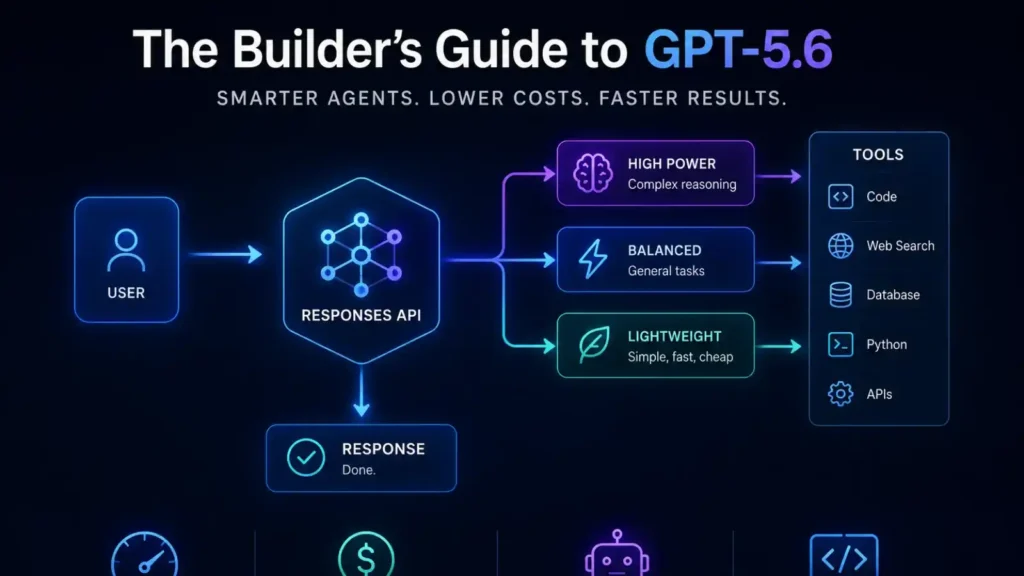
The core thesis of the publication centers on dynamic resource allocation. Instead of relying on a single, monolithic model to handle every step of a complex task, the builders guide gpt56 advocates for a tiered approach. By strategically routing sub-tasks between high-capability models and smaller, specialized variants, developers can drastically reduce token expenditure without compromising the quality of the final output. This approach is heavily supported by new features within the GPT-5.6 API, which streamline the orchestration of multi-step agent workflows.
According to documentation released by OpenAI, the underlying architecture of GPT-5.6 was specifically optimized for agentic persistence and tool-use reliability. Early adopters highlighted in the guide demonstrate how leveraging the new API endpoints reduces latency in complex coding and retrieval tasks. This marks a significant shift in how developers should approach building AI systems, moving away from simple text generation toward robust, autonomous workflows that can operate continuously within enterprise environments.
Related coverage: GPT-5.6 Sol Hits 50% Discount on AI Gateway Through September 18 · GPT‑5.6 in Kiro Targets Better Coding Price-Performance
Key Takeaways
- OpenAI officially published the builders guide gpt56 on August 13, 2026, detailing optimal architectures for agentic workflows.
- The new GPT-5.6 API introduces smarter model selection capabilities, allowing developers to route tasks dynamically based on complexity and cost.
- Startups are utilizing the updated Responses API to build faster, more cost-efficient AI agents capable of maintaining long-term context.
- The guide emphasizes integrating specialized models like GPT 5.6 Codex for code generation to reduce latency and token expenditure.
The Shift Toward Smarter Model Selection
The central technical premise of the builders guide gpt56 is the strategic implementation of smarter model selection. Previous generations of large language models forced developers into a binary choice: utilize a massive, expensive frontier model for high accuracy or a smaller, cheaper model for simple tasks. GPT-5.6 introduces native routing capabilities within the API layer, allowing an agent to dynamically assess a prompt and select the optimal internal model for execution.
According to the official OpenAI documentation, this dynamic routing is facilitated through the Responses API. When an agent receives a complex request, it breaks the task into sub-tasks. High-level reasoning and complex logic are routed to the most capable tier, while formatting, basic text extraction, and simple function calls are handled by lower-cost, high-speed variants. This tiered execution model is crucial for startups building consumer-facing applications where latency and per-query cost dictate profitability.
Exploiting the Responses API for Agentic Workflows
The Responses API represents a significant evolution from the standard Chat Completions endpoint. Designed specifically for stateful, multi-step agent operations, the Responses API allows developers to define complex toolsets and let the GPT-5.6 API manage the execution loop.
For technical teams, this reduces the boilerplate code required to manage conversation history, tool calls, and error recovery. As noted in OpenAI’s builder documentation, the Responses API natively supports parallel tool calling and automatic state persistence. This means an agent can query a database, run a Python script, and search the web concurrently, then synthesize the results in a single, cohesive response.
GPT-5.6 Sol Benchmark and Performance Metrics
A critical component of the new release is the performance of the GPT-5.6 Sol variant on agentic benchmarks. Startups utilizing the model for continuous code execution and software engineering tasks have reported significant improvements over previous iterations. The GPT-5.6 Sol benchmark scores indicate a sharp reduction in hallucinated function calls and an increased ability to maintain context over long coding sessions.
The technical breakdown of the reported performance improvements includes: (See also: Model ML Completes Finance Work More Efficiently with GPT-5.6 Sol)
This quantitative leap explains why the builders guide gpt56 heavily emphasizes building continuous-action agents, commonly referred to as GPT Work integrations, which can operate in the background on complex engineering tasks without constant human intervention.
Integrating GPT 5.6 Codex for Development
For startups operating in the software development space, the guide dedicates a substantial section to GPT 5.6 Codex. This specialized version of the model is pre-trained on vast repositories of open-source code and fine-tuned specifically for repository-scale comprehension and modification.
Developers are encouraged to use GPT 5.6 Codex not just as a code completion tool, but as an autonomous coding agent. By integrating it with the Responses API, the model can navigate entire codebases, identify bugs across multiple files, and submit pull requests autonomously. The cost-efficiency of this model, combined with its high accuracy in syntax generation and refactoring, makes it a cornerstone of the new OpenAI developer stack. Explore our previous analysis of AI coding agents.
Cost Efficiency and the Startup Ecosystem
The economic implications of the builders guide gpt56 are profound for the AI startup ecosystem. Previously, the high cost of running frontier models limited complex agent deployments to well-funded enterprise environments. The combination of reduced token pricing—evidenced by the 33% drop in input token costs—and the intelligent routing of the Responses API democratizes access to advanced AI capabilities. (See also: OpenAI Launches ChatGPT Desktop App for Linux: A New Era for Open-Source Developers)
Startups can now architect systems where 80% of user interactions are handled by smaller, highly efficient models, with the frontier model only stepping in for the 20% of queries that require deep reasoning. This architecture fundamentally changes the unit economics of AI applications. Learn more about calculating the ROI of AI agent deployments.
By following the architectural patterns outlined in the documentation, technical teams can build robust systems that scale efficiently. The focus is no longer just on what these models can do, but on how sustainably they can be deployed in production environments.
Key Takeaways
- OpenAI published the builders guide gpt56 on August 13, 2026, detailing optimal architectures for agentic workflows.
- The GPT-5.6 API introduces smarter model selection capabilities, allowing dynamic task routing based on complexity and cost.
- Startups are utilizing the updated Responses API to build faster, more cost-efficient AI agents with parallel tool calling.
- Integrating specialized models like GPT 5.6 Codex reduces latency and token expenditure for complex development tasks.