
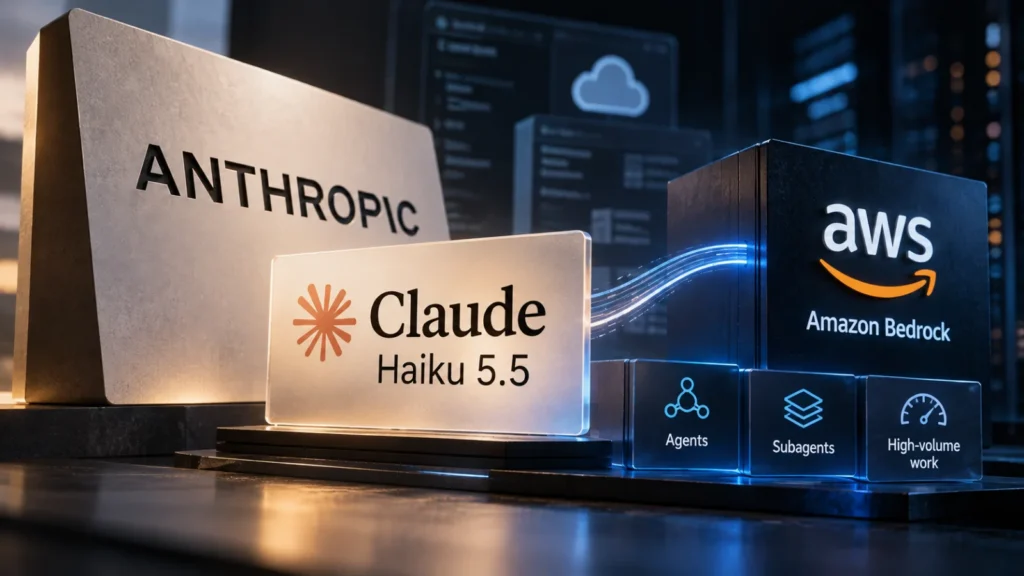
Anthropic has published an announcement page for Claude Haiku 5.5, and AWS says the model is available on Amazon Bedrock and Claude Platform on AWS. Anthropic describes it as the fastest and most efficient model in the Claude 5.5 family, built for subagents and high-volume work, according to the AWS post that relays the positioning. The announcements surfaced around 7 October 2026, though the exact publication time is not in the material available.
The pitch is a worker-tier model for agent setups, offered on a major cloud from day one. That matters because a single agent task can trigger many model calls, and a small, fast tier is where much of that volume is likely to run. The material available carries no pricing, speed figures or benchmark results yet, so this report separates what is stated from what is only claimed.
What did AWS and Anthropic say about Claude Haiku 5.5?
AWS stated the availability, and Anthropic supplied the positioning. AWS says the model can be used on Amazon Bedrock and Claude Platform on AWS. The same AWS post attributes the other description to Anthropic: fastest and most efficient in the Claude 5.5 family, built for subagents and high-volume work.
The name is not in dispute. The AWS post and the title of Anthropic’s own page agree on Claude Haiku 5.5. For Anthropic’s page, though, we have only the title and address, not its text, so the positioning reaches us through AWS and we keep it to that wording.
The AWS excerpt also breaks off after mentioning high-volume work. We therefore add no use cases beyond subagents and high-volume work.
The link to Anthropic’s page has reportedly drawn more than 200 points on a developer discussion site. That is a lower bound from a single community site. It shows interest, not quality, and we do not characterize the discussion or developer sentiment.
What are subagents, and why build a small model for them?
A subagent is a worker model that handles one narrow task for a lead model. In agent systems, an orchestrating model plans the work and hands subtasks such as searching, summarizing or checking to smaller models. Because one job can trigger many such calls, speed and cost per call tend to matter more than peak capability.
That is the usual reason a vendor ships a distinct fast, efficient tier inside a model family instead of offering only one flagship. The larger model can handle planning and the hardest steps, while the small tier absorbs the repetitive volume. This is general background and BriefFlash analysis, not something Anthropic or AWS spells out in the material available, though it fits the stated positioning.
How far does the Claude Haiku 5.5 speed and efficiency claim go?
Not beyond Anthropic’s own model family. As relayed by AWS, the claim is fastest and most efficient in the Claude 5.5 family. It is a within-family statement, not a comparison with other companies’ models, and no figures accompany it.
Efficient is the vaguer of the two words. The material does not say whether it refers to price, compute use per request or something else, and we will not guess. Both claims also come from the vendor and its cloud partner, with no independent test in the material.
Availability on Bedrock tells you where the model can be used. It does not tell you how well it works.
What is Amazon Bedrock, and why does launching there matter?
Amazon Bedrock is AWS’s managed service for reaching foundation models from several providers through AWS accounts. For teams already on AWS, a model launching there means they can try it without setting up a separate vendor relationship. That lowers the friction of testing a new tier, which is one reason cloud availability is part of the story from the start.
AWS also names Claude Platform on AWS as a place the model is available. The material does not explain what that is, so we refer to it by name only. Another launch on Amazon Bedrock is covered separately.
What do we not know yet about Claude Haiku 5.5?
Most of what a buyer would need. The material available does not include any of the following:
- Pricing on Anthropic’s API or on Bedrock
- Latency, throughput or cost-per-task figures
- Benchmark scores, or comparisons with earlier Haiku models, other Claude 5.5 models or rival small models
- Context window, model identifiers or regional availability on Bedrock
- What high-volume workloads the model is meant for beyond the phrase itself
- Any independent testing
The table below sets each claim against the evidence that would make it meaningful. It is BriefFlash analysis, not a finding from the announcements.
| Claim or statement | What would back it up |
|---|---|
| Fastest in the Claude 5.5 family | Published latency or throughput figures against other family members, with test conditions |
| Most efficient in the family | A definition of efficient, plus cost or compute figures |
| Built for subagents and high-volume work | Results from multi-step or multi-agent workloads |
| Available on Amazon Bedrock | Already stated by AWS; regional availability and model identifiers are still missing |
Who should pay attention to Claude Haiku 5.5 now?
Developers and technical leads on AWS, and teams that run multi-step or multi-agent workflows. If your setup delegates many narrow calls, a cheaper, faster tier is the part worth testing, because that is where volume accumulates. If your work is mostly single, hard prompts, the speed pitch matters less, though we cannot say how the family’s other tiers compare.
A sensible order of work, given what is missing:
- Check Anthropic’s and AWS’s own pricing pages, since none is in the material available.
- Run a sample of your real subagent tasks and record latency, cost and accuracy yourself.
- Compare the results with whatever model you use for those tasks today.
- Revisit once independent tests or published figures appear.
This is a proprietary-model story. Nothing in the material describes an open license, so the model should not be read as open source or open weight. Our earlier report on a separate Claude launch with a similar cheaper, faster framing shows this is a pitch Anthropic has made before.
Frequently asked questions
What is Claude Haiku 5.5?
Claude Haiku 5.5 is a model from Anthropic. Anthropic describes it as the fastest and most efficient model in the Claude 5.5 family, built for subagents and high-volume work, according to AWS, which relays that positioning. Those are vendor claims without published figures in the material available, and no independent testing has been reported.
Where can I use Claude Haiku 5.5?
AWS says Claude Haiku 5.5 is available on Amazon Bedrock and Claude Platform on AWS. Anthropic has also published its own page for the model. The material available does not cover regional availability on Bedrock or model identifiers, so check AWS and Anthropic directly before planning a deployment.
What are subagents and why use a small model for them?
Subagents are worker models that handle narrow tasks, such as searching, summarizing or checking, for a lead model that plans the work. One job can trigger many such calls, so speed and cost per call matter more than peak capability. That is why vendors offer a small, fast tier. This is general background, not a finding about Haiku 5.5.
How much does Claude Haiku 5.5 cost?
The material available does not include pricing for Claude Haiku 5.5, either on Anthropic’s API or on Amazon Bedrock. The efficiency claim also comes without cost figures. Check the providers’ own pricing pages for current numbers, and test your own workload to see what a task actually costs.
Is Claude Haiku 5.5 open source?
Nothing in the material available suggests it is. Claude Haiku 5.5 is offered through Anthropic and through AWS services, and no open license or downloadable weights are mentioned. Treat it as a proprietary hosted model unless Anthropic states otherwise, and read its licensing terms before assuming anything different.