

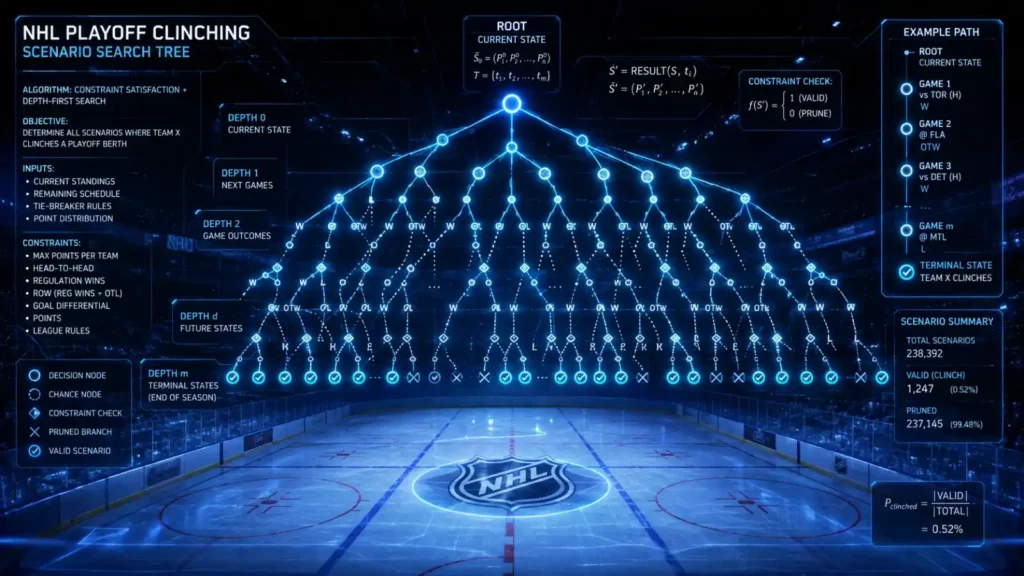
The AWS Generative AI Innovation Center has successfully developed an automated system capable of determining playoff clinching scenarios in the National Hockey League (NHL) with absolute mathematical certainty. By leveraging advanced constraint programming and custom tree search algorithms, the system calculates exactly when and how a team secures a postseason berth. This automated approach eliminates the ambiguity and manual calculation traditionally associated with late-season sports standings.
Determining playoff clinching involves navigating a massive combinatorial space of possible game outcomes. The AWS research team built a robust computational framework that models league standings, game schedules, and tie-breaking rules to verify clinching conditions. According to a recent publication by AWS, this system was rigorously validated against four full NHL seasons of officially published results.
The application of constraint programming to professional sports represents a significant crossover between operations research and real-time sports analytics. Rather than relying on heuristic estimates or Monte Carlo simulations that provide probabilistic outcomes, this mathematical approach yields definitive proof of a team's postseason eligibility, offering fans, analysts, and organizations precise clarity. (See also: Securing AI Agents with Temporal Policies in Amazon Bedrock AgentCore)
Key Takeaways
- The AWS Generative AI Innovation Center developed an automated system using constraint programming to calculate NHL postseason eligibility.
- The approach was validated against four full NHL seasons of officially published results, ensuring perfect accuracy.
- A custom tree search algorithm narrows down the massive combinatorial space of possible game outcomes to find exact clinching conditions.
- This methodology eliminates probabilistic guesswork, providing mathematical certainty for sports standings and analytics.
The Combinatorial Challenge of NHL Standings
In professional sports, particularly in the NHL, determining playoff clinching scenarios late in the regular season is a computationally intense process. The league's standings are governed by a complex set of rules, including point allocations for wins, overtime wins, shootout wins, and overtime losses. Furthermore, the NHL employs specific tie-breaking procedures—such as regulation wins, regulation plus overtime wins (ROW), and head-to-head records—which must be factored into any calculation. (See also: Alibaba Unveils Most Powerful AI Model Yet with Qwen3.8-Max)
As the regular season nears its conclusion, the number of possible future game outcomes grows exponentially. For a single team, a clinching scenario occurs when no possible combination of future results across the entire league can mathematically eliminate them from a playoff spot. Manually calculating these conditions is practically impossible due to the sheer volume of permutations. Traditionally, organizations have relied on Monte Carlo simulations to estimate the probability of a team making the playoffs. However, these simulations cannot provide the 100% mathematical certainty required to officially declare a team a playoff participant.
Constraint Programming and Custom Tree Search
To solve this, the AWS team utilized constraint programming, a paradigm well-suited for solving combinatorial problems. Constraint programming involves defining the problem as a set of variables, a domain of possible values for each variable, and a series of constraints that the solution must satisfy. In this context, the variables are the outcomes of future NHL games, and the constraints are the league's point system and tie-breaking rules.
The technical documentation published by AWS outlines how the system pairs constraint programming with a custom tree search. The tree search systematically explores the space of possible outcomes. If the solver can prove that a team accumulates enough points to finish ahead of all non-playoff-bound teams under every remaining permutation of game results, the team is officially declared a clincher.
System Validation and Accuracy Benchmarks
To ensure the computational model accurately reflected reality, the AWS team validated the system against four complete NHL seasons. By feeding the historical schedule and game results into the solver, they checked if the dates and conditions of its calculated clinching scenarios matched the officially published results from those seasons. The automated system perfectly matched the official standings and clinching dates, proving its reliability.
Industry Impact and Future Applications
The successful implementation of this system extends beyond professional hockey. The methodology developed by the AWS Generative AI Innovation Center demonstrates how constraint programming can be applied to any domain requiring definitive combinatorial verification. This includes supply chain logistics, automated scheduling, and complex resource allocation where probabilistic estimates are insufficient and strict guarantees are required.
For the sports industry, this technology shifts the paradigm from probabilistic forecasting to absolute mathematical fact. Broadcasters and sports networks can utilize such systems to provide audiences with real-time, verified clinching updates the moment the final whistle blows, rather than waiting for manual confirmations. Furthermore, integrating this capability into broader AI-driven sports analytics platforms could fundamentally change how late-season standings are presented and consumed.
As AI and machine learning continue to permeate sports analytics, the use of deterministic optimization techniques like constraint programming will likely become the standard for official record-keeping and scenario planning. The NHL clinching solver serves as a prime example of applying advanced operations research to solve high-stakes, combinatorial problems with unprecedented precision.
Key Takeaways
- The AWS Generative AI Innovation Center developed an automated system using constraint programming to calculate NHL postseason eligibility.
- The approach was validated against four full NHL seasons of officially published results, ensuring perfect accuracy.
- A custom tree search algorithm narrows down the massive combinatorial space of possible game outcomes to find exact clinching conditions.
- This methodology eliminates probabilistic guesswork, providing mathematical certainty for sports standings and analytics.
FAQ
What is constraint programming in the context of NHL standings?
Constraint programming is a mathematical optimization technique used to solve combinatorial problems. In the NHL standings context, it models future game outcomes as variables and league rules as constraints to determine if a team can mathematically clinch a playoff spot.
How does this system differ from traditional playoff probability models?
Traditional models often use Monte Carlo simulations to estimate the probability of a team making the playoffs. The AWS system uses constraint programming to provide 100% mathematical certainty, proving that no possible future outcome can eliminate the team.
How was the AWS clinching system validated?
The system was validated by running it against four complete historical NHL seasons. The automated system's calculated clinching dates and conditions perfectly matched the officially published results from those seasons.
📰 Sources & References