Diraq will deploy a quantum computer inside a commercial Equinix data center in Sydney, Australia, the companies announced Monday, August 31, 2026, marking the first time a silicon spin quantum system has operated inside shared commercial infrastructure rather than a dedicated lab. The eight-qubit machine will sit alongside standard servers, drawing less than 20 kilowatts of power, with installation targeted for completion in October 2026.
The announcement comes from a joint press release by Diraq and Equinix (Nasdaq: EQIX), corroborated by independent trade coverage from Quantum Computing Report, The Quantum Insider, and HPCwire. Diraq is a silicon spin qubit company spun out of UNSW Sydney in 2022 by physicist Andrew Dzurak, who remains Founder and CEO; the company has U.S. operations headquartered in Palo Alto, with a lab in Chicago and a technology hub in Los Angeles.
The pitch is narrower than the headline might suggest. This is a real-world integration test, not a commercial product launch. Diraq and Equinix say the goal is to prove an eight-qubit system can run inside operational data center infrastructure, alongside classical CPUs and GPUs, before opening the facility to partner and customer demonstrations.
What Diraq and Equinix Actually Announced
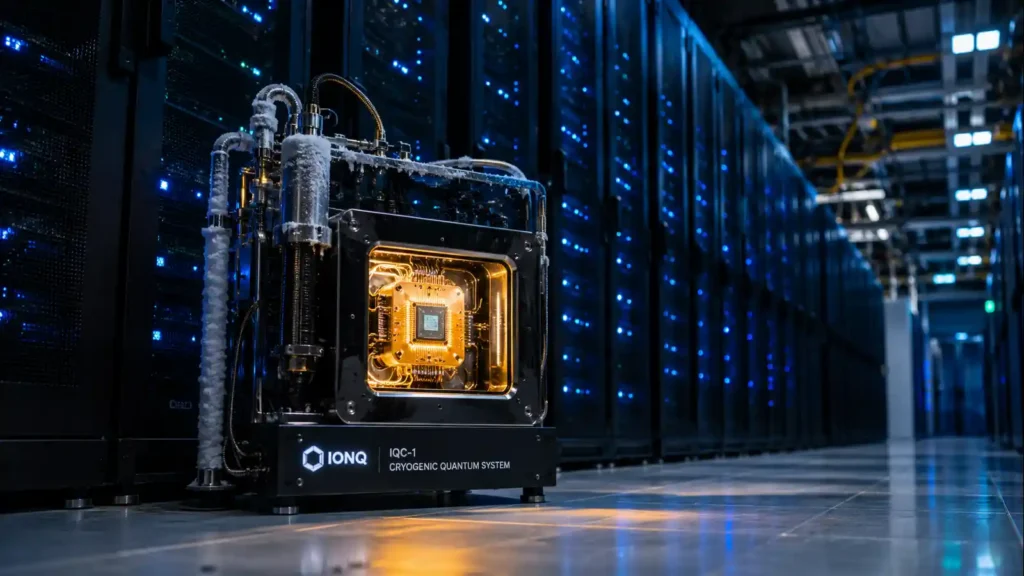
According to the joint release, the deployment is billed as the world's first silicon spin quantum computer to operate inside a shared commercial data center. The system consists of a silicon chip containing eight qubits, with cryogenic cooling and control electronics fully self-contained in the unit. Diraq says the complete system fits within Equinix's existing Sydney facility next to standard servers, requiring minimal integration work and drawing less than 20kW of power.
That power figure and the eight-qubit count are the two hard specs in the release, and every independent outlet that covered the announcement, including Quantum Computing Report and HPCwire, repeated the same two numbers without adding independent verification of their own. That's worth flagging plainly: the performance and power claims here are Diraq and Equinix's own figures, not numbers confirmed by a third-party benchmark.
Why a Data Center, Not a Lab
Diraq's core technical bet is that silicon spin qubits, built using standard CMOS semiconductor fabrication, can be manufactured on the same production lines that make ordinary computer chips. That's the reasoning behind putting a quantum system in a commercial data center at all: if the hardware is small and low-power enough to sit in a standard rack, Diraq's argument is that data centers could eventually host fleets of these machines rather than one-off lab installations.
The company says scaling to higher qubit counts requires only swapping the chip, not reworking the surrounding infrastructure. That claim tracks with a July 2026 peer-reviewed paper in Nature Communications, where researchers from UNSW Sydney, Diraq, and semiconductor foundry imec reported tuning and controlling an 8-qubit array fabricated on imec's 300mm CMOS production line, with Dzurak among the senior authors. The Equinix deployment appears to build directly on that foundry-fabricated device rather than a new architecture.
Once initial testing is complete, Diraq and Equinix plan to give industry partners a chance to see the system running inside a facility that already meets enterprise data sovereignty, security, and compliance requirements, according to the release. No specific customer names or use cases have been announced.
The Bigger Diraq Picture
This deployment doesn't happen in isolation. Diraq signed a Letter of Intent with the U.S. Department of Commerce in May 2026 for up to $38 million in proposed CHIPS Act funding to scale domestic silicon quantum manufacturing, and it's one of a small number of companies shortlisted for Stage B of DARPA's Quantum Benchmarking Initiative, a program assessing whether quantum approaches can hit utility-scale performance by 2033. Diraq is privately held; founder Dzurak has said its valuation sits under $1 billion, according to Forbes Australia, and the company hasn't disclosed plans for a public listing.
That pattern, government relationships plus foundry partnerships (GlobalFoundries, imec) plus now a live commercial deployment, is the more interesting story than the eight qubits themselves. It's a company trying to prove a manufacturing thesis, that quantum chips can ride existing chip-fab infrastructure, at every level simultaneously: research paper, government funding, and now a real data center.
Why It Matters
Eight qubits is a small number by the standards quantum computing coverage usually leads with; companies like IBM and Google have discussed processors with hundreds of qubits. The news here isn't qubit count, it's placement. Getting a quantum system, any quantum system, running inside a live commercial data center alongside production servers is a different engineering problem than running one in a shielded university lab, and it's a problem Diraq is choosing to solve early rather than at scale.
The framing from both companies, and it's a fair one, is explicitly not about quantum computers taking over classical workloads. Diraq's own language in the release describes a hybrid future where quantum, AI, and classical systems each handle what they're suited for, with quantum systems eventually tackling problems like molecular modeling for drug discovery once they reach what the industry calls utility scale, the point where a quantum computer delivers more value than it costs to operate. Diraq hasn't said when it expects to hit that threshold, and no company in the industry has hit it yet.
What to Watch
The October 2026 installation date is the near-term checkpoint. Beyond that, watch whether Diraq or Equinix publish any actual performance data from the live deployment, since the current release contains only power and qubit-count specs, not benchmark results. Also worth tracking: whether Diraq names specific enterprise partners once the demonstration phase opens, and whether Diraq's CHIPS Act funding with the Department of Commerce moves from a non-binding Letter of Intent to a finalized award.
Key Takeaways
- Diraq and Equinix will install an eight-qubit silicon spin quantum computer inside an operational Equinix data center in Sydney, targeted for completion in October 2026.
- The system draws less than 20kW of power and fits alongside standard servers, with cryogenic cooling and control electronics fully self-contained.
- Diraq, founded in 2022 as a UNSW Sydney spin-out led by CEO Andrew Dzurak, is privately held, has a Letter of Intent for up to $38 million in CHIPS Act funding, and is shortlisted for Stage B of DARPA's Quantum Benchmarking Initiative.
- No independent performance benchmarks have been published; the qubit count and power figures come from Diraq and Equinix's own announcement.
FAQ
Who is the CEO of Diraq?
Andrew Dzurak is Diraq's Founder and CEO. He's a physicist and Scientia Professor in Quantum Engineering at UNSW Sydney, where his research group worked on silicon spin qubits for roughly two decades before he founded Diraq in 2022 to commercialize the technology.
What is the most promising quantum computing stock?
Diraq itself isn't a stock to buy; it's a privately held company, and founder Andrew Dzurak has said its valuation sits under $1 billion, according to Forbes Australia, with no announced plans for a public listing. This article can't responsibly recommend a specific investment, since stock picking depends on your own risk tolerance and research, not a news summary. Publicly traded companies with quantum computing exposure do exist, including IonQ, Rigetti Computing, and IBM, but their prospects vary widely by technology approach and business model, and this isn't a recommendation to buy any of them.
Is quantum computing a threat to XRP?
Not from this announcement specifically. The general concern is real long-term: XRP, Bitcoin, and most major blockchains rely on elliptic curve cryptography that a sufficiently powerful quantum computer could theoretically break using Shor's algorithm. A March 2026 Google Quantum AI paper estimated that breaking Bitcoin's elliptic curve cryptography could require fewer than 500,000 physical qubits, and Ripple has an active roadmap targeting full quantum resistance for the XRP Ledger by 2028. But Diraq's Sydney system has eight qubits, several orders of magnitude below that threshold, so this specific deployment doesn't move that timeline.
Can a QPU replace a GPU?
Not based on how Diraq itself describes this deployment. The companies frame quantum processing units as complementary to, not a replacement for, classical compute: quantum systems are expected to work alongside CPUs and GPUs, tackling specific problems like molecular simulation, while classical hardware continues to handle the workloads it already does well. Today's quantum computers, including this one, also can't run general-purpose GPU workloads like deep learning training at any competitive scale.
How many qubits does the Diraq system going into Equinix have?
Eight qubits, according to the joint Diraq-Equinix announcement. The silicon chip's qubit count can reportedly be increased later just by swapping the chip, without changing the surrounding data center infrastructure, though Diraq hasn't given a timeline for when a higher-qubit version might be installed.