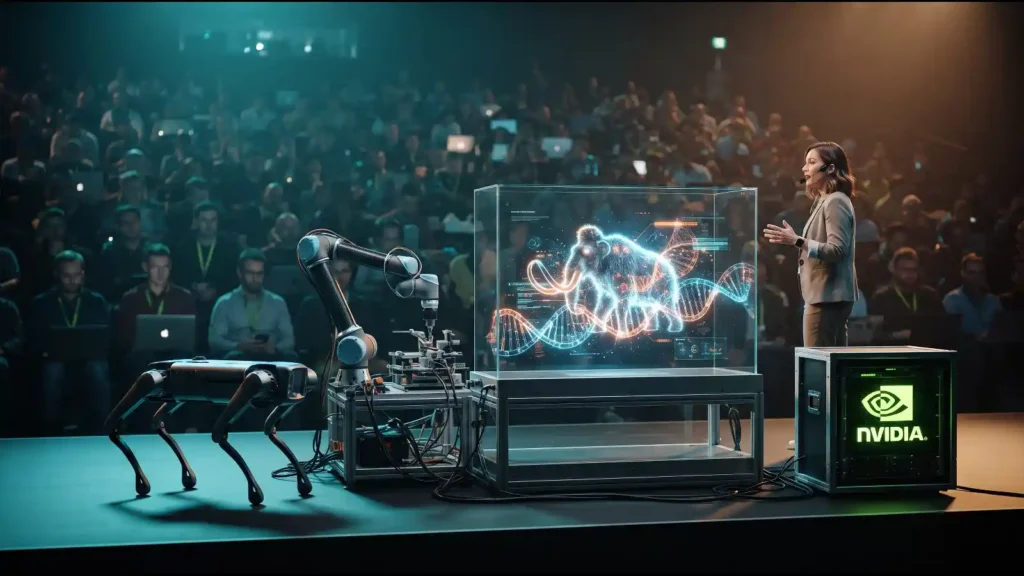
TechCrunch Disrupt 2026 is splitting its AI programming into two dedicated stages instead of one, and the new one is built entirely around AI that acts in the physical world. TechCrunch Events confirmed the addition of a Real World AI Stage on September 2, 2026, alongside the return of its existing AI Stage, as part of the broader TechCrunch Disrupt 2026 conference running October 13 to 15 at Moscone West in San Francisco.
The stage centers on what TechCrunch calls the intersection between the digital and physical, covering autonomous hardware moving past self-driving cars into public spaces, battlefields, homes, and even attempts to bring extinct species back. Confirmed speakers so far include Nvidia's Head of Physical AI, Shield AI's CTO, and Colossal Biosciences CEO Ben Lamm, with TechCrunch noting the lineup is still growing.
This is the kind of announcement that is easy to read as routine conference programming and easy to miss the signal in. Splitting a single AI stage into two, one for software and one for hardware meeting the real world, says something about where TechCrunch thinks the interesting AI stories are heading next.
What TechCrunch Announced
On September 2, 2026, TechCrunch Events published a post confirming that TechCrunch Disrupt 2026's AI programming is splitting into two stages instead of one. The existing AI Stage returns with its usual focus on SaaS pricing, security, and business model questions. A brand-new Real World AI Stage joins it, dedicated to autonomous hardware that is moving past self-driving cars and into public spaces, battlefields, homes, and attempts to bring back extinct species.
Both stages run as part of the broader TechCrunch Disrupt 2026 conference, scheduled for October 13 to 15 at Moscone West in San Francisco.
Who's Confirmed for the Real World AI Stage So Far
TechCrunch's post names five sessions and their speakers, while noting more names are still coming. Confirmed so far:
- Les Karpas, Head of Physical AI at Nvidia, on what is standing between today's robotics and a breakout moment for physical intelligence
- Nate Michael, CTO of Shield AI, on how defense and industrial AI companies validate systems where failure has real consequences
- Ben Lamm, CEO of Colossal Biosciences, in a fireside chat about the company's de-extinction work and the debate over whether it counts as conservation
- Dr. Ali Agha of FieldAI, Michelle Lee of Medra, and Aidan Madigan-Curtis of Eclipse Ventures, on building AI systems that operate without reliable cloud access
- John Mackey of MBRYONICS, Boris Sofman of Bedrock Robotics, and Adrian Macneil of Foxglove, on what breaks when hardware startups try to move from prototype to production
That is a partial lineup, not a final one. TechCrunch's own wording flags more speakers still to come, so this reads as round one of announcements rather than the complete agenda.
Why Split the AI Programming in the First Place?
TechCrunch is not new to running an AI stage at Disrupt. What changed is scope. A single track covering both software-heavy AI news, like SaaS pricing and agent security, and hardware-heavy physical AI, like autonomous defense systems and lab-driven de-extinction biology, was starting to strain against two very different audiences with two very different sets of concerns.
The split lines up with a pattern this outlet has been tracking all year. TurbineOne's new defense AI hub in Maine and Pony.ai's robotaxi expansion into Korea both show autonomous and edge-focused AI systems shipping into real deployments rather than staying in demos. Nvidia's own moves, including its stake in MediaTek's AI chip push, point the same direction, chasing the hardware layer that physical AI actually runs on.
The timing lines up with something bigger than one conference agenda. The World Economic Forum and Frontiers published their Top 10 Emerging Technologies of 2026 report in June, and its central finding was a shift from software-first AI toward technologies acting directly on physical systems, energy, materials, and biology among them. TechCrunch building a stage explicitly for that intersection is a smaller-scale version of the same trend line.
The Rest of Disrupt 2026's Stage Lineup
The Real World AI Stage is one piece of a six-stage event. TechCrunch has also announced:
- The Disrupt Stage, with speakers from Replit, Amazon, and Tether
- The AI Stage, focused on SaaS pricing shifts and agent security, which TechCrunch separately confirmed will include speakers from Anthropic and OpenAI
- The Smart Money Stage, covering stablecoins, instant payments, and AI's role in financial trust
- The Smart Systems Stage, on fusion power and the grid strain tied to AI infrastructure
- The Builders Stage, tactical advice for founders on fundraising, hiring, and scaling
TechCrunch's own event pages put the full conference at more than 200 sessions across those six stages, with more than 250 speakers and over 10,000 attendees expected.
What to Watch
The clearest thing to watch is the rest of the Real World AI Stage lineup. TechCrunch has said more speakers are coming, and how the final roster balances defense, biotech, and consumer robotics companies will say a lot about which corner of physical AI the outlet thinks deserves the spotlight this year.
Ben Lamm's fireside chat is worth watching for reasons beyond the stage itself. Colossal Biosciences has drawn plenty of scrutiny over how it frames its de-extinction claims, and a live, unscripted conversation is a different test than a company's own press materials.
Registration and the rest of the speaker list will keep updating on TechCrunch's event site between now and October 13.
Key Takeaways
- TechCrunch Disrupt 2026 is splitting its AI programming into two stages: the existing AI Stage and a new Real World AI Stage focused on physical, embodied AI.
- Confirmed Real World AI Stage speakers include Nvidia's Les Karpas, Shield AI's Nate Michael, Colossal Biosciences CEO Ben Lamm, and founders from FieldAI, Medra, MBRYONICS, Bedrock Robotics, and Foxglove.
- TechCrunch says more speakers are still to be announced, so this is a partial lineup, not the final agenda.
- The full event runs October 13 to 15 at Moscone West in San Francisco, with TechCrunch projecting more than 10,000 attendees across six stages.
FAQ
Is TechCrunch Disrupt a real thing?
Yes. It is TechCrunch's flagship in-person conference, held annually in San Francisco. The 2026 edition runs October 13 to 15 at Moscone West, and TechCrunch's own event pages project more than 10,000 founders, investors, and operators onsite across six stages.
Is TechCrunch Disrupt worth it?
That depends on what someone wants out of it. As of September 3, 2026, ticket prices on TechCrunch's own site range from $249 for an Expo+ pass up to $999 for a full Investor Pass, with Attendee and Founder passes at $849 and $899. For that, attendees get access to 200-plus sessions across six stages, an expo hall TechCrunch says will include 300-plus exhibiting startups, and the Startup Battlefield 200 pitch competition. Since it is TechCrunch's own event, its marketing naturally emphasizes the upside. Whether it is worth the ticket and travel cost comes down to whether direct, in-person access to that network is actually what someone needs, versus following the coverage after the fact.
What are the top 10 emerging technologies in 2026?
TechCrunch Disrupt itself does not rank this, but the World Economic Forum and the publisher Frontiers released a Top 10 Emerging Technologies of 2026 report in June that is relevant background for the Real World AI Stage's theme. It named technologies including everything-to-grid energy storage, direct lithium extraction, passive radiative cooling materials, exosome-based drug delivery, personalized cancer vaccines, and lattice-based cryptography, among others. Its overall finding, that the frontier is shifting from software-first AI toward technologies acting directly on physical systems, lines up with exactly what TechCrunch is building its new stage around.
Who attends TechCrunch Disrupt?
TechCrunch's registration pages describe an audience of founders, investors, operators, and corporate innovation and press teams, with more than 10,000 attendees expected for the 2026 event. Pass types are split by role, including Founder Passes, Investor Passes, general Attendee Passes, plus Non-Profit, Student, and Expo+ tiers.