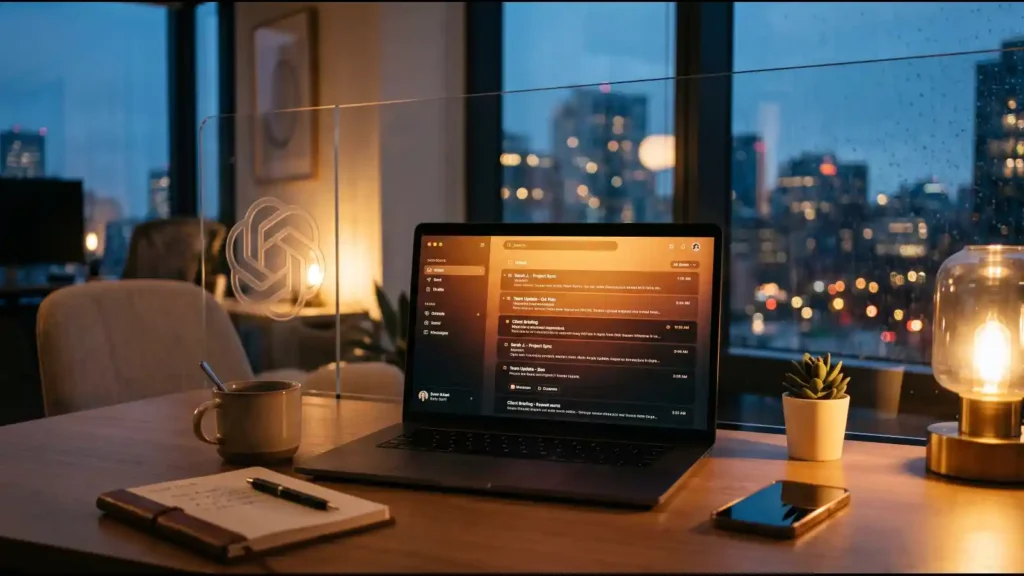
OpenAI published a customer story on September 14, 2026 explaining how Fyxer built an AI executive assistant, an inbox tool that reads email, drafts replies in each user's voice, and tracks commitments across meetings and messages. OpenAI says 90% of Fyxer's users are still active 90 days after signup, and 53% of its AI-generated drafts get sent without edits. Fyxer built the system on frontier OpenAI models, heavy fine-tuning, and more than 500,000 hours of human executive assistant data the company collected before it went all-in on AI.
OpenAI has leaned into these founder-facing case studies all year, including one on Perplexity's production reliance on GPT-6 Astra published earlier this month. They're written to sell other founders on OpenAI's platform, not to independently audit the customer, which matters here because Fyxer's own press page, funding history and a growing pile of user reviews tell a slightly messier story than the case study does, especially on the exact size of its revenue growth.
What follows separates what OpenAI and Fyxer have confirmed from what's still just a claim, and checks both against independent funding coverage, reviews and security research.
How Fyxer's AI Assistant Actually Works
Fyxer did not start as an AI company. Before building its own product, the company ran a human-staffed executive assistant service, and OpenAI's post says that operation generated more than 500,000 hours of annotated executive assistant workflows, the training data Fyxer later built its AI system on. Fyxer was founded in late 2023, according to funding coverage from LionHerald, and OpenAI lists the company's region as Europe and the UK.
That system now runs on somewhere between 30 and 50 specialized models, according to OpenAI, each handling one narrow part of the email workflow instead of one large model trying to do everything. A reply decision model first classifies an incoming email: does it need a response, a scheduling action, or nothing at all. If a reply is needed, separate models read intent, pull in relevant memory from past threads, and draft the response in the user's tone.
Fine-tuning sits underneath all of it. Fyxer uses supervised fine-tuning and Low-Rank Adaptation (LoRA) to create task-specific model variants, and more recently worked with OpenAI's managed fine-tuning team to move a new checkpoint into production, per the case study. Every drafting change then goes through an A/B test, and Fyxer says it only ships a version once it clears a statistically significant bar, sometimes within a day given its user volume.
Fyxer told OpenAI it chose the company's models because they performed best on Fyxer's internal benchmarks, offered strong fine-tuning support for subjective judgment calls like tone, and came with hands-on engineering help. That combination, a frontier model provider plus heavy in-house fine-tuning, is becoming a familiar setup this year. Together AI's own recent fine-tuning expansion points to the same demand for customization over raw model size.
The Money Behind the Pitch
Fyxer's public numbers get less consistent once you leave OpenAI's write-up. The case study puts Fyxer's 2025 growth at $1 million to $32 million in annual recurring revenue. Fyxer's own press page rounds that same year to $1 million to $30 million. The company's September 2025 Series B announcement said it had reached just over $17 million in ARR by August 2025, with a public target of $50 million by year end. A GrowthBook customer case study and a startup data directory both put Fyxer's one-year mark closer to $35 million.
None of those figures necessarily contradict each other, since they cover slightly different months and Fyxer's growth has clearly been fast either way. But four sources tied to the same company describing the same stretch of 2025 with four different endpoints is worth flagging before repeating any single number as the definitive one.
Funding is more consistent. Fyxer raised a $30 million Series B in September 2025, led by Madrona with participation from Lakestar Capital, and counts Salesforce founder Marc Benioff among its earlier backers through 20VC and 20Growth. That round brought Fyxer's total funding to $43 million, per the company's own press page, a figure that does not cleanly divide into its disclosed Series A ($10 million, led by 20VC) and Series B ($30 million) amounts, which points to an earlier seed round Fyxer has not broken out publicly. The company has not disclosed a valuation for either round.
For Archie Hollingsworth, Fyxer's co-founder, the ARR headline is not even the number that matters most. "Everyone talks about ARR, but I think retention is the real flex," he told OpenAI, pointing to that 90% figure instead.
What Users Are Actually Saying
Independent reviews back up the tone-matching Fyxer advertises, and push back on almost everything else. Reviewers at eesel AI and tldv, who both tested the product hands-on, say Fyxer's drafts genuinely sound like the user rather than a generic AI voice, and note the setup has a low learning curve. Both also flag the same recurring complaints turning up in Fyxer's own Reddit and Trustpilot reviews: categorization that's sometimes too rigid, important emails occasionally buried in the wrong folder, and multiple users reporting they were billed after canceling a free trial.
Pricing draws its own criticism. Fyxer's Starter plan only connects one inbox, so anyone juggling a work and personal account gets pushed to the Professional plan, priced around $50 a month as of eesel's October 2025 review. There's no free tier beyond a trial period. tldv's July 2026 retest found the product had matured since its 2025 launch, with a more stable dashboard, but still called it overpriced at the entry level and said the meeting notetaker remains a secondary feature next to the email tools.
Fyxer vs Microsoft Copilot
Fyxer positions itself as a complement to Copilot rather than a replacement, and its own comparison content makes that case directly: Copilot works well across Word, Excel and Teams, but the two tools are built for different jobs.
|
|Fyxer | Microsoft 365 Copilot |
|—|—|—|
|Core focus | Dedicated email and meeting assistant | General AI layer across Microsoft 365 |
|Works with | Gmail and Outlook | Microsoft 365 apps only |
|Reported pricing | About $50/month, Professional plan (eesel, Oct. 2025) | About $30/user/month add-on (widely reported) |
|Independent Outlook scorecard | 18/25 | 16/25 |
That scorecard comes from get-alfred.ai's 2026 Outlook comparison, which needs a caveat: the site ranked its own competing product, alfred_, highest at 24/25. Treat any head-to-head from a competing vendor, including this one, as a starting point for your own testing rather than a verdict.
Can You Trust Fyxer With Your Inbox?
Fyxer's own security page claims SOC 2 Type II and ISO 27001 certification, plus GDPR and HIPAA compliance, and says customer data is stored exclusively on Google Cloud infrastructure in the EU and EEA. The company also says it does not use customer email content to train third-party models, including the OpenAI models it runs on.
Sourcing on the exact SOC 2 tier isn't perfectly clean, though: a third-party compliance directory lists Fyxer at SOC 2 Type I rather than Type II, a meaningfully lower bar, since Type I audits control design at a single point in time and Type II audits those controls over several months. Worth confirming directly with Fyxer's trust center rather than treating either version as settled.
An independent security review from Drel, a security research firm, found Fyxer's compliance posture "among the strongest in the AI email assistant category," while noting that the underlying risk in this whole product category isn't the vendor, it's the access pattern. Any tool that reads and drafts your email needs broad inbox permissions, and that risk applies to Fyxer's competitors as much as it applies to Fyxer.
What to Watch
Three things worth tracking. First, whether Fyxer's next public update settles on one ARR figure instead of the four currently floating around from company-adjacent sources. Second, whether Fyxer clarifies its SOC 2 audit tier directly, since that's a quick fix if the third-party listing is simply outdated. Third, watch whether other AI labs start publishing similar trust-building customer stories for agents with sensitive access, the way Meta's rollout of its Muse agent is already testing how much access users will hand an AI assistant for email, shopping and travel booking.
Key Takeaways
- OpenAI's September 14, 2026 customer story says 90% of Fyxer users are still active at 90 days, and 53% of AI-drafted emails are sent without edits, per OpenAI's own account of the product.
- Fyxer raised a $30 million Series B in September 2025, led by Madrona with Lakestar Capital, bringing its total funding to $43 million per the company's own press page.
- 2025 ARR figures for Fyxer range from about $17 million to $35 million depending on the source and month cited, an inconsistency worth noting before repeating any single number.
- Fyxer claims SOC 2, ISO 27001, GDPR and HIPAA compliance and stores EU customer data within the EU, though its SOC 2 audit tier is reported differently across sources.
FAQ
What are people saying about Fyxer AI?
Independent reviews and user feedback on Reddit and Trustpilot are mixed. Praise centers on how closely Fyxer's drafts match a user's own writing voice and how much time it saves on high email volume. The recurring complaints are rigid or inaccurate categorization, occasional billing charges after a canceled trial, and a meeting notetaker feature that reviewers consistently describe as weaker than the email tools.
What is the best AI for executive assistants?
There isn't a single, settled answer. It depends on your existing stack and what's actually slowing you down. Fyxer markets itself as a specialist that complements Microsoft Copilot rather than replacing it, since Copilot covers documents and Teams but is more generic in the inbox. Independent comparisons vary too: one 2026 Outlook scorecard ranked a competing product, alfred_, above both Fyxer and Copilot, but that scorecard came from the company that makes alfred_, so it's worth testing candidates yourself rather than taking any single vendor's ranking at face value.
How much is Fyxer AI worth?
Fyxer has not publicly disclosed a valuation for either funding round. What's confirmed is total funding of $43 million, including a $30 million Series B led by Madrona with Lakestar Capital in September 2025. Revenue estimates that outlets sometimes use to infer worth range from about $17 million to $35 million in 2025 ARR depending on the source, so any specific valuation figure circulating publicly should be treated as an estimate, not a confirmed number.
Is Fyxer AI safe?
Fyxer says it's SOC 2 Type II and ISO 27001 certified, GDPR and HIPAA compliant, stores EU customer data exclusively in the EU and EEA, and doesn't use customer email content to train third-party AI models. A third-party compliance directory lists an older SOC 2 Type I certification rather than Type II, which is worth confirming directly. An independent security review found Fyxer's compliance posture strong for its category, while noting that any tool with this level of inbox access carries inherent risk regardless of vendor.