Apple's first foldable phone has an AI story built into its factory floor, not its software. During the company's Surprise and Shine event on September 9, 2026, Apple hardware chief Johny Srouji said the iPhone Duo's hinge is built using AI algorithms that pair each individual hinge with its best matching housing, followed by laser scanning and a 3D printing process meant to iron out manufacturing variance before the phone reaches anyone's hands.
This is Apple's first entry into the foldable category, arriving seven years to the day after Samsung shipped the original Galaxy Fold. It's also the first product launch led by new CEO John Ternus, who took over from Tim Cook on September 1. The iPhone Duo starts at $1,999 for 256GB and runs up to $3,199 for 2TB, with preorders opening October 16 and shipping starting October 23.
The manufacturing detail is specific enough to take seriously. Whether it fixes the durability problem that has dogged foldable phones since 2019 is a separate question, and one Srouji didn't directly answer on stage.
What Apple Actually Said
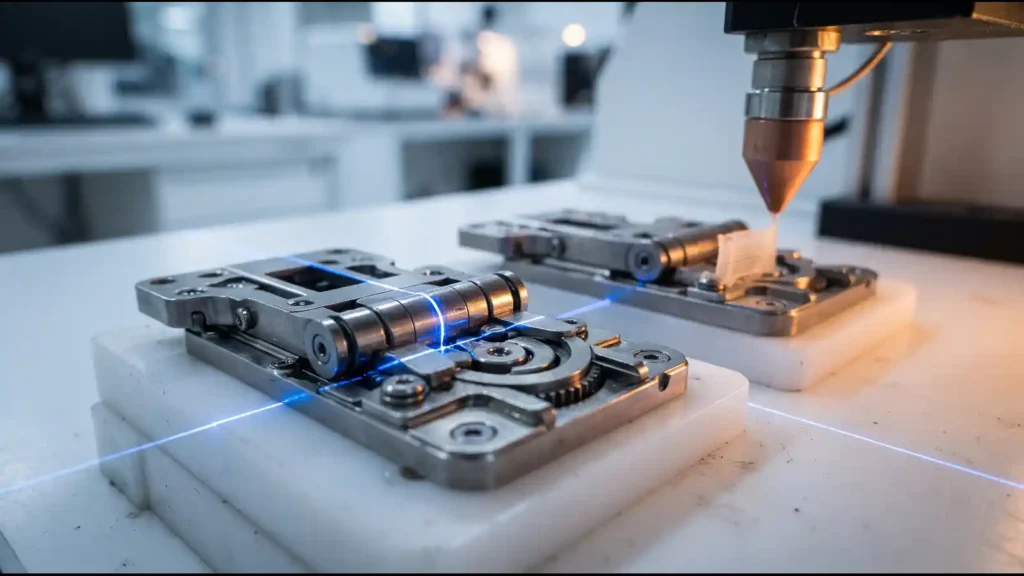
Srouji described a two-part process. AI algorithms match each hinge to its best-fit housing during assembly, which Apple says improves alignment precision. From there, a confocal laser scans the surface topology of every unit, and a 3D printer "3D prints up to 25 micro layers of a custom photopolymer" onto it, according to Srouji's remarks reported by TechCrunch, to smooth out what he called residual waviness.
Apple says the hinge assembly itself contains more than 100 precision components, a figure reported by The Register from Apple's own presentation. The company paired that with a nano-texture display finish meant to cut glare, plus a multi-layer lamination strategy it says improves durability. The inner display measures 7.6 inches with an under-display FaceTime camera, a first for iPhone, next to a 5.4-inch outer display.
Apple is also claiming an IP68 dust and water resistance rating for the Duo. That's worth flagging on its own: Samsung's eighth-generation Galaxy Fold, after years of iteration, is only rated IP48, according to The Register. Independent teardowns haven't confirmed Apple's claim yet, and that verification gap matters more than the marketing copy suggests.
This Isn't Apple's First 3D-Printed Part, and It's Not the Industry's Either
Apple has used 3D printing in consumer hardware before. The company has built titanium Apple Watch cases using laser powder bed fusion, a process that cuts raw material use by roughly 50% compared to forged designs, according to 3D Printing Industry's reporting. That gives Apple actual manufacturing experience with the technique, not just a talking point for a keynote.
But Apple isn't the first phone maker to 3D print hinge hardware, either. 3D Printing Industry notes that Oppo has already used 3D printing more extensively on structural hinge components than what Apple is doing with the Duo's hinge cover. Apple's application here is narrower in scope, which is a useful correction to the framing that Apple invented something new. It applied a known technique to a hard problem, which is different from solving the problem.
That hard problem is durability. Foldable phones undergo roughly twice the mechanical stress of a standard phone by design, and every generation of Galaxy Fold has shipped with hinge complaints that iFixit still flags as Samsung's core weakness, per The Register's teardown history. "the most transformational change to iPhone since the original," is how Ternus described the Duo at the event, per Variety. That's a CEO's opening pitch, not an independent assessment, and it's worth remembering Apple's own hardware chief stopped short of promising the hinge will hold up over years of folding.
Early reaction backs up that caution. Threads on MacRumors' forums flagged the hinge as "overly complex and likely to be a serious point of failure" within hours of the keynote, and Reddit's response split roughly along the same lines: genuine interest in the design, paired with skepticism that Apple, on its first attempt, has actually cracked what Samsung hasn't in eight generations. This is Ternus's first product launch as CEO, and the Duo is the device he's chosen to stake that debut on.
Why It Matters
Manufacturing-floor AI is a less glamorous story than a chatbot feature, but it's also more verifiable. Apple gave a specific process (AI-based component matching, laser scanning, 25 printed layers) rather than a vague "AI-powered" label, and that specificity is what separates this from most AI marketing claims I cover. The catch is that specificity applies to how the hinge was built, not to how long it will last, and Apple didn't offer numbers on the second part.
What to Watch
The real test starts once independent reviewers and teardown outlets get units in hand after the October 23 ship date. iFixit's take on whether the IP68 claim and the 100-plus-component hinge actually hold up under repeated folding will tell you more than anything said on stage. Watch for early durability complaints in the first few weeks after release, the pattern that has defined every foldable phone's post-launch cycle since 2019.
Key Takeaways
- Apple's iPhone Duo uses AI to match each hinge with its best-fit housing during manufacturing, then 3D prints up to 25 photopolymer layers to smooth surface variance, per Apple hardware chief Johny Srouji.
- The Duo starts at $1,999 for 256GB and reaches $3,199 for 2TB, with preorders opening October 16 and shipping October 23, 2026.
- Apple has used 3D printing in hardware before (titanium Apple Watch cases), but Oppo has already applied it more extensively to structural hinge parts, per 3D Printing Industry.
- Apple claims an IP68 rating versus Samsung's IP48 on the Galaxy Fold 8, but independent teardowns haven't verified that claim yet.
FAQ
How much will the iPhone Duo cost?
Apple priced the iPhone Duo starting at $1,999 for the 256GB model, rising to $3,199 for the 2TB version, according to the company's September 9, 2026 announcement. That makes it the most expensive iPhone Apple has released at launch.
What is the iPhone Duo's hinge, and how was it built?
Apple says the hinge assembly contains more than 100 precision components. During manufacturing, AI algorithms pair each individual hinge with its best-fit housing, then a confocal laser scans the unit's surface and a 3D printer applies up to 25 micro layers of custom photopolymer to reduce surface inconsistencies, according to Apple hardware chief Johny Srouji.
Is Apple's foldable iPhone real?
Yes. Apple unveiled it as the iPhone Duo on September 9, 2026, ending years of rumors that circulated under names like iPhone Fold and iPhone Ultra.
Will Apple release a folding phone in 2026?
Yes. Preorders for the iPhone Duo open October 16, 2026, with the device shipping starting October 23, 2026.