
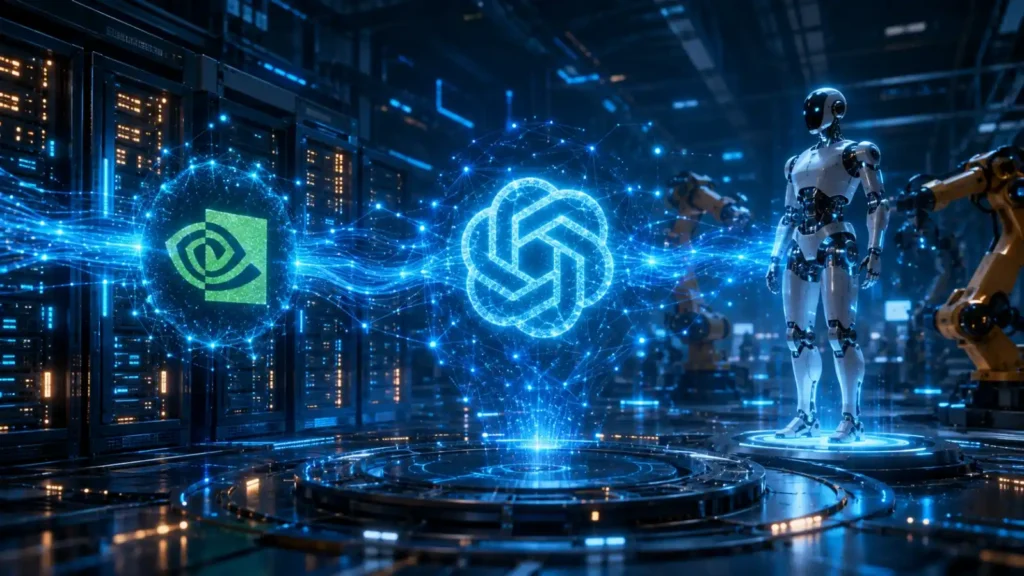
LG has confirmed plans to release an Nvidia-powered humanoid in 2027, marking a pivotal shift in physical AI from research concepts to real-world deployments. Announced as part of an expanded partnership between the two technology giants, the upcoming robot will leverage Nvidia’s advanced Isaac and Jetson Thor computing platforms to handle complex autonomous tasks. This strategic move directly addresses the growing enterprise demand for intelligent, general-purpose machines capable of navigating human-centric environments. (See also: Anthropic shares more details about how Claude’s new watermarks will work)
The collaboration pairs LG’s expertise in hardware manufacturing and robotics with Nvidia’s industry-leading artificial intelligence and simulation technologies. By integrating Nvidia’s Isaac GR00T foundation model, designed specifically for humanoid robots, the joint project aims to accelerate the timeline for commercial viability. The initiative signals a definitive transition away from limited, single-purpose industrial automation toward highly adaptable robotic labor. (See also: Prompt: Wall Street Is Coming for AI Infrastructure)
As global industries face escalating labor shortages and operational bottlenecks, the pressure to deliver functional humanoid robots has intensified. LG’s commitment to a 2027 launch provides a concrete timeline for the commercialization of physical AI, setting the stage for a competitive showdown with other major robotics developers aiming for similar market entry windows.
The Strategic Alliance Behind the 2027 Launch
The announcement that LG will release an Nvidia-powered humanoid in 2027 represents a calculated alignment of two distinct technological capabilities. LG brings decades of consumer and industrial hardware manufacturing to the table, while Nvidia provides the critical computational backbone required for autonomous decision-making. This collaboration relies heavily on Nvidia’s Isaac robotics platform and the upcoming Jetson Thor compute modules, which are engineered specifically to process the massive volumes of sensor data required for real-time spatial navigation.
According to Jensen Huang, Nvidia’s CEO, the future of artificial intelligence depends heavily on its integration into physical forms. "The next phase of AI is physical AI. We are building the infrastructure for the millions of humanoid robots that will transform the world's labor force," Huang stated during a recent developer keynote. This expanded partnership with LG serves as a primary proving ground for that vision, transitioning Nvidia’s foundational models from laboratory simulations into deployable commercial hardware.
How Does the Nvidia Isaac GR00T Platform Power Humanoid Robots?
The Nvidia Isaac GR00T reference humanoid robot framework is the central technology driving this 2027 deployment. GR00T, which stands for Generalist Robot 00 Technology, is a foundation model designed to give humanoid robots multi-modal capabilities. It processes vision, language, and action inputs simultaneously, allowing the robot to understand complex natural language commands and translate them into precise physical movements. This architecture represents a significant leap over traditional robotic programming, which relies on rigid, pre-mapped routines.
To train these systems efficiently, the partnership utilizes Nvidia Isaac Sim, a scalable reference application built on the Omniverse platform. Isaac Sim allows developers to generate highly realistic, physically accurate virtual environments. By running millions of hours of simulated training scenarios, the AI models learn to navigate stairs, manipulate irregular objects, and recover from falls without the physical wear and tear associated with real-world testing. This simulation-to-reality pipeline is critical for meeting the aggressive 2027 commercial launch window, as it drastically reduces the time required to achieve safe operational reliability.
Technical Specifications and Expected Capabilities
While LG has not yet released the exact physical dimensions of its upcoming humanoid, the underlying Nvidia architecture dictates a specific set of baseline capabilities. The robot is expected to operate utilizing the Jetson Thor system-on-module, delivering up to 800 teraflops of sparse AI compute performance. This level of processing power is necessary to run the GR00T foundation model locally, ensuring ultra-low latency for balance, obstacle avoidance, and object manipulation without relying on a continuous cloud connection.
### How Does This Impact Enterprise AI Deployments?
For enterprise operators, the integration of GR00T into a commercially available humanoid like LG's means a drastic reduction in integration friction. Currently, deploying robotics in environments like warehouses or manufacturing floors requires extensive custom coding to map the environment and define acceptable behaviors. A robot powered by a generalist foundation model can be instructed via natural language to "move the blue boxes from the conveyor belt to the pallet," using its onboard computer vision and spatial awareness to figure out the optimal execution path autonomously.
This shift fundamentally alters the ROI calculation for enterprise automation. Companies will no longer need to maintain a staff of specialized robotics engineers to adjust hardcoded pathways every time a warehouse layout changes. The adaptability of physical AI promises to make automation accessible to mid-sized businesses that previously lacked the technical resources to deploy traditional robotic systems. As Wall Street increasingly views AI infrastructure as a distinct investable asset class, the financial backing for these enterprise robotics deployments is scaling rapidly.
Market Competition and the 2026 Landscape
LG’s 2027 target places it in a highly competitive race against several prominent players. Agility Robotics has already deployed its Digit humanoid in commercial logistics facilities, while Figure AI has secured massive funding rounds to accelerate its own general-purpose robots. Tesla continues to iterate on its Optimus prototype, though the company has faced delays in achieving full autonomy outside of controlled factory environments.
The rush to market raises critical questions about standardization and safety. Unlike software applications, physical AI operates in shared spaces with human workers, meaning a single edge-case failure can result in physical harm. Nvidia addresses this through its Nvidia humanoid robot Developer Program, which provides hardware and software tools to researchers aiming to establish safer operational protocols. LG’s entry into this space will likely accelerate the development of universal safety standards, as the company's massive global supply chain and distribution network can drive industry-wide adoption faster than niche robotics startups.
The Path to Commercial Viability
Achieving a successful release of an Nvidia-powered humanoid in 2027 depends heavily on overcoming current hardware limitations. Battery density remains a primary bottleneck; bipedal locomotion is highly energy-intensive, and most current humanoids struggle to operate beyond four to six hours on a single charge. Furthermore, the cost of high-precision actuators and specialized sensors places the initial price of these units well outside the consumer market.
However, LG’s manufacturing scale provides a distinct advantage in driving down these component costs. By leveraging existing supply chains for electric motors, battery cells, and optical sensors, the company can achieve economies of scale that smaller robotics firms cannot match. While the exact NVIDIA humanoid robot price remains unconfirmed, industry analysts project initial enterprise models will cost between $30,000 and $50,000, positioning them as alternatives to annual human labor costs rather than premium consumer electronics. As AI infrastructure investments continue to scale, the financial models supporting these robotic deployments are becoming increasingly viable for large-scale enterprise adoption.
Key Takeaways
- LG and Nvidia are partnering to release a commercial humanoid robot in 2027, utilizing Nvidia's Isaac GR00T foundation model and Jetson Thor compute platform.
- The collaboration leverages Nvidia Isaac Sim to run millions of hours of simulated training, drastically reducing the time needed to achieve safe, real-world operational reliability.
- The robot targets enterprise logistics and manufacturing, aiming to replace rigid industrial automation with adaptable, natural-language-driven physical AI.
- LG's global manufacturing scale is expected to drive down component costs, making enterprise deployment financially viable against traditional human labor models.
FAQ
Has the Tesla robot been released?
No, the Tesla robot, known as Optimus, has not been commercially released. Tesla currently uses prototypes of the Optimus robot internally at its factories for basic tasks like battery cell sorting and material handling, but a public commercial release date has not been confirmed.
Can I pre-order a Tesla Optimus?
No, consumers and businesses cannot currently pre-order a Tesla Optimus. Tesla has not opened a pre-order system for its humanoid robot, as the hardware and autonomous software are still in the prototype and internal testing phases.
How much is Elon Musk's human robot?
Elon Musk has stated that the Tesla Optimus human robot will eventually cost between $20,000 and $30,000 once production is scaled. However, this is a long-term target price, and the initial cost of early commercial units is expected to be higher.
What is the most advanced humanoid robot expected to be released in 2026?
Several highly advanced humanoid robots are expected to see expanded deployment in 2026, including Figure AI's Figure 02 and Agility Robotics' Digit. Additionally, robots powered by Nvidia's Isaac GR00T platform are anticipated to enter early commercial pilots in 2026 ahead of broader releases like LG's planned 2027 launch.