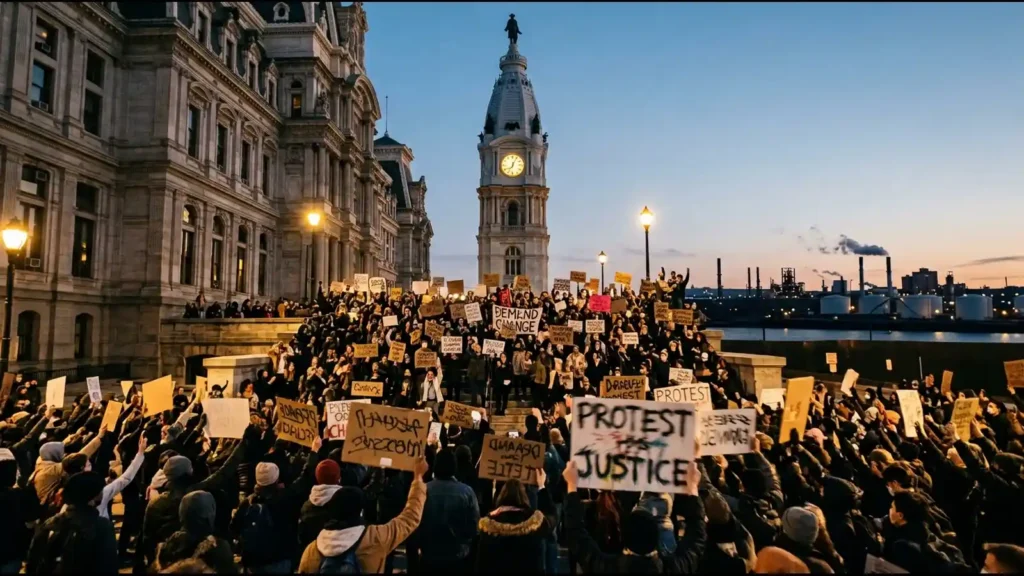
More than 100 people rallied at Philadelphia City Hall on September 14, 2026 to launch the No Data Centers in Philly campaign, demanding a citywide moratorium before officials advance either of two possible data center sites, according to reporting from TechCrunch, WHYY, and Axios Philadelphia. One of those sites sits in Grays Ferry, a Southwest Philadelphia neighborhood that spent decades next to what was once the East Coast's largest oil refinery before a 2019 explosion shut it down for good.
The rally is the most personal flashpoint yet in a national data center boom backlash that has already produced construction pauses in New York, Denver, Indianapolis, Asheville, Charlotte, and Reno. What makes Philadelphia different is the specific history involved: a community that already believes it paid a health price for one industrial neighbor is now being asked to weigh a second one, with essentially no local rules on the books to govern it.
City officials have not received a formal development proposal for either site. But between a refinery legacy still shaping local politics and a state government that just reversed its own pro-data-center posture, Philadelphia is shaping up as a test case for whether environmental justice history can slow the data center boom before ground ever breaks.
Background: A Refinery's Ghost Still Hangs Over Grays Ferry
Southwest Philadelphia's Grays Ferry neighborhood sat for decades next to what was once the East Coast's largest oil refinery, a complex that processed up to 335,000 barrels of crude oil a day before a 2019 explosion forced its permanent closure, according to TechCrunch's reporting. Shawmar Pitts grew up beside it, and didn't connect his family's chronic health conditions to the plant until Philly Thrive, an environmental justice group, came through his neighborhood in 2018 warning about a proposed refinery expansion.
Pitts is now Philly Thrive's managing co-director, and the same organization is now leading opposition to a very different kind of industrial neighbor. Philadelphia's city planning commission identified two potential data center sites in July 2026: one on the old refinery's Grays Ferry footprint, the other near Grant Avenue in Northeast Philadelphia, according to Fox29 and the Philadelphia Inquirer. Neither site has a formal construction proposal attached to it yet.
The Current Picture
A Citywide Campaign Launches at City Hall
More than 100 people gathered at Philadelphia City Hall on September 14, 2026 for the kickoff rally of the No Data Centers in Philly campaign, a coalition that includes Philly Thrive, the Clean Air Council, the 215 People's Alliance, and the Black Alliance for Peace, according to TechCrunch, WHYY, and Axios Philadelphia. Organizers say the city currently has no zoning rules specific to where data centers can be built or what protections nearby residents would get.
Philly Thrive board president Sonya Sanders told the crowd, "we don't want the pollution, we don't want the noise," TechCrunch reported. Sanders said her husband, also a Grays Ferry resident, died of a rare bone cancer in 2020 that she attributes to refinery emissions, though that link has not been independently established.
In a statement to WHYY, Pitts called Philadelphia's lack of data center rules "a recipe for disaster." He argued unchecked growth would keep pushing up electricity bills, pollution, and surveillance infrastructure without any local guardrails in place.
Clean Air Council attorney Annie Fox told Fox29 that "500 cities around the country have moratoriums" already and that organizers want Philadelphia to be next. That figure comes from the campaign itself, and BriefFlash has not independently verified the full count. What is confirmed: moratoriums are active in at least five U.S. cities, including Denver, Indianapolis, Asheville, Charlotte, and Reno.
Philadelphia Joins an Already Crowded Moratorium Map
The Philadelphia fight arrives after a wave of similar action elsewhere. Kathy Hochul signed an executive order in July 2026 that temporarily blocks New York from approving permits for large new data center projects, saying such projects should only be built in places that want them, TechCrunch reported.
Pennsylvania's own posture has shifted too. Governor Josh Shapiro signed an executive order in August 2026 eliminating fast-tracked permit approval for data centers and requiring developers to cover the cost of new energy infrastructure their projects need, according to WHYY. That's a reversal from just over a year earlier, when Shapiro praised Amazon's commitment to build $20 billion worth of data centers in the state, including a facility in Bucks County.
Clean Air Council executive director Alex Bomstein told Axios Philadelphia that advocates want to keep Philadelphia from becoming "an extraction zone" for Big Tech, arguing the projects offer few long-term jobs while consuming resources and paying limited local taxes. Mayor Cherelle Parker has not publicly staked a position, and a spokesperson for her administration declined Axios' request for comment. That's notable heading into next spring's municipal elections, when data centers have become a bipartisan flashpoint that also draws support from unions eyeing construction jobs, per the Inquirer.
Reality Check: Sorting the Data Center Boom's Numbers From the Rhetoric
It's tempting to draw a straight line between a refinery that processed 335,000 barrels of oil daily and a proposed data center, but the comparison only goes so far. A refinery's pollution profile (particulate matter, benzene, sulfur dioxide) is chemically different from a data center's footprint, which centers on electricity and water demand, cooling-system noise, and the diesel backup generators most large facilities keep on site for grid emergencies.
At the rally, Fox raised that generator concern specifically: large Pennsylvania data centers typically keep hundreds of diesel backup engines on hand that, under state grid guidance, can be activated instead of drawing from an already stressed system during heat waves, a scenario she expects to become more frequent as the climate warms, per TechCrunch's reporting.
On the broader climate math, BloombergNEF now projects that U.S. data centers could consume more natural gas than Germany and Japan combined by 2035, according to a companion TechCrunch analysis. That projection is already almost double what the same firm forecast just nine months earlier. Forecasts on data center energy demand keep moving in one direction, and quickly, which is worth flagging on its own: a number that doubles in nine months isn't a number to treat as settled.
A national Gallup poll cited by TechCrunch found that a majority of Americans oppose new data center construction in their own area, largely over environmental and energy concerns rather than opposition to AI itself. That distinction matters. It's not that most Americans are anti-AI, it's that most don't want the infrastructure that powers it built next door without guardrails they trust.
The Philadelphia rally also landed the same week the AI industry's own leadership was publicly debating how fast to build. On September 12, 2026, Anthropic CEO Dario Amodei published an essay arguing the industry should slow its own pace of capability growth, and rivals including OpenAI's Sam Altman signaled support for the idea, according to the Inquirer's framing of the rally's backdrop. It's a strange split screen: the people building frontier AI models debating whether to slow down, while the people building the physical plants that run those models keep breaking ground regardless. That same tension is showing up in how enterprises are navigating the broader AI safety crunch, where regulatory pressure is mounting even as compute demand keeps climbing.
Who the Philadelphia Data Center Boom Fight Actually Affects
Residents and environmental justice groups are the most directly exposed. For a neighborhood that already attributes elevated illness rates to the old refinery, the standard data center pitch of jobs and tax revenue carries less weight than it might elsewhere, especially since organizers describe construction jobs as few and temporary once a facility is built.
Data center developers and the AI companies that lease from them face a harder siting environment than the pitch usually assumes. No developer has formally proposed a Philadelphia project yet, so there's no confirmed capital, timeline, or tenant to report. What is confirmed is that Philadelphia has no siting rules, meaning any developer moving forward now would do so without a regulatory framework and against an organized opposition campaign that exists before a single permit application does.
City officials face a decision with no easy answer. Mayor Parker and City Council members are gearing up for reelection races next spring, according to the Inquirer, which makes taking an early, visible side on data centers politically risky in either direction.
What to Watch Next
The most immediate marker is procedural: organizers say they plan to press City Council directly at this week's Thursday session for a moratorium bill, according to Fox29. No council member had introduced such a bill as of this writing, and Mayor Parker's office had not stated a position, per Axios.
Beyond that, watch whether either identified site (Grays Ferry or the Grant Avenue parcel in Northeast Philadelphia) draws a formal development proposal, which would turn this from an organizing campaign into an actual land-use fight. Also watch whether Philadelphia joins the list of cities with an enacted moratorium, which would make it one of the largest East Coast cities to do so.
Key Takeaways
- More than 100 people rallied at Philadelphia City Hall on September 14, 2026 to launch the No Data Centers in Philly campaign for a citywide moratorium.
- City officials have flagged two possible sites: the former Philadelphia Energy Solutions refinery grounds in Grays Ferry and a parcel near Grant Avenue in Northeast Philadelphia.
- Philadelphia has no zoning rules specific to data centers, and no formal development proposal exists for either site yet.
- The pushback mirrors moratoriums already active in Denver, Indianapolis, Asheville, Charlotte, and Reno, and follows New York's temporary halt on new large-scale data center permits.
FAQ
Why is the data center boom happening right now?
The current wave of construction is driven primarily by demand for the computing power behind generative AI. Training and running large language models requires far more electricity and specialized hardware than the previous decade's cloud buildouts, and every major AI developer and cloud provider is racing to secure that capacity, often in communities that have little say in where it lands.
How long will the data center boom last?
There's no confirmed end date, and forecasts disagree sharply on pace. BloombergNEF's own natural gas demand projection for U.S. data centers nearly doubled in nine months, a sign that models are still shifting rather than settling. At the same time, Anthropic's Dario Amodei and other AI leaders have recently called for slowing AI capability development, a stance that could cool construction faster than current projections assume if it actually changes compute demand. Nobody building this infrastructure is confidently predicting when it plateaus.
Why is there an explosion of data centers across the country?
AI training and inference workloads are compute-intensive in a way much of the existing data center footprint wasn't built to handle. That's triggered a nationwide site search by developers and hyperscalers, and Philadelphia's two identified sites are part of that broader search, not a project specific to the city.
When did the current data center boom start?
Most industry trackers date the current acceleration to the years following the generative AI wave that began in late 2022, as demand for AI training and cloud infrastructure climbed sharply. By 2026, that demand has translated into local fights like Philadelphia's in cities across the country, several of which, including Denver, Indianapolis, Asheville, Charlotte, and Reno, have already passed construction moratoriums.