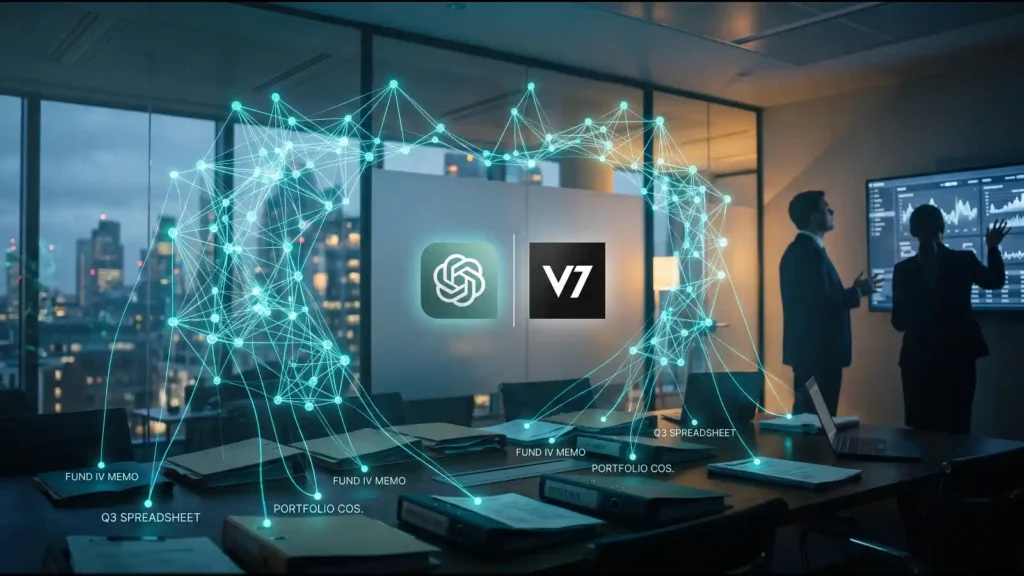
On September 21, 2026, OpenAI published a customer story on how London startup V7 gives agents institutional memory: a Context Graph that turns scattered company files into structured, source linked context. V7 runs it on GPT-5.6 models and says GPT-6 Astra scored 89% on its hardest test queries. Nearly every figure in the story was measured by V7 itself.
The pitch targets finance and insurance teams, where an agent that cannot tell which fund report is current is a liability. V7 picked the right problem, but the evidence for its fix is thinner than the post suggests.
By Alex Carter | Published September 21, 2026 | News date: September 21, 2026 (OpenAI's post carries the same date)
Quick Take
- What happened: OpenAI published a customer story on V7 Go, whose Context Graph gives agents institutional memory using entities and cited evidence extracted from company files.
- Who it affects: Finance and insurance teams weighing document agents, and anyone choosing between graph memory and long context.
- Why it matters now: V7 reports 89% for GPT-6 Astra on its hardest queries, but V7 built and ran that test.
How V7 Gives Agents Institutional Memory
According to OpenAI's post, V7 Go connects to repositories such as SharePoint and Google Drive and scans files for entities, relationships, facts and metrics. Each fact lands in a graph with a citation back to its original file. If the graph lacks an answer, V7 says the system falls back to searching the documents with RAG.
For long running agents, recent exchanges stay in the model's active context while older material moves into the graph. V7 says this graph is an order of magnitude cheaper and faster to traverse than long context approaches, but the post gives no figures.
Luna handles high volume extraction across millions of files, per the post, while Terra and Sol handle reasoning and tool use. V7 says it is only starting to use GPT-6 Astra, on its hardest Context Graph queries. Customers can query the graph from ChatGPT through V7's MCP server and create workflows from Codex.
Which Numbers Are Verified and Which Are V7's Own?
Every performance figure in the post comes from V7, published on OpenAI's site. OpenAI's own list of recent startup stories shows Legora on September 3, Fyxer on September 14 and Hex on September 16. I covered the Fyxer story, where independent reviews and security claims complicated OpenAI's version, so I read this one the same way.
Two details deserve a closer look. V7 says Luna cut cost per document by 78% against GPT-5.4 mini. OpenAI cut Luna's list price by 80% on July 30, 2026, to $0.20 per million input tokens and $1.20 per million output tokens, according to eesel AI's pricing tracker. The post does not say which price V7 measured against, and a tile showing 11.6 points higher Luna accuracy never names its baseline.
The other is HERB, a public benchmark from Salesforce researchers. Their EMNLP 2025 paper reported that the best agentic RAG methods averaged 32.96 out of 100. V7 says its retrieval only system beat the official baseline by 69% and cut hallucinations on unanswerable queries by 38%. It does not say whether 69% is relative or in points, and it gives no absolute score. The paper also says finance use would need domain experts to build accurate workflows. V7 sells into finance.
Why It Matters: Retrieval Is the Hard Part
My read is that V7 picked the right problem. The Salesforce paper names retrieval, not reasoning, as the main bottleneck, and a graph that keeps citations is what an auditor asks for. It also fits my reporting on the enterprise AI operations problem, where model routing, data quality and agent oversight are where projects break.
The evidence is the weak part. Astra's 89% comes from a test where V7 says it has only started using the model, and the customer results come from unnamed firms. Alberto Rizzoli, V7's CEO, says finance firms getting real value from AI will be "the ones with the best context." Whether V7 gives agents institutional memory that holds up outside its own tests is the open question.
What to Watch
Three things would move this from company claim to evidence. V7 could publish its absolute HERB score, the baseline it beat and its method. A named customer could report its own results. And someone independent could test the Context Graph, which I found no sign of as of September 21.
V7 also says it is working toward workflows that start when graph facts change, such as flagging analyses built on a restated fund report. No date was given, so treat that as unconfirmed roadmap.
Related BriefFlash coverage: Perplexity's GPT-6 Astra story
Key Takeaways
- Confirmed by OpenAI's post: V7 Go builds a Context Graph from company files, keeps citations to source documents, and exposes it through an MCP server.
- Company claim: GPT-6 Astra scored 89% and GPT-5.6 Sol 78% on the very hard tier of a graph query test that V7 designed and ran.
- Company claim: 99.9% accuracy on 50 to 100 step workflows, with accuracy undefined and no independent check found.
- Open question: V7's 78% Luna cost cut does not say whether it predates OpenAI's 80% Luna price cut on July 30, 2026.
FAQ
What are examples of agents?
In this story, the examples are V7 Go's workflow agents. One screens private equity deals by pulling key financials, deal terms, management details and risk fields from a Confidential Information Memorandum before drafting a screening note, per OpenAI's post. Others handle insurance underwriting and claims processing. The post says V7 keeps an auditable trail of every decision, and I found no independent review of that trail.
What is an agent in finance?
The term has two meanings. In traditional finance and law, an agent is a person or firm authorized to act for another party, called the principal, such as a broker. In AI coverage like this story, an agent is software that carries out multi step tasks with tools. V7's agents belong to the second group: they extract data, apply rules and draft outputs such as screening notes.
How do companies pay for AI agents like V7's?
V7 Go is sales led. The Rundown reports that price depends on platform access, users and document processing volume, and V7 publishes no standard monthly rate. The underlying models are metered per million tokens: OpenAI lists GPT-6 Astra at $10 input and $50 output, and independent trackers list Luna at $0.20 and $1.20 after the July 30 cut. The post does not say how those model costs feed into V7's pricing.