

The Agent-Editing World Model paper argues that LLM agents gain little from predicting what their tools will return when they can observe the real result. The arXiv preprint, titled Agent-Editing World Model: Rethinking World Modeling for LLM Agents, appeared in the wire BriefFlash received on September 24, 2026.
It is worth a reader’s time because agents are being handed longer, messier tasks, and the failure the paper names is easy to picture: stale plans and unsupported assumptions sitting in an agent’s running record. This is an abstract, not a results section, so what follows covers the problem the authors describe, not whether they solved it.
What does the Agent-Editing World Model paper say?
It questions what existing agent world models are trying to predict. According to the abstract, recent advances in large language models let agents tackle long horizon tasks across diverse environments, and existing language world models typically predict environment observations. Reconstructing high entropy, execution dependent tool responses, the authors argue, offers limited value when real feedback is available.
A world model, in plain terms, is a component that predicts what will happen in an environment. For an agent using tools, that can mean guessing what a tool will return. Those outputs depend on actually running something and vary a lot, which is why the abstract treats rebuilding them as poor value when the real output is on hand.
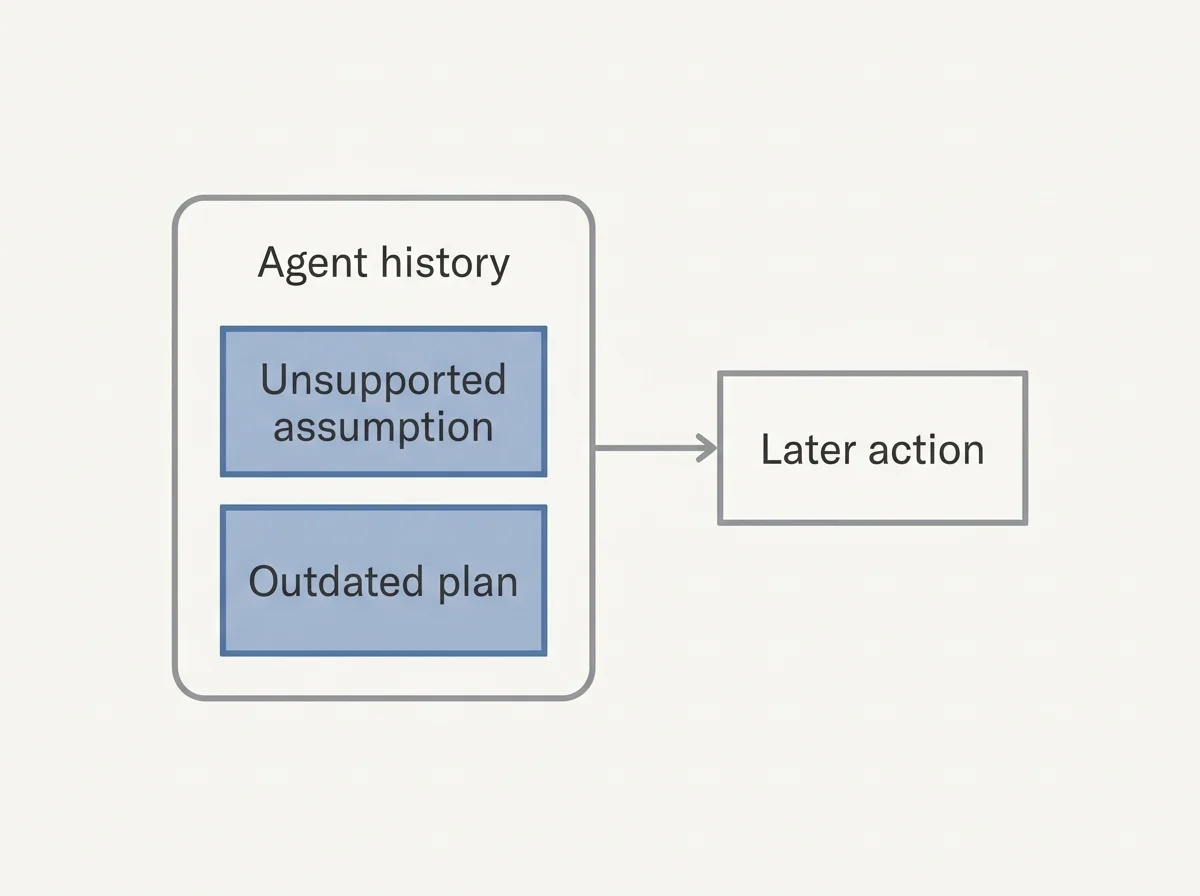
The abstract also names a second problem, task-state contamination: unsupported assumptions and outdated plans that persist in an agent’s history. On long horizon tasks, where early decisions carry forward and errors can compound, stale information in that record can be acted on later. The excerpt cuts off mid sentence after this point, so the paper’s response is not known.
The title carries a contrast worth noting. Predicting an observation and editing something are different ideas, but the excerpt does not say what the paper’s model edits, so BriefFlash does not guess. That answer sits in the full paper, not in the abstract available here.
What do the other three agent papers address?
They are separate works, and the wire does not say they share authors, methods or findings. Each is limited here to its abstract or title.
| Paper | What the excerpt addresses | Not shown in the wire |
|---|---|---|
| Agent-Editing World Model (arXiv 2609.28416) | Predicting tool responses; task-state contamination | Method and results |
| Semantics Delivery Network (arXiv 2609.22486) | Web retrieval for LLM agents, per the title | Anything beyond the title |
| Improving Constraint Models with LLM Agents (arXiv 2608.08127) | Solver runtime sensitivity to modeling choices | What the agents do; results |
| Trains but Doesn’t Learn (arXiv 2609.25237) | Post-training as a service; a delivery benchmark, per the title | Tasks and results |
The constraint programming paper starts from a practical point. Constraint Programming is a way of solving problems by stating the rules a solution must satisfy, and the abstract says solver runtime is highly sensitive to modeling choices such as symmetry breaking, implied constraints, global constraints, constraint reformulation and variable representation. Its excerpt cuts off mid sentence.
Post-training as a service (PTaaS) is the subject of the third paper. Per the abstract, a customer hands an operator data and a goal, and a forward-deployed engineer returns a fine-tuned, evaluated and deployed model under a budget, a human-approval gate and reproducibility requirements. That excerpt also cuts off mid sentence.
One more item, the web retrieval paper, reached BriefFlash through a Hacker News listing. The wire carries only its title, so this article says nothing about how it works.
Why does LLM agent research matter now?
BriefFlash’s monitoring shows LLM agents going from no mentions in the previous two weeks to 23 mentions across 5 sources, so readers are meeting the term before a clear explainer exists. Agents are also running outside the lab: BriefFlash has covered an OpenAI agent’s reported hack of an Australian health service and Gemini Call for Me on the Pixel 11, a consumer example of an agent acting for a user on a third party.
Reliability is the common concern. An agent that works through many steps needs to keep track of what it has actually confirmed, and a paper about stale assumptions in an agent’s history speaks to that directly, even before any results are published.
Taken together, and this is BriefFlash’s interpretation rather than anything the papers state, the four abstracts point to researchers working on how agents track state, how they get information, what tasks they can be handed and how they are delivered as a service.
What can a preprint abstract tell you?
It tells you the problem the authors chose, not that they solved it. All four papers are arXiv preprints, posted publicly before or without peer review, so the claims are the authors’ own and not yet independently validated.
An abstract can show what the authors consider limited about existing approaches, as this one does with predicted tool responses. It cannot show how large any improvement is, what tasks it was tested on or how it compares with other methods. No excerpt here contains a score or comparison, and three are cut off mid sentence.
The wire’s five sources are four different papers, one seen only as a Hacker News link, not five outlets confirming one event. That count says the topic is active, not that any claim has been checked.
What to watch next
Watch for the full paper’s method, any measured results against world models that predict observations, and independent commentary. None is in the coverage available so far. BriefFlash will note any update on this page with a date.
Frequently asked questions
What is the Agent-Editing World Model paper about?
It is an arXiv preprint whose abstract says existing language world models typically predict environment observations, yet reconstructing high entropy, execution dependent tool responses offers limited value when real feedback is available. It also names task-state contamination. The excerpt available ends mid sentence, so its method and results are unknown.
What is task-state contamination in LLM agents?
Task-state contamination is the Agent-Editing World Model abstract’s term for unsupported assumptions and outdated plans that persist in an LLM agent’s history. An agent that keeps stale information in its record can act on it later. The excerpt available gives no figure for how often this happens.
What is a world model for an LLM agent?
In this setting, a world model is a component that predicts what will happen in an environment. The Agent-Editing World Model abstract says existing language world models typically predict environment observations, such as tool responses, and questions the value of that when real feedback is available.
What is post-training as a service?
Post-training as a service (PTaaS) is the term used in the paper Trains but Doesn’t Learn. Per its abstract, a customer gives an operator data and a goal, and a forward-deployed engineer returns a fine-tuned, evaluated, deployed model under a budget, a human-approval gate and reproducibility requirements.
Are these arXiv papers peer reviewed, and do their results hold up?
The coverage available does not say they are. arXiv preprints are posted publicly before or without peer review, so their claims are the authors’ own and not yet independently validated. The excerpts here contain no results and no independent commentary or replication appears, so it is too early to say whether findings hold up.