
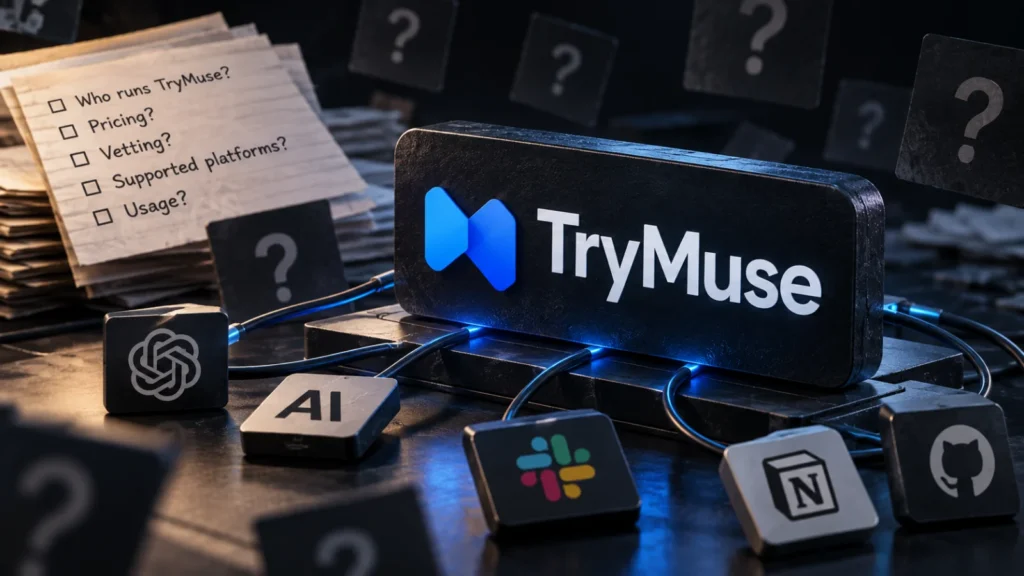
A submission on a developer discussion site points to TryMuse and invites builders to get an AI agent connector or integration discovered there. Going by that title alone, TryMuse presents itself as a place where connectors and integrations can be found.
The TryMuse AI agent connectors pitch matters because agents are only as useful as the software they can reach, and connectors are hard to find and hard to judge. The material available holds no pricing, ownership, vetting process or usage figures, so this is a pitch to evaluate, not a product to adopt.
What does TryMuse say it offers?
Discovery for AI agent connectors and integrations, and nothing beyond that. The only evidence is the title of one submission and a link to trymuse.com, and that title may be the submitter’s wording rather than TryMuse’s own.
The submission carries no engagement figures and no page text, and sitting in a list of newest submissions says nothing about adoption or quality. We cannot say who runs TryMuse or how it works, and we do not call it a marketplace, directory or registry, because the title says only that connectors can be discovered.
What is an AI agent connector, and why does finding one matter?
An AI agent connector, also called an integration, is the piece that lets an agent read from or act in another app or service. Agents act on a user’s behalf by calling other software, and each connector gives them access to one specific thing, such as a calendar, a CRM or a database.
Discovery is a problem on both sides. A builder with a good connector gains little if nobody finds it, and connectors sit scattered across code repositories and vendor pages. A user faces the reverse: many options, unclear maintenance and unclear security.
For a small team building an agent integration, the consequence is practical: distribution is part of the product, so where to publish is a real decision. For a team adopting agents, the same gap means more time spent hunting for connectors and vetting them by hand. We think that makes any service pitching itself as the answer worth examining, though one submission does not show TryMuse is succeeding.
App stores, extension stores and package registries solve a similar problem for other software. Those are analogies only; nothing in the material says TryMuse works like any of them. This section is general background and BriefFlash analysis, not a finding about TryMuse.
What does the TryMuse AI agent connectors pitch leave unanswered?
Nearly everything a builder would need to decide. The comparison below sets the little that is stated against what is not.
What we do not know yet is broad. We do not know who operates TryMuse, whether listing is free, how listings are ranked, which agent platforms or connector standards it works with, or whether anyone uses it. No launch information, funding, partners or usage figures appear in the material either.
Many discovery services start with large claims and little traction, but nothing here lets us say where TryMuse falls. A missing answer is a reason to ask, not evidence of a problem.
How can builders judge a connector discovery platform?
Ask five questions before listing anything, and put the same ones to any service.
- Who runs it? An identifiable operator shows who is accountable if a listing goes wrong.
- How are listings vetted? Review matters most when a connector can touch accounts and data.
- What does it cost? That includes whether listing is free and how listings are ranked.
- Which agent platforms does it support? A connector helps only where agents can use it.
- What traction does it show? Usage, partners and a track record separate a pitch from a place people rely on.
For TryMuse, the material answers none of the five. That is the most useful thing we can say on this little evidence.
Is it safe to give an agent access through a third-party connector?
Not automatically, and it depends on who vets what is listed. A connector can give an agent access to accounts and data, so a platform that lists connectors takes on a trust role. The material does not say whether or how TryMuse reviews listings.
Until that is stated, treat any connector found through a discovery service as unreviewed. Check who maintains it, what access it asks for and whether that access can be limited.
What should builders and users do next?
Builders deciding where to publish should read TryMuse’s own site, the only source for what TryMuse says about itself, and look for answers to the five questions before investing effort. Users should hold off connecting anything that touches real accounts until vetting is described.
Related ground is covered in our reporting on AI agents being blocked by websites, which looks at how agents get access to outside services at all, and on a model positioned for subagent work, the model-side view of the same ecosystem. For a different case of integrations meeting agent tooling, see Vercel Marketplace integrations installing agent skills automatically.
Frequently asked questions
What is an AI agent connector?
An AI agent connector, also called an integration, is the piece that lets an agent read from or act in another app or service, such as a calendar, a CRM or a database. Agents act on a user’s behalf by calling other software, and the connector is what gives them access to each specific tool.
Why does it matter where connectors are discovered?
Builders need their connectors found, or good work goes unused. Users need to know which connectors are maintained and safe, and options are scattered across repositories and vendor pages. A discovery service can help both groups, but only if it explains who runs it and how listings are checked. That is general analysis, not a finding about any one service.
Is it free to list a connector on TryMuse?
The material available does not say. A submission pointing to TryMuse invites builders to get connectors discovered there, but it carries no pricing, no mention of whether listing is free and nothing on how listings are ranked. Check TryMuse’s own site for current terms before investing time in a listing.
How can builders judge a connector discovery platform?
Ask five questions: who runs it, how listings are vetted, what it costs, which agent platforms it supports and what traction it shows. An identifiable operator, a described review process, clear terms, relevant platform support and visible usage are all reasonable signs. Missing answers are a reason to ask, not proof of a problem.
Is it safe to give an agent access through a third-party connector?
Not automatically. A connector can give an agent access to accounts and data, so who vets a listing matters. Treat a connector found through any discovery service as unreviewed until you know who maintains it, what access it asks for and whether that access can be limited. Whether TryMuse vets listings is not stated in the material.