
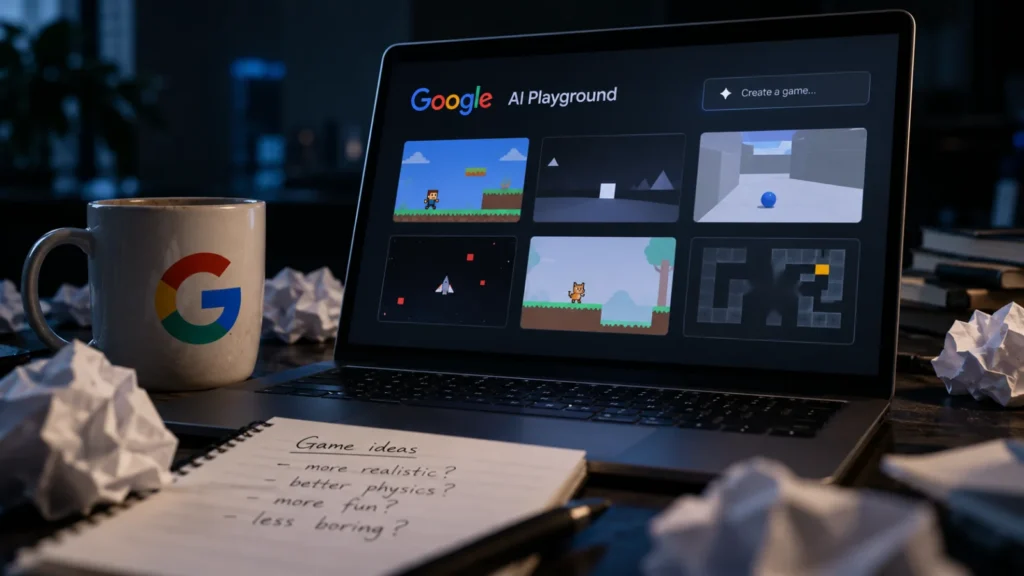
A writer who spent a long day making Google AI Playground games came away calling them terrible, according to a first-person account published on 2026-10-11. The account reportedly frames the output as video game slop, a label commonly applied to low-quality, mass-produced generative content.
Tools that promise a playable game from a prompt appeal to hobbyists, students and small studios, so a bad hands-on result works as a reality check on the distance between pitch and product, even when it comes from one writer on one day. BriefFlash has not tested the tool, and the material available to us does not say which model sits behind it, what the games were or what terrible meant in practice. This piece uses the account to set out how anyone should judge AI-generated games.
What was reported about the Google AI Playground games?
Very little beyond the verdict. A writer spent a long day making games with Google’s AI Playground, and an account published on 2026-10-11 reportedly judges the results terrible. That is a quality statement from one person, not a description of what the games did or where they failed.
Everything else is absent from the material available here: the model behind the tool, how many games were attempted, the prompts, whether the games ran, the price, who can use it, and any response from Google. BriefFlash will not guess at those, and readers should not either.
The gap matters because the verdict is the only fixed point. Without details, a reader cannot tell whether the tool failed, the prompts were weak, or the expectations did not match what the tool is designed to do.
What does terrible mean for an AI-made game?
It can mean at least four different things, and they matter to different people. A broken game and an ugly one are both disappointing, but only one stops you from playing.
| Kind of failure | What a player or creator sees | Who it hurts most |
|---|---|---|
| Broken | The game does not run, or a core rule fails | Anyone who needs a playable result |
| Incoherent | It runs, but rules, visuals and goals do not fit together | Creators who want a finished idea |
| Dull | It works and makes sense, but is not fun | Anyone building for an audience |
| Ugly | It plays acceptably but looks poor | Less of a problem for quick prototypes |
The account as relayed does not say which of these applied. That is the most important missing detail, because the sensible response to a broken game (try another tool) differs from the sensible response to a dull one (rethink the idea). These four categories are our framework, not findings from the account.
Why are generated games harder to get right than other AI output?
A game has to keep rules, state and interaction consistent while someone plays it, so a flaw anywhere shows up as a failure in play. A generated image or paragraph only has to look or read plausibly. An odd detail in a picture may pass unnoticed; a scoring rule that contradicts the goal will not.
This is BriefFlash analysis, not something the account reports, and we hold it with moderate confidence. It would explain why a tool that handles static content well could still produce disappointing games, but it cannot tell us whether that happened here.
How much should one hands-on test count?
One test is a data point, not a verdict on the tool. The account covers one writer, one day and an unknown number of games, and it has not been reproduced. A poor result can reflect prompts or expectations as much as the product, and early tools often improve quickly, so a verdict tied to one date may not hold later.
A fairer test would include:
- Several prompts of varying difficulty, from a simple arcade idea to a game with multiple rules
- Success criteria written down before the first run
- Repeat runs of the same prompt, to see how much results vary
- The same prompts tried on other AI game tools
We would weight repeat runs most heavily. A tool that produces a good game occasionally is a different product from one that does so reliably.
What should you do before trying an AI game tool yourself?
Decide what you need first: a throwaway prototype, a classroom exercise or something you intend to show others. That choice sets how much failure you can tolerate. Then run a small test with a simple idea, keep the prompts, and note what you could not fix by editing, since editability decides whether a flawed first draft is salvageable.
What we do not know yet: which model powers the tool, its pricing and availability, how Google describes its intended use, and whether other writers get similar results. Until independent hands-on accounts or details from Google appear, the reported verdict is best read as a caution, not a ruling.
Frequently asked questions
What is Google’s AI Playground?
The material available to BriefFlash identifies it only by name, so we cannot say which model powers it, what it costs or who can use it. What has been reported is that a writer used it for a long day to make games and judged the results terrible. Check Google’s own product pages for current details.
Can AI make a playable game from a prompt?
Tools that promise this exist, but this account does not settle whether they deliver. It reportedly records a negative result from one writer and does not say whether the games ran. A game needs rules, state and interaction to agree, which is harder than producing a plausible image or paragraph, so uneven results would not be surprising.
How should I judge an AI game tool before using it?
Check four things: whether the game runs, whether its rules, visuals and goals fit together, whether you can edit it when something is wrong, and whether the same prompt gives similar results on repeat runs. Write your success criteria before the first test, and try at least one other tool on the same prompt.
Is one bad review enough to write a tool off?
No. One review reflects one person’s prompts, expectations and day, and it has not been reproduced. It is a useful warning, particularly when it matches your own use case, but early tools can change quickly. Treat it as a reason to run a small test yourself rather than as a final ruling.