
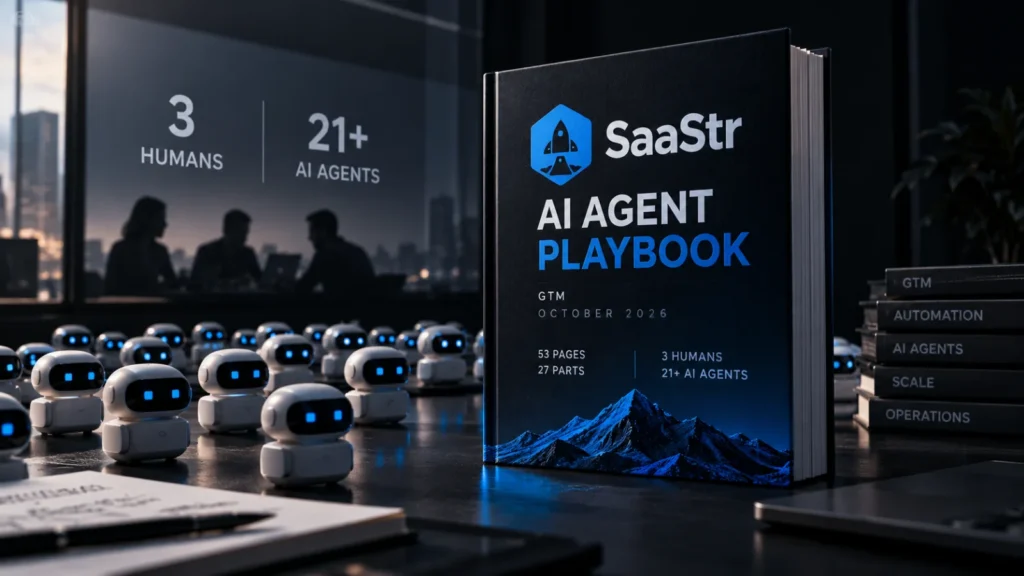
The October 2026 edition of the SaaStr AI Agent Playbook for GTM is out. SaaStr says the guide runs 53 pages across 27 parts and is based on running SaaStr with 3 humans and 21+ AI agents in production.
Those figures are SaaStr’s own, and the announcement carries no revenue, cost or results data to test them against. That limits what a reader can conclude: the headcount describes how the work is staffed, not whether the work is going well.
What does the SaaStr AI Agent Playbook contain?
It is a 53-page guide in 27 parts, and SaaStr describes it as a near-total refresh for readers who only know the June version. This is an update, not a debut. SaaStr says the new edition folds in material from SaaStr AI Annual 2026, recent episodes of The Agents, the ICONIQ 2026 GTM benchmarks and conversations with operators using agents at scale.
SaaStr also says the playbook holds every number, every mistake and every framework from running the operation this way. That is the company’s description of its own product. The announcement text is partly cut off, so BriefFlash is not describing anything beyond its opening, and the ICONIQ benchmarks are named but not characterized here.
What is GTM, and what does an AI agent do in it?
GTM stands for go-to-market: the sales, marketing and customer success work a software company does to win and keep customers. In this setting an AI agent usually means software that carries out a recurring task, such as outreach, qualification or support, with some autonomy.
Definitions vary widely. One team’s agent may be a single prompt, while another’s is a multi-step system. A count of agents therefore means little until you know which kind is being counted, and the announcement does not say how SaaStr counts.
What can 3 humans and 21+ AI agents actually prove?
On its own, very little: it is a ratio, not a result. Taken at face value, 21+ agents across 3 humans is at least 7 agents per person, but that is arithmetic, not a measure of output.
The table sets each part of SaaStr’s wording against what it leaves open.
| SaaStr’s wording | What it suggests | What it leaves open |
|---|---|---|
| 3 humans | A small permanent staff | Whether contractors, vendors or the people who build and maintain the agents are counted |
| 21+ agents | Many automated workflows | How an agent is counted, whether 21+ is a floor, and over what period it was reached |
| In production | The agents are live, not demos | What tasks they handle and which remain with the humans |
| Every number, mistake and framework | Full disclosure | What was selected for inclusion, and why no revenue, cost or results figures appear in the announcement |
We think the missing denominator is the bigger gap. Without revenue, cost or results, 3 and 21+ describe the shape of the operation, not its outcome. A reader cannot tell from the announcement whether the agents save money, win customers or simply add activity.
Why does it matter that SaaStr is describing itself?
Because the publisher is also the subject, and it has reasons to present the operation well. SaaStr is a SaaS-focused community, content and events brand, and the playbook sits alongside its events and shows, so it also serves as promotion. That does not make the claims false. It means they arrive without independent verification.
Transfer is a second problem. One organization’s operating model does not carry over automatically to a team with different customers, sales cycles or volume. A playbook promising every mistake may still be selective about what it includes, and a headcount of 3 may leave out contractors, vendors or the effort of building and maintaining the agents.
Customer-facing agents also carry risks beyond cost. Our guide to what to check before adding an AI agent to text messages covers one deployment, and a report of an AI model sending a false tip to police shows what can go wrong when agents act with real-world consequences.
What should a team ask before copying the setup?
Ask for the missing numbers before changing any staffing plan. These six questions would close most of the gaps:
- What does each agent do, and which tasks stay with a human?
- How is an agent counted: a single prompt or a multi-step system?
- Who builds and maintains the agents, and are they in the headcount?
- What does the setup cost, including tools and vendors?
- What outcome was measured, over what period, and by whom?
- How do our customers, sales cycle and volume differ from SaaStr’s?
What do we not know yet?
The announcement leaves these points open, and BriefFlash has not been able to fill them in:
- What the 21+ agents do, and whether 21+ is a floor or a changing number
- Whether the playbook is free or paid, and who it is aimed at
- What the ICONIQ 2026 GTM benchmarks say
- Any revenue, pipeline, cost-per-agent or productivity figure
- Any independent check of the operating claims
If SaaStr or an independent party publishes revenue, cost or per-agent figures, the claim becomes testable. Until then it is a description of a setup, not evidence that the setup works.
Frequently asked questions
What is the SaaStr AI Agent Playbook?
The SaaStr AI Agent Playbook is a guide for go-to-market teams from SaaStr. The October 2026 edition runs 53 pages across 27 parts and is an update to a June version. SaaStr says it is based on running SaaStr with 3 humans and 21+ AI agents in production. The announcement does not say whether it is free or paid.
What does GTM mean?
GTM stands for go-to-market. It covers the sales, marketing and customer success work a software company does to win and keep customers. In the context of the SaaStr AI Agent Playbook, GTM agents are software that carries out recurring tasks such as outreach, qualification or support with some autonomy, though definitions vary.
Is it realistic to run a company function on 3 humans and 21+ agents?
SaaStr’s announcement cannot settle that. SaaStr says it runs this way, but it gives no revenue, cost or results data, does not say what the agents do, and does not say how an agent is counted. The claim is a starting point for questions, not proof that a go-to-market team can be replaced.
What should a team ask before copying this setup?
Ask what each agent does, how an agent is counted, who builds and maintains them, what the setup costs, and which outcome was measured over what period. Then compare SaaStr’s customers, sales cycle and volume with your own, since one organization’s operating model does not transfer automatically.