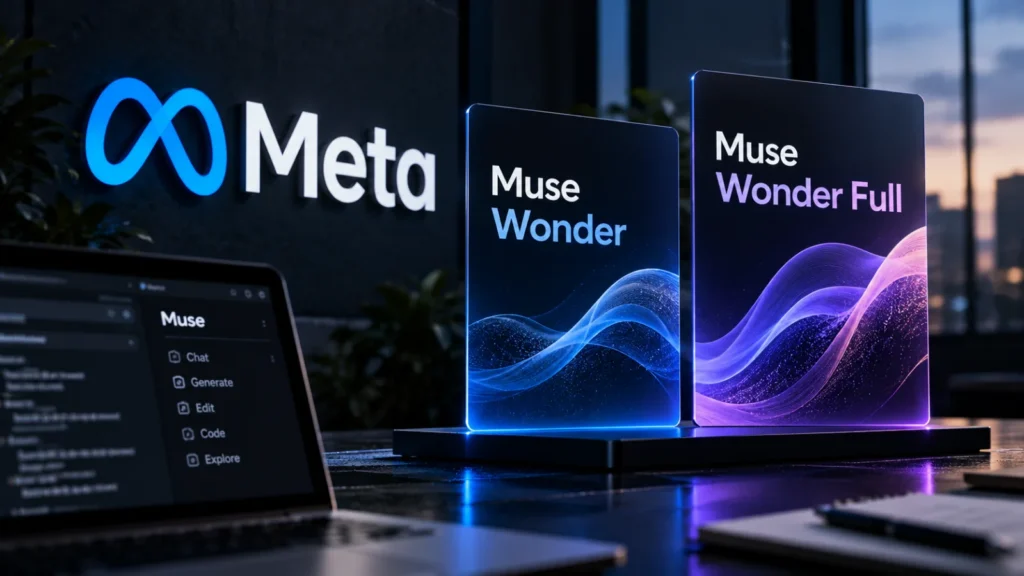
Meta released two models on 12 October 2026, Muse Wonder and Muse Wonder Full. Meta says both are available to Muse Code subscribers starting today, and that Wonder can also be reached through the Meta Model API.
The Meta Muse Wonder launch comes with a large capability claim and no figures behind it. Meta says the models can compete with the industry’s best and are larger and more capable than the earlier Muse Spark, but no benchmark names, scores, prices or license terms are in hand, and no independent evaluation has been seen.
What did Meta release, and who can use the models today?
Muse Code subscribers can use both models today, according to Meta. Meta also says Wonder is reachable through the Meta Model API; it has not said whether Wonder Full is, so we are not assuming it. Meta’s announcement post drew more than 200 points on a developer news aggregator, which measures interest, not quality.
Four similar names now sit in Meta’s Muse lineup. Here is how they differ on what has been stated.
| Name | What it is | Access stated so far |
|---|---|---|
| Muse Spark | First model from Meta’s revamped Superintelligence Labs; lightweight, aimed at low latency | See our earlier coverage of its developer rollout |
| Muse agent | Meta’s AI agent, launched separately from Spark | Meta says it eventually plans to power it with Wonder |
| Muse Wonder | Larger than Spark and said to be more capable | Muse Code subscribers today; Meta Model API, per Meta |
| Muse Wonder Full | Second new model; how it differs from Wonder is not explained | Muse Code subscribers today; API access not stated |
The gaps matter as much as the entries. Nothing available explains what separates Wonder from Wonder Full, whether size, price, speed, context or access tier, so the word Full should not be read as larger or better.
How is Muse Wonder different from Muse Spark?
Wonder is larger and said to be more capable, while Spark was built to be lightweight and fast. Spark was the first model from Meta’s revamped Superintelligence Labs division and was aimed at low latency. Wonder reportedly posts higher benchmark scores and better results on complex tasks such as coding, though that account names no benchmarks and gives no scores.
Larger does not automatically mean better for a given workload. Bigger models tend to cost more and respond more slowly, and Meta has published neither price nor latency figures. Because Spark is deliberately small, beating it is not evidence of parity with rival flagships.
Labels also differ across coverage. One report calls Wonder Meta’s first frontier model, while Spark is described as the first model from Superintelligence Labs. The two fit together only if frontier means top tier, so we treat it as a positioning term, not a specification, and we do not call Wonder Meta’s first model.
What does the Meta Muse Wonder launch confirm, and what is only a claim?
The launch establishes availability and Meta’s intentions; it does not establish performance. Meta states that the models exist, that Muse Code subscribers can use them, that Wonder is on the Meta Model API and that the Muse agent will eventually run on Wonder. Everything about capability traces back to Meta’s own framing.
Three claims need evidence. Meta says the models can compete with the industry’s best, but no rival model or benchmark is named, so the claim cannot be tested. The higher scores and coding gains rest on one report and arrive without numbers. Meta’s biggest model also reportedly includes new features meant to keep agents from going off the rails; they are not described, and nobody says how they were tested.
Vendor benchmark scores need independent reproduction before they settle a comparison, because test conditions, comparison sets and tool access can all change a result.
What we do not know yet:
- Pricing for Muse Code, the Meta Model API and per-token use
- License and weight availability, so the models cannot be called open source or open weight
- Context window, supported modalities, and latency or hardware figures
- Benchmark names, scores and comparison models
- How Wonder differs from Wonder Full, and whether Wonder Full is on the API
- How the agent safeguards work and how they were tested
- Any independent evaluation
Why does the plan to power the Muse agent with Wonder matter?
It ties a model release to a consumer product that is already under scrutiny. Meta says it eventually plans to power the Muse agent with Wonder. No timeline is in hand, and nothing says what changes for existing agent users when the switch happens.
The agent already carries unresolved questions. We have covered the Muse agent privacy dispute and Meta’s defense of the Muse agent’s sexual content, a separate story from today. We are not claiming Wonder will change either. Our narrower view is that the model underneath an agent shapes much of what it says, so the switch is a natural point to ask Meta to describe the agent’s behavior and safeguards.
Who should test Muse Wonder first, and what should they check?
Muse Code subscribers and developers with API access can act now. Subscribers can try both models today. Developers can reach Wonder through the Meta Model API, according to Meta, which matters because subscription access suits individual use while API access lets a team build the model into its own products.
We would test on your own tasks before trusting any ranking. Compare response time and cost against a lighter model you already use, such as Muse Spark, which we covered in Muse Spark 1.2 on Vercel AI Gateway. Hold off on moving production traffic until pricing and license terms are published.
What to watch next
Five items would settle most open questions: benchmark names and scores with named comparison models, pricing, license terms, an explanation of how Wonder Full differs, and independent testing. Meta has given no date for moving the Muse agent onto Wonder in the material we hold.
Frequently asked questions
Who can use Muse Wonder today?
Muse Code subscribers can use both Muse Wonder and Muse Wonder Full starting 12 October 2026, according to Meta. Meta also says Muse Wonder can be accessed through the Meta Model API. It has not stated whether Muse Wonder Full is available through the API, and no pricing has been published in the material available.
What is the difference between Muse Wonder and Muse Wonder Full?
Meta has not explained it in the material available. Nothing states whether Muse Wonder Full differs from Muse Wonder in size, price, speed, context window or access tier, so it should not be assumed larger or better. Both are available to Muse Code subscribers, while API access has been stated for Wonder only.
How is Wonder different from Muse Spark?
Muse Spark was the first model from Meta’s revamped Superintelligence Labs and was aimed at being lightweight with low latency. The Wonder models are larger and said to be more capable, and reportedly score higher on benchmarks and coding tasks. No scores have been published, so the size of any gap is unknown.
Is Muse Wonder open source or open weight?
Not on current evidence. No license or weight availability has been stated, so Muse Wonder cannot be called open source or open weight. The access described so far is a Muse Code subscription and, for Wonder, the Meta Model API. Developers should wait for published license terms before assuming anything more.
Will Muse Wonder change the Muse agent?
Meta says it eventually plans to power the Muse agent with Wonder, but no date has been given and nothing explains what would change for users. Whether the agent’s behavior shifts is unknown. The switch is a reasonable moment to ask Meta how the agent is meant to behave and which safeguards apply.