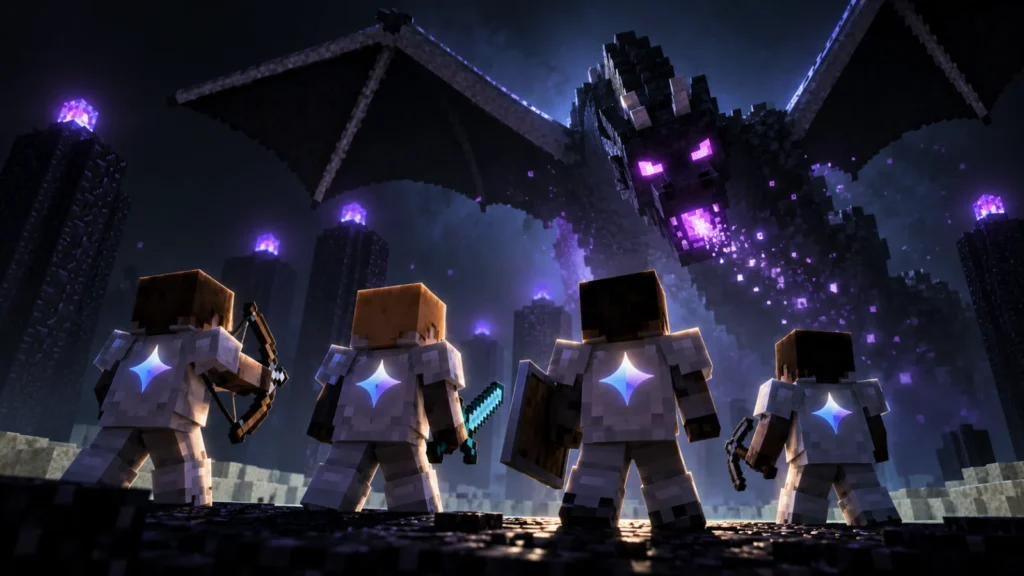
A new paper reports that a team of four Gemini 4 Argon agents beat Minecraft, with defeating the Ender Dragon as the goal. The authors placed the agents in a sandboxed survival world and gave them that single objective.
The notable part, according to the paper, is what the researchers left out. No one assigned roles or wrote game logic, and the agents planned, wrote and debugged every program themselves. Every claim here comes from the authors, and none has been independently reproduced.
What the Gemini 4 Argon Minecraft setup actually involved
Four agents shared one world and one objective, according to the paper. Each controlled a player through Mineflayer, an open-source library, and the four coordinated with each other through in-game chat and shared memory.
The researchers could watch the run on a live dashboard and pause or stop it at any time. The abstract text we have breaks off just as it addresses whether they needed to, so BriefFlash is not reporting that humans never intervened.
Which part is the model, which is the library, and which is the claim?
Three separate things sit under the headline, and it is easy to blur them. The model is Gemini 4 Argon, whose name places it in Google’s Gemini family. Beyond the name, BriefFlash has no description of how it differs from other Gemini models. For how Google’s models reach developers, see earlier BriefFlash coverage of Gemini models.
| Component | What it is | What the paper says |
|---|---|---|
| Gemini 4 Argon | The model behind the agents | Four agents, one goal |
| Mineflayer | An open-source library for controlling Minecraft players with code | Each agent controlled a player through it |
| Chat and shared memory | Coordination channels | Agents coordinated through both |
| Live dashboard | A view for the researchers | They could pause or stop the run at any time |
The ‘open source’ label belongs to Mineflayer. Nothing in the available text says the Gemini model is open source or open weight. The third item, the claim that a team beat the game, comes from the paper’s title, and the abstract excerpt states the goal rather than the details of the outcome.
Why no assigned roles and no game logic is the detail to watch
Removing human scaffolding is what separates this from a scripted demo. The Ender Dragon is Minecraft’s final boss, reached only after a long chain of survival tasks, so a run that ends there needs sustained planning. Earlier research has used language-model agents in Minecraft, including single-agent systems that write their own code. What this paper adds, as described, is four agents doing it together without a human dividing the work.
Our reading: the coordination is the novelty, but the available text does not show that it was necessary. Whether four agents beat one is a comparison the abstract does not give. Without it, the result shows that a team can finish the game, not that a team is better.
What we do not know yet
The abstract leaves several questions open. No score is reported in the available text either, so this should not be read as a benchmark result.
- How many runs were attempted, and whether the success came from one run or many
- How long the successful run took
- The cost, compute or token usage
- Failure cases and how the agents recovered from them
- How a single-agent setup would have performed
- Whether anyone independent can reproduce the result
What does this mean for people building agents?
It is evidence for a design pattern, not proof of reliability. Agents that plan, write code, debug it and coordinate through shared memory resemble the structure of many current agent products. A game offers a clear finish line, which makes success easy to check. Real tasks often lack one, so a Minecraft win says little about unattended work elsewhere. Teams weighing an agent for a real workflow can start with what to check before adding an agent.
For a sense of how widely the Gemini family is used, see BriefFlash’s report on the Gemini app’s user growth.
What to watch next
The next signal is independent reproduction, along with any release of run counts, duration and cost. Until those appear, treat the result as one paper’s account of one game.
Frequently asked questions
What is the Gemini 4 Argon Minecraft experiment?
It is a paper in which four Gemini 4 Argon agents were placed in a sandboxed Minecraft survival world with one goal: defeat the Ender Dragon. The paper, titled ‘A team of Gemini 4 Argon agents beats Minecraft’, says the agents controlled players through Mineflayer and coordinated through in-game chat and shared memory.
Did humans help the Gemini 4 Argon agents?
According to the paper, no one assigned roles or wrote game logic, and the agents planned, wrote and debugged every program themselves. Researchers could watch a live dashboard and pause or stop the run at any time. The available abstract text is cut off before it says whether they intervened, so that point is unconfirmed.
What is Mineflayer?
Mineflayer is an open-source library for controlling Minecraft players with code. In this paper, each of the four agents controlled its player through it. The open-source label applies to the library, not to the Gemini 4 Argon model, which the available text does not describe as open source or open weight.
Does this show AI agents can run long tasks reliably?
No. The result comes from the authors’ own paper, has not been independently reproduced, and the available text does not give the number of runs, time taken or cost. A game with a clear finish line is also easier to judge than most real work, so it does not establish reliability elsewhere.