
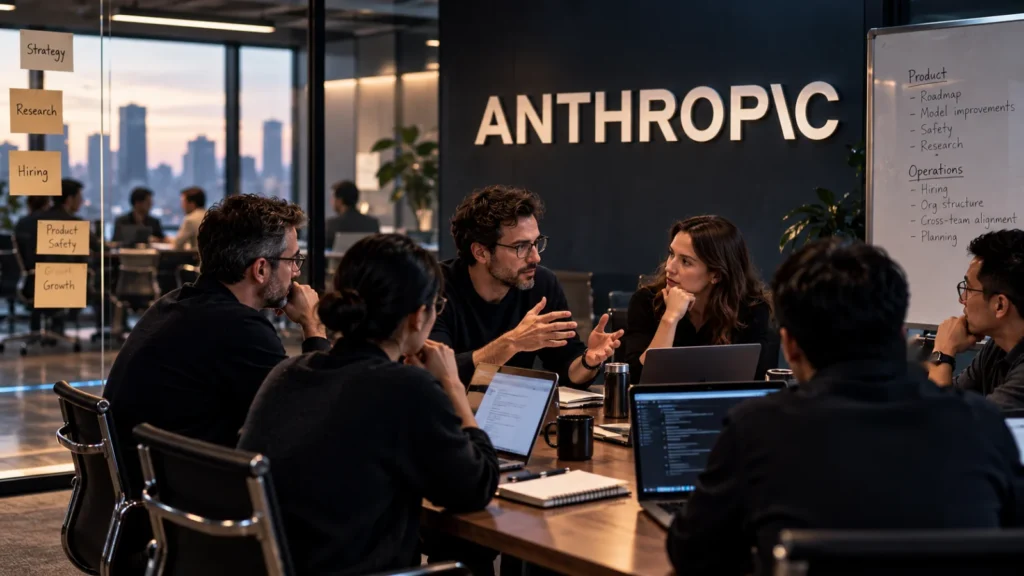
Anthropic says its workforce has become less junior and is spending more time in meetings, according to a report of the company’s own description. It reportedly characterizes the composition of its workforce and the type of work getting done as having changed significantly over the past year.
The stakes are interpretive. The Anthropic workforce less junior claim feeds a wider debate about AI and entry-level jobs, and about how labs run as they scale. But the statement as reported gives no numbers and no cause, so this piece treats it as a signal to test, not a finding to repeat.
What does the Anthropic workforce less junior statement actually say?
The statement, as reported, contains two specific claims and one general framing. The claims are that the workforce has become less junior and that it is spending more time in meetings. The framing is that the composition of the workforce and the type of work have changed significantly in the past year.
That is the full extent of the material available to BriefFlash. It reaches us through a single report, and we have not seen the underlying document. There is no headcount, no seniority percentage, no figure for meeting time and no definition of what counts as junior.
The headline bundles three separate things: the seniority mix, the kind of work, and the time spent in meetings. The first and third are stated directly. The second is asserted only in general terms, with no example of what the work looked like a year ago or now. Placing the claims side by side also does not show that one caused another.
Why are seniority mix and meeting time worth watching?
Both are common markers of an organization changing shape, which is why they deserve attention even without numbers. This is BriefFlash context, not an explanation Anthropic gave. Companies that scale often add managers and senior specialists, and coordination work such as meetings tends to rise with size.
Read that way, a more senior workforce spending more time in meetings could describe a lab moving past its early, build-first phase. We hold that reading loosely, because the premise is general and the statement supplies nothing specific to test it against.
A workforce can also become less junior in at least three ways, and each would appear differently in data Anthropic has not released.
| Possible explanation | What it would mean | What would show it |
|---|---|---|
| Hiring more senior people | New hires skew experienced while junior hiring holds steady | Seniority mix of new hires over the past year |
| Promotions | Existing junior staff move up, so the same people count as more senior | Promotion rates and average tenure |
| Fewer junior hires | The company brings in fewer early-career staff than before | Junior hires counted year on year |
Which one applies matters. The first and third describe a change in who the company brings in; the second describes a change in who it already has.
Is the shift connected to AI replacing junior work?
The available material does not say so, and BriefFlash is not drawing that connection. Whether AI tools reduce demand for entry-level work is a widely debated question, and a statement from a leading AI developer about its own staffing will naturally be read through it. Yet a less junior workforce can come from hiring choices or growth with no AI involvement at all.
Anthropic is the maker of Claude, and BriefFlash has covered its product side, such as the Claude Sonnet 5.5 launch, and its research, including an Anthropic researcher showing Claude automating its own alignment training. Nothing in the material at hand links either to staffing, so we treat them as background on the company, not evidence for this story.
Settling the question would take specific numbers: junior hiring over time, set against total hiring and overall growth, plus some account of which tasks changed.
Who is affected if the reported shift is real?
Early-career job seekers and hiring managers elsewhere have the most to learn, though the evidence cannot yet say what they should conclude. If the change reflects fewer junior hires, applicants to AI labs face a narrower entry route. If it reflects growth and promotions, it is the ordinary life cycle of a scaling company. The statement does not distinguish between them.
For business readers, the more useful point is about method. A company’s description of its own workforce is a claim, not a dataset, and no comparison with other AI labs or software companies is available. Whether peers show the same pattern is unknown.
What we do not know yet
The reported statement leaves most of the questions that would give it meaning unanswered.
- Total headcount and how it changed over the past year
- The share of staff Anthropic counts as junior, then and now
- How many hours or what share of time goes to meetings
- How Anthropic defines ‘junior’ and which teams the change covers
- What ‘type of work’ changed, and how
- Whether the cause is hiring choices, promotions, growth or AI tools
- How any of this compares with other AI labs or software companies
What to watch next
The first thing to watch is whether Anthropic publishes the figures or the document behind the statement: seniority shares, headcount, meeting time and a definition of junior. The second is any comparison with other labs or software firms. Until then, this is one company’s self-description. Its other news today, a reported pitch of its own AI safety bill to lawmakers, is a separate matter.
Frequently asked questions
What did Anthropic say about its workforce?
According to a report of the company’s statement, Anthropic says its workforce has become less junior and is spending more time in meetings. It also describes the composition of its workforce and the type of work getting done as having changed significantly over the past year. No figures, definitions or causes were available.
Does this mean Anthropic is hiring fewer junior people?
Not necessarily. A workforce can become less junior because a company hires more senior people, promotes existing staff, or hires fewer junior people. The statement as reported does not say which, and no headcount or seniority figures are available, so the available material cannot distinguish between them.
Is Anthropic’s workforce change caused by AI?
The available material does not say so. Anthropic’s statement, as reported, describes a shift in seniority and in time spent in meetings, but it gives no cause. Any link to AI tools replacing junior tasks would be speculation, and BriefFlash is not drawing one.
Why does time spent in meetings matter in this story?
Meeting time is a rough indicator of coordination work, which tends to grow as companies get larger. In BriefFlash’s reading, more meetings alongside a more senior workforce is consistent with an organization maturing, but Anthropic has not given that explanation, and no hours or comparisons are available.