
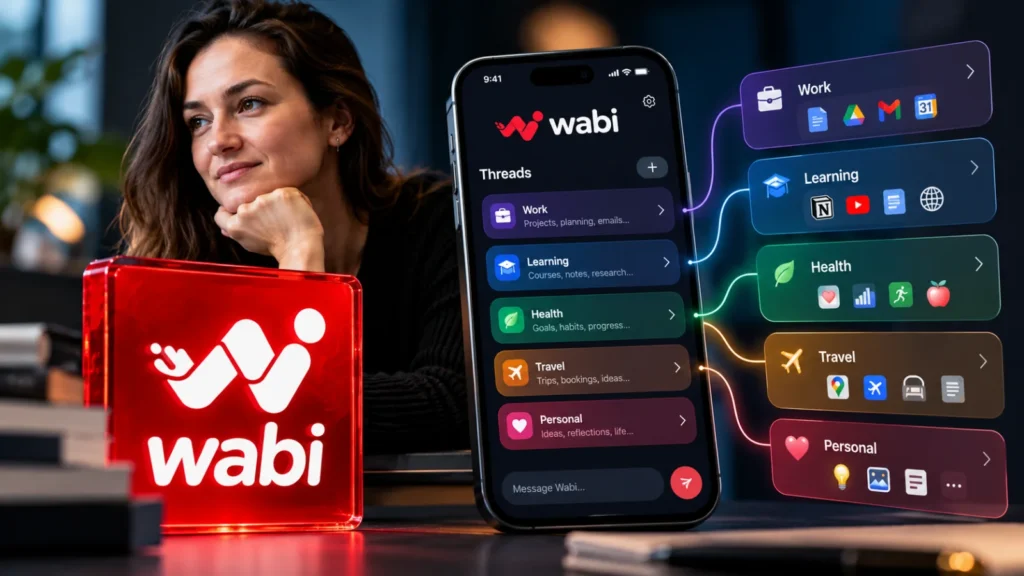
Eugenia Kuyda, the founder of Replika, officially launched the Wabi AI assistant for all users on Monday, October 19, 2026. According to TechCrunch’s exclusive interview with Kuyda, the product works like a messenger app, with separate agentic threads for different tasks and long-term goals rather than one continuous conversation.
Kuyda argues that single-thread assistants get worse as context piles up, and that separate threads avoid the problem. Wabi is free for now, has no settled business model, and is in talks to raise more funds.
What is the Wabi AI assistant, and what changed in 2.0?
Wabi 2.0 is a multi-thread AI assistant organized like a messenger app. Each thread is dedicated to a task or goal, and users can build and use custom apps inside it. TechCrunch gives two examples from the company: a weight-loss tracker in a health thread and an app showing nearby children’s events in a family thread.
The agent now decides which apps to build. Once connected to a user’s email, it automatically creates a number of starting threads and apps, per Kuyda. The earlier version, covered by TechCrunch last year alongside a $20 million pre-seed round, was a social platform where users made mini apps from prompts and shared them. TechCrunch calls the launch a pivot; Kuyda describes it as more of an evolution.
Kuyda left as CEO of Replika last year, 2025, and founded Wabi. Replika, a popular AI chatbot companion company, grew out of Luka, whose first product was IO, a lifestyle concierge chatbot. TechCrunch notes she pitched it at Disrupt 12 years ago.
Do separate threads fix the problem Kuyda describes?
In an assistant built around one conversation, every request lands in a single running history. Wabi splits that history by purpose, so each thread carries its own task or goal and its own apps. Speaking to TechCrunch, Kuyda made the case against single-thread assistants such as Instinct and Muse this way:
Single thread experiences, if you think about it, get worse over time because it’s just so much context in one endless conversation.
TechCrunch adds that, according to interviews with AI researchers it does not name, longer chatbot conversations make hallucination and loss of context more likely. That supports one half of the argument. It does not show that splitting work into threads solves the problem, and nothing in the source reporting compares the two designs.
We think the evidence worth waiting for is a side-by-side test: the same long-running tasks, run over months, in a threaded assistant and a single-conversation one.
Is it safe to share email, calendar and bank details in a Wabi thread?
That cannot be established from the available reporting. Threads can be shared like group chats, and within one, users choose how much to share, from email and calendar data to bank account details. Kuyda says access is scoped to individual chats and that everyone in a chat can see when someone’s personal information is requested.
Wabi also says it is SOC 2 compliant, which TechCrunch explains as its data security controls having been independently audited. Per Kuyda, it runs entirely in the cloud and most user data is stored in the U.S. The reporting does not say whether the SOC 2 report is Type I or Type II. In our reading, an audit of an organization’s controls is a different thing from a review of how a group-sharing feature behaves, so the scoping and visibility promises still rest on Kuyda’s account.
Questions worth asking of any assistant that connects to email and shares data in group chats:
- Can each participant see exactly what has been shared, and by whom?
- What happens to information already surfaced in a thread when someone leaves it?
- Which SOC 2 report covers the service, and which type is it?
- Which AI models process the data?
What do we know about Wabi’s price, backing and rivals?
Wabi is free for now, and the company has not settled on a business model. The table sets out what the source reporting covers and what it leaves open.
| Question | What the reporting says |
|---|---|
| Price | Free for now |
| Business model | Not settled |
| Funding | $20 million pre-seed announced last year; Kuyda says more fundraising talks are under way |
| User numbers | Not stated |
| Supported platforms | Not stated |
| Underlying AI models | Not stated |
| Independent testing | None in the source reporting |
TechCrunch names Muse, which is Meta’s, and Instinct as the assistants Wabi sits beside; both are described as personal assistants that promise to manage inboxes and find flight deals. Kuyda says she does not think anyone has yet cracked multi-player assistants. That is her opinion, and the sources do not test it against competitors.
Wabi arrives alongside other assistant and companion news the same day, including Tolan’s $30M round for its AI companion. Launch timing says little about quality, and we are not ranking these products.
Frequently asked questions
Is the Wabi AI assistant free?
Yes, for now. Wabi launched to all users on October 19, 2026 at no charge, and Kuyda says the company has not settled on a business model. TechCrunch reports it is in talks to raise more funds. No pricing plans have been announced, so the free status is not guaranteed to last.
How does Wabi differ from Muse and Instinct?
Wabi organizes its assistant into separate threads, each with its own task or goal and apps, and lets threads be shared like group chats. Kuyda describes Muse and Instinct as single-thread assistants and argues that design degrades over time. That argument is hers, and the reporting contains no test comparing the approaches.