
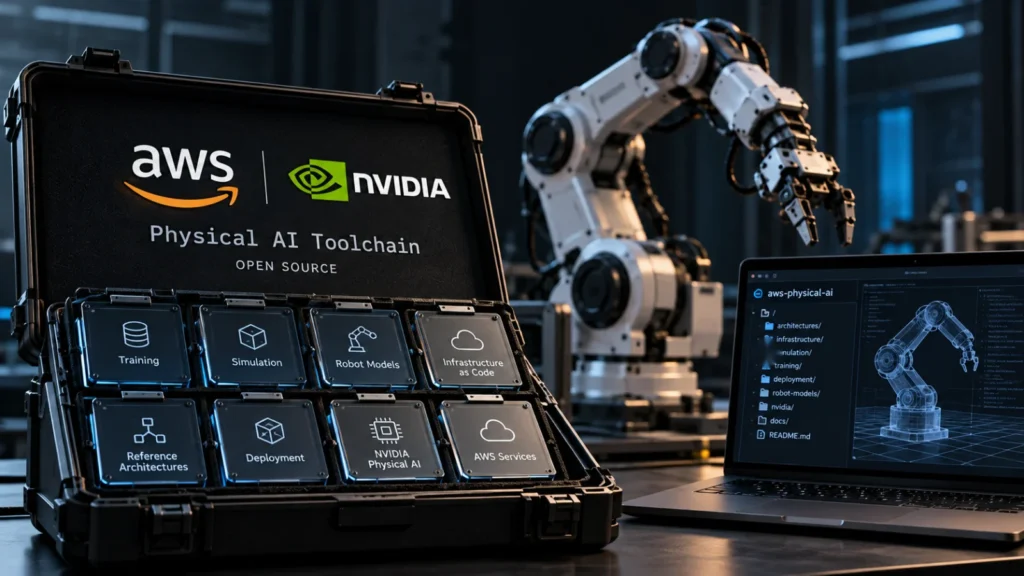
The AWS Physical AI Toolchain is a public GitHub repository of Apache 2.0 reference architectures, Infrastructure as Code and deployment automation for training, simulating and deploying robot models on Amazon Web Services with NVIDIA‘s physical AI software. It launched around Oct 7 to 8, 2026, so this is an explainer rather than breaking news.
The “open source” label needs careful reading. The code sits under AWS’s aws-samples organisation and describes itself as sample code, one component is marked planned, and AWS’s own guidance page advises against production use. We read the launch description against the repository as it stood on Oct 20, 2026, a snapshot that may have changed since launch.
What does the AWS Physical AI Toolchain repository contain?
It contains infrastructure templates and pipeline code that wire AWS services to NVIDIA tools. The README’s component table marks eight items as Available: Foundation, Cosmos, Isaac Lab, Isaac GR00T, DreamZero, Isaac Sim, OSMO and Strands Agents. Isaac Lab Arena Evaluation is marked Preview, and Edge Deployment, covering Jetson via EKS Hybrid Nodes and Greengrass, is marked Planned.
The README organises the work as a flywheel of four pillars: synthetic data generation, model training, software-in-the-loop simulation, and sim-to-real with hardware-in-the-loop testing. An agentic orchestration layer sits in the middle, with NVIDIA OSMO coordinating scheduling and Strands Agents driving robots in natural language. The pipeline runs in five stages:
- Ingest teleoperation recordings and convert them to LeRobot v2 format in S3.
- Fine-tune GR00T with imitation learning on SageMaker.
- Generate synthetic demonstrations with Cosmos 3 Predict, or restyle video with Cosmos Transfer 2.5.
- Train a policy in Isaac Lab.
- Export to TensorRT and deploy to a robot fleet via Greengrass.
The included example uses a UR3 arm with a Robotiq 2F-85 gripper and 27 real teleoperation episodes for a pick-and-place task. OSMO is optional: the README says to adopt it for a new end-to-end pipeline, or to use individual components alongside existing tools such as Kubeflow, Airflow or Argo Workflows. For the Cosmos side, our earlier how-to on building a physical AI model factory with Nvidia Cosmos 3 on AWS covers the groundwork.
Where does the launch description differ from the code?
The Robot Report’s Oct 8 coverage describes five pieces, citing SageMaker for training and AWS IoT Greengrass for edge distribution. The table sets those against the repository. The pairings are our own, since the README uses a different framing.
| Piece in The Robot Report | Closest match in the repository |
|---|---|
| Synthetic data generation | A README pillar; Cosmos is marked Available |
| Model training | A README pillar; Isaac GR00T, DreamZero and Isaac Lab are marked Available |
| Simulation and validation | A README pillar; Isaac Sim is Available, Isaac Lab Arena Evaluation is Preview |
| Edge deployment | Edge Deployment is Planned, though the pipeline’s last stage describes a Greengrass deploy step |
| Continuous improvement | Described as a flywheel in the README; the component table has no entry by that name |
The edge row is the one that matters. AWS’s guidance page lists Greengrass edge deployment among its benefits, yet the README marks the Edge Deployment component as planned. Our reading is that the deploy-to-robot step is design intent today, not something to build a rollout on. The Robot Report article, as read, does not mention the planned and preview status or the production disclaimer.
How much does it cost to run?
The README publishes cost estimates, which are AWS’s own figures and not independently measured. Running anything requires an AWS account with GPU quota for SageMaker and EC2, AWS CLI v2, Python 3.11 or later, an NVIDIA NGC API key and a Hugging Face token. The production path also needs Terraform 1.5 or later.
| Workload | README estimate |
|---|---|
| GR00T smoke test | About $2 |
| GR00T full training run | About $79 (11 hours on ml.g5.12xlarge) |
| DreamZero smoke test | About $10 |
| DreamZero fine-tune, 1,000 steps | About $93 |
| Cosmos 3 Predict | About $37 an hour (p5.48xlarge) |
| Cosmos Transfer 2.5 | About $8 an hour |
| Isaac Sim workstation | About $1.86 an hour |
| Isaac Lab reinforcement learning | About $10 to $30 |
| Full OSMO deployment | About $5 an hour |
What does open source mean here, and can teams use it in production?
Apache 2.0 is verified for the AWS repository only. What it frees is the reusable infrastructure code. The GPU capacity is paid AWS compute, and the NVIDIA components are separate software whose licenses were not checked for this article. Teams planning to build on GR00T or Cosmos should read those terms themselves.
On production, AWS is explicit: its page says the content should not be used in production accounts or on production or other critical data, and that deploying may incur charges. AWS’s Sri Elaprolu told The Robot Report the toolchain is hardware-neutral and not a direct replacement for RoboMaker, which was shut down in 2025. He said the toolchain “is intentionally staying neutral to that final step.”
Elaprolu also cited Amazon’s more than 1 million robots, Telexistence’s deployment of more than 300 humanoids in Japanese convenience stores, and use of components by participants in AWS’s Physical AI Fellowship with MassRobotics and NVIDIA. Those are AWS’s claims. We found no independent test or customer report of the toolchain in the sources read, and the repository’s 85 commits, 20 stars and 9 forks on Oct 20 are too small a snapshot to judge adoption.
The things to watch are whether the Edge Deployment component moves from Planned to Available, whether Arena Evaluation leaves Preview, and what the NVIDIA components’ licenses allow.