
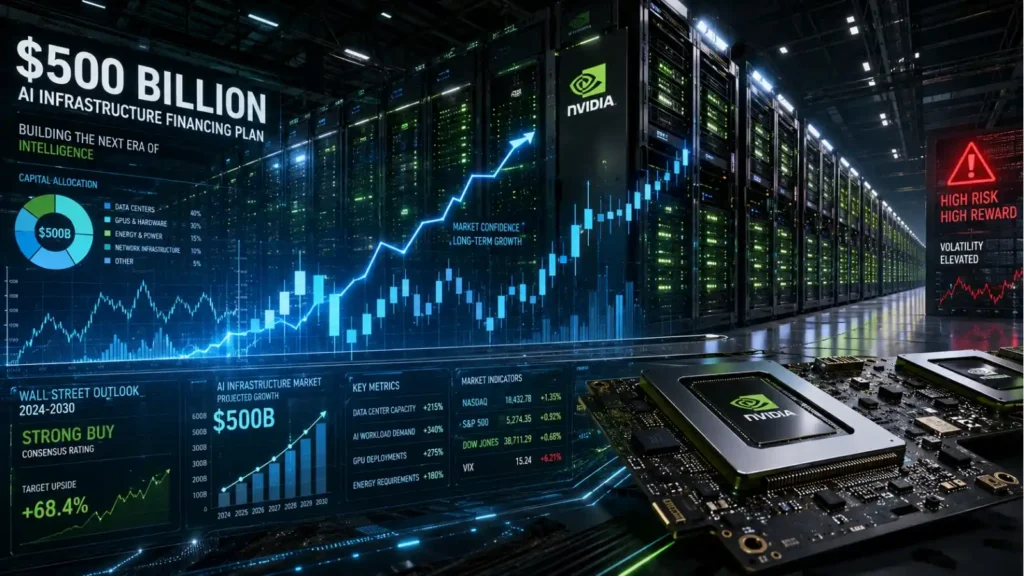
On August 13, 2026, Nvidia unveiled an ambitious financial strategy designed to sustain the massive capital expenditure wave powering the artificial intelligence sector. Known informally as nvidias 500b plan, the initiative seeks to establish a robust financing ecosystem involving major Wall Street asset managers. The core objective is to ensure that AI startups and enterprise developers can continue purchasing the compute power required for large language model training and inference. (See also: Model ML Completes Finance Work More Efficiently with GPT-5.6 Sol)
The strategy directly addresses a looming crisis in the AI hardware market: the rapid depreciation of GPUs. As Nvidia releases increasingly powerful chip architectures, previous generation hardware risks losing its residual market value. By convincing a new crop of financiers to fund AI buildouts, Nvidia aims to guarantee that older GPUs remain productive, monetizable assets rather than stranded capital. (See also: Embattled hedge fund Situational Awareness invests $400M in chip startup Source Foundry)
This approach represents a significant pivot from pure hardware sales to full-stack infrastructure lifecycle management. According to reporting by Julie Bort at TechCrunch, the initiative carries substantial financial risk but offers a brilliant mechanism to stabilize the secondary compute market. Here is an analysis of how nvidias 500b plan functions and what it means for the future of AI hardware valuation.
Nvidias 500B Plan: A Risky Masterstroke for Aging GPUs
Key Takeaways
- Nvidia is partnering with major Wall Street firms to back a $500 billion financing initiative for AI infrastructure.
- The primary goal is to prevent aging GPUs from losing value by ensuring continuous demand for AI buildouts.
- This strategy shifts the financial burden of rapid hardware depreciation from AI startups to institutional financiers.
- If successful, the plan will stabilize the secondary compute market and guarantee long-term revenue streams for Nvidia.
The Core of Nvidias 500B Plan
Nvidias 500b plan centers on a straightforward but capital-intensive concept: if you build the AI infrastructure, the financiers will come. Nvidia is actively working to convince massive asset management firms to provide the capital necessary for AI developers to build out their data centers. As reported by TechCrunch, the company is partnering with financial giants like Apollo, BlackRock, and Blackstone to secure the massive funding required to keep the AI hardware pipeline flowing.
The fundamental problem Nvidia faces is the lifecycle of its own hardware. AI models require massive parallel processing capabilities, driving unprecedented demand for Nvidia accelerators. However, as architectures evolve rapidly from Hopper to Blackwell and beyond, the cutting-edge chips of today become the aging GPUs of tomorrow. If the market cannot absorb or utilize these older chips, their value plummets. This depreciation creates a precarious financial situation for the startups and enterprises that borrowed heavily to purchase them.
The Financial Mechanics of the Strategy
To understand the brilliance of nvidias 500b plan, one must look at the financial mechanics of AI infrastructure. AI startups typically lack the massive cash reserves required to purchase tens of thousands of GPUs outright. They rely on venture capital and debt financing. When interest rates rise or venture capital tightens, infrastructure buildouts stall. Nvidia recognized that maintaining its revenue growth required guaranteeing a continuous flow of capital to its customers, regardless of macroeconomic conditions.
By bringing in Wall Street financiers, Nvidia is effectively creating a specialized lending market for AI compute. Financiers provide the capital for the hardware. Startups use that hardware to train models and generate revenue, paying back the financiers over time. The crucial addition to nvidias 500b plan is the implicit or explicit backing of the hardware's residual value. If the startup defaults, the financiers are left holding aging GPUs. Nvidia's plan aims to ensure those GPUs retain utility and value, making them attractive collateral for institutional lenders.
Technical and Financial Specifications
Why the Plan is Risky
Despite its elegant design, nvidias 500b plan carries substantial risk. The primary danger is the assumption that current and previous generation GPUs will remain highly productive assets. The utility of an aging GPU depends entirely on the software ecosystem and the demand for inference workloads. While training cutting-edge foundation models requires the latest Blackwell architecture, running inference on existing models can often be handled by Hopper or even Ampere chips.
However, if the AI software market fails to generate sufficient commercial demand for inference, the compute supply will vastly outweigh demand. Financiers backing the $500 billion initiative would find themselves holding expensive, depreciating silicon. The AI sector has a history of hype cycles that do not always translate into immediate enterprise adoption. If the ROI on AI buildouts delays further, the financial partners could face significant losses, which would chill future lending.
Furthermore, rapid shifts in algorithmic efficiency could reduce the total compute required for training and inference. If new techniques allow models to be trained on commodity hardware or specialized ASICs rather than Nvidia GPUs, the value proposition of the aging GPU fleet collapses. Nvidia is betting heavily that the software ecosystem will remain locked into its CUDA platform, ensuring persistent demand for its hardware across generations.
The Brilliance for Aging GPUs
The genius of nvidias 500b plan lies in its proactive approach to hardware lifecycle management. Traditionally, hardware manufacturers operate on a sell-and-forget model, leaving the secondary market to dictate residual values. Nvidia is taking an active role in supporting the secondary market by ensuring there is always a funded buyer ready to utilize older hardware.
This strategy effectively turns aging GPUs from a liability into a feature. Enterprise customers can now purchase older, discounted GPUs with confidence, knowing that a massive financial ecosystem is backing their utility. It creates a tiered market structure: cutting-edge research and training happen on the newest chips, while inference, fine-tuning, and edge computing happen on financed, aging GPUs.
Discover how AI infrastructure financing is reshaping enterprise IT budgets
Industry Impact and Enterprise Implications
For the broader AI ecosystem, nvidias 500b plan is a stabilizing force. It signals to the market that the capital required to reach artificial general intelligence will not be bottlenecked by traditional venture capital cycles. By tapping into the deep pools of institutional capital managed by firms like BlackRock and Apollo, Nvidia is ensuring that the compute scaling laws can continue to be exploited.
Enterprises looking to deploy AI solutions will benefit from this arrangement through lower barrier to entry. Financed hardware agreements backed by institutional lenders typically offer more favorable terms than standard vendor financing. This allows mid-market companies to access the compute resources necessary to compete with hyperscalers.
Learn more about the impact of GPU depreciation on enterprise AI ROI
According to the original report by Julie Bort, this financial engineering is necessary to maintain the staggering growth trajectory Nvidia has experienced. Without a funded buyer for the previous generation of chips, the entire upgrade cycle slows down. By ensuring Wall Street has skin in the game, Nvidia protects its own future revenue streams and cements its position as the foundational layer of the AI economy.
Key Takeaways
- Nvidia is partnering with major Wall Street firms to back a $500 billion financing initiative for AI infrastructure.
- The primary goal is to prevent aging GPUs from losing value by ensuring continuous demand for AI buildouts.
- This strategy shifts the financial burden of rapid hardware depreciation from AI startups to institutional financiers.
- If successful, the plan will stabilize the secondary compute market and guarantee long-term revenue streams for Nvidia.
FAQ
Is Nvidia investing 500 billion in AI?
Nvidia is not directly investing $500 billion of its own capital. Instead, nvidias 500b plan involves partnering with major Wall Street asset managers like Apollo, BlackRock, and Blackstone to facilitate $500 billion in financing for AI infrastructure buildouts. Nvidia is acting as the catalyst and ecosystem builder to ensure capital flows to its customers.
Will Nvidia hit $300 in 2026?
Predicting exact stock prices is speculative. However, nvidias 500b plan to secure long-term infrastructure financing and protect the residual value of its hardware could provide a strong bullish signal to investors. The plan reduces the risk of a sudden drop in demand caused by capital constraints in the AI startup sector, which could support a higher stock valuation.
What would $1000 in Nvidia 5 years ago be worth today?
Nvidia has experienced unprecedented growth over the last five years due to the explosion of artificial intelligence and the demand for its GPUs. A $1000 investment in Nvidia five years ago would be worth significantly more today, reflecting the massive appreciation in its market capitalization as it became the dominant hardware provider for the AI revolution.
Is it true that 75% of Nvidia employees are millionaires?
While exact current figures are not publicly disclosed, it is widely reported that a vast majority of Nvidia employees with long tenure are millionaires due to the company's stock appreciation. Nvidia has a strong culture of equity compensation, and the massive surge in its stock price over the last decade has created significant wealth for its early and mid-career employees.