
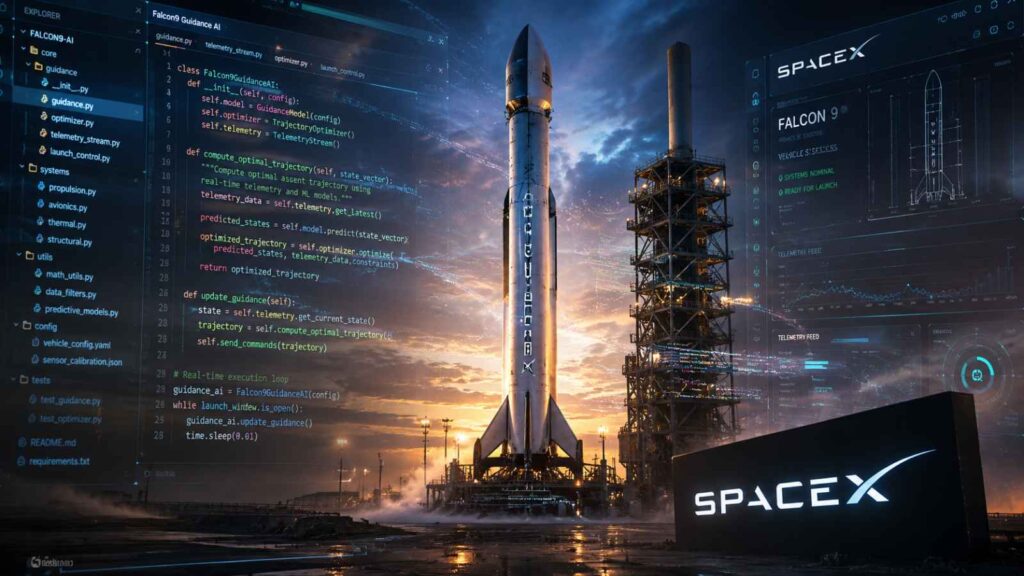
In a move that converges aerospace engineering with artificial intelligence, SpaceX has completed its acquisition of Cursor, the prominent AI coding startup. Reported first by Anthony Ha at TechCrunch, the deal signifies a major push by Elon Musk's space exploration company to internalize advanced software development tools. The announcement confirms that AI coding startup Cursor is now officially a part of SpaceX.
The aerospace sector demands rigorous, fault-tolerant software for flight control, telemetry, and avionics systems. By absorbing Cursor, SpaceX gains direct control over a cutting-edge AI coding assistant specialized in code generation, refactoring, and debugging. This acquisition highlights a growing trend where large technology and engineering firms are purchasing AI tooling companies outright rather than licensing external models, ensuring proprietary control over their internal development pipelines.
For the broader AI ecosystem, this transaction removes one of the most popular independent coding assistants from the open market. It underscores the intense strategic value of AI coding tools, as enterprises seek to compress development cycles and reduce human error in critical systems.
Key Takeaways
- SpaceX officially closes its acquisition of AI coding startup Cursor, integrating the tool into its proprietary engineering workflows.
- The acquisition shifts Cursor from a public-facing AI coding assistant to an internal asset for aerospace software development.
- This move aligns with a broader industry trend of aerospace and technology giants internalizing AI infrastructure to secure development pipelines.
- Financial terms of the SpaceX closing remain undisclosed, though the strategic value of owning a high-performance coding model is substantial.
The Strategic Value of Internal AI Coding Models
When SpaceX officially closes an acquisition of this nature, the implications extend far beyond standard technology consolidation. Aerospace software development operates under constraints rarely seen in standard enterprise IT. Code must meet stringent verification and validation standards for flight readiness, where a single error can result in the loss of a vehicle and mission failure.
Cursor employs advanced large language models optimized for understanding entire codebases, predicting subsequent code blocks, and identifying potential vulnerabilities before compilation. By absorbing this technology, SpaceX can tailor the AI models specifically for its proprietary languages and hardware interfaces. This internalization allows the aerospace manufacturer to bypass the security concerns associated with sending sensitive code to external API providers.
The trend of internalizing AI development tools is gaining momentum across sectors. As enterprises evaluate the ROI of AI coding tools, the focus has shifted toward maintaining local control over data and model fine-tuning. For instance, Microsoft has aggressively reduced its coding model prices to remain competitive, but major players like SpaceX are opting for outright ownership rather than renting compute and models.
Integration with Aerospace Engineering Pipelines
The integration of Cursor into SpaceX's ecosystem will likely focus on several core engineering workflows:
- Flight Code Generation: Assisting engineers in drafting boilerplate code for telemetry and sensor integration, allowing human developers to focus on logic verification.
- Automated Refactoring: Streamlining legacy codebases to improve performance on resource-constrained flight computers.
- Bug Detection: Utilizing AI to identify potential race conditions or memory leaks in real-time operating systems.
A Shift Toward Proprietary AI Infrastructure
This acquisition is not an isolated event but part of a larger strategy by Elon Musk’s companies to control their AI destiny. SpaceX and Tesla have previously committed massive capital to silicon manufacturing, with SpaceX and Tesla investing $16.8 billion in a Terafab chip factory in Texas. Securing both the compute infrastructure and the software layer gives Musk's ecosystem a vertically integrated AI pipeline.
Furthermore, the demand for specialized AI infrastructure is reshaping financial models across the technology sector. Wall Street is rapidly transforming AI infrastructure into a distinct asset class, a trend explored in recent analyses of AI infrastructure investments. By owning the models, the compute, and the coding interface, SpaceX insulates itself from the pricing volatility of third-party AI clouds.
Impact on the AI Coding Market
The departure of Cursor from the independent market leaves a notable void. The startup was widely regarded as one of the most effective AI coding assistants available, competing directly with GitHub Copilot and other proprietary tools. Developers relied on Cursor for its deep context awareness and seamless integration with existing IDEs.
With the SpaceX closing of this deal, individual developers and external enterprise customers will need to transition to alternative platforms. This opens the door for competitors capturing the displaced market share. Startups offering open-weight models, such as Z.ai's GLM 5.2 available through Blackbox on AI Gateway, are well-positioned to absorb developers seeking flexible, cost-effective coding agents.
The competitive landscape is further complicated by the rapid pace of model releases. OpenAI's latest iterations, including the GPT-5.6 Sol architecture, demonstrate how quickly raw inference speed and coding capabilities are evolving. SpaceX's decision to acquire rather than build from scratch indicates that acquiring a polished, proven developer interface is faster than engineering one internally.
Future Implications for Enterprise AI
The finalization of this deal sets a precedent for how critical AI tooling will be valued and acquired. As AI models become increasingly commoditized, the user interface, workflow integration, and context-handling capabilities of tools like Cursor become the primary differentiators.
Enterprises in highly regulated or mission-critical sectors, such as defense, healthcare, and aerospace, will likely follow SpaceX's lead. The need for air-gapped, internally controlled AI coding assistants will drive further mergers and acquisitions in the AI startup space. According to the initial report by TechCrunch, the transition of Cursor's team and technology into SpaceX will begin immediately, with the standalone product winding down for external users.
For developers and enterprise IT leaders, the message is clear: relying on third-party AI startups for critical workflows carries inherent risk. As the AI industry matures, the most valuable tools will inevitably be absorbed by the giants they serve.
Key Takeaways
- SpaceX officially closes its acquisition of AI coding startup Cursor, bringing the tool in-house for aerospace engineering.
- The deal removes a major independent AI coding assistant from the market, forcing external users to seek alternatives.
- This acquisition aligns with SpaceX's broader strategy to control its AI infrastructure, including previous investments in chip manufacturing.
- The move signals a trend where mission-critical industries will acquire AI tooling outright rather than risk relying on third-party APIs.
FAQ
What does it mean that SpaceX officially closes its Cursor acquisition?
It means that the acquisition deal has been finalized. AI coding startup Cursor is now officially a part of SpaceX, and the technology will be integrated into SpaceX's internal engineering workflows rather than being offered as a standalone product to external developers.
Why did SpaceX acquire an AI coding startup?
Aerospace engineering requires highly complex, fault-tolerant software. By acquiring Cursor, SpaceX gains direct control over a cutting-edge AI coding assistant, allowing them to tailor the models for proprietary codebases, improve development speed, and ensure data security by keeping code internal.
What happens to current Cursor users after the SpaceX closing?
While specific transition timelines may vary, the acquisition typically means the standalone Cursor product will be wound down for external users. Developers will need to seek alternative AI coding assistants like GitHub Copilot, or open-weight alternatives like GLM 5.2.