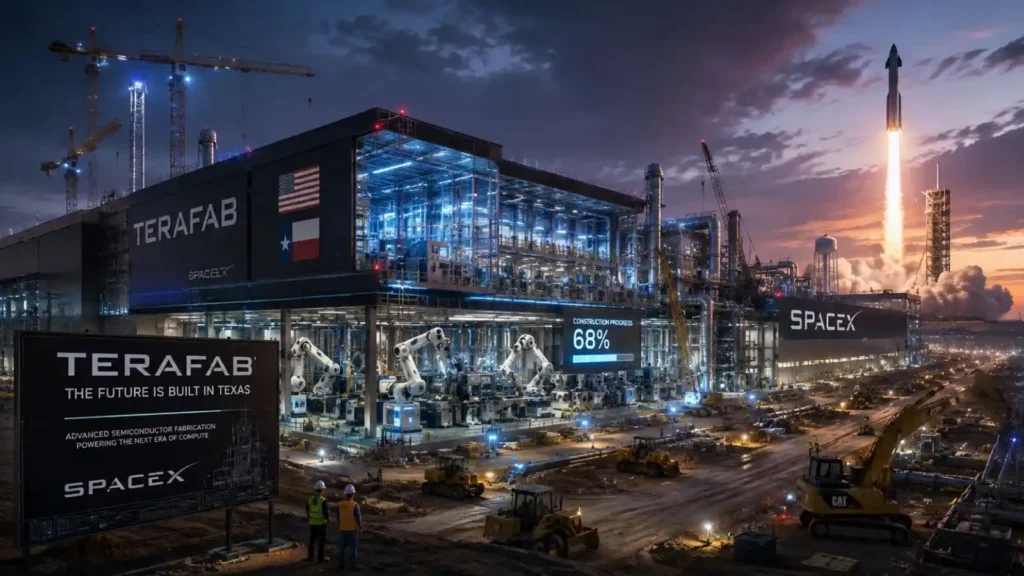
In a massive strategic pivot to secure silicon supply chains, SpaceX and Tesla are committing $16.8 billion to construct a new mega-scale semiconductor manufacturing facility in Texas. The joint venture, internally referred to as the Terafab, aims to insulate Elon Musk’s sprawling enterprise from global chip shortages while providing dedicated capacity for next-generation artificial intelligence workloads, autonomous robotics, and space-based data centers.
The unprecedented SpaceX Tesla spend signals a fundamental shift in how vertically integrated technology conglomerates are approaching the AI hardware bottleneck. As demand for high-compute silicon skyrockets, reliance on traditional foundries has become a strategic vulnerability. By funding a facility of this scale, Musk’s companies are moving to guarantee the hardware foundation required to power their ambitious AI roadmaps. (See also: Baseten on Hugging Face Inference Providers: A New Standard for Low-Latency AI Deployment)
Reported first by AI Business, the $16.8 billion capital expenditure reflects the escalating hardware arms race among tech titans. The Texas-based facility will focus on producing high-throughput compute components tailored for the unique environmental and operational demands of orbital data centers and fully autonomous terrestrial fleets. (See also: Jeff Dean and Other Top AI Researchers Depart Google to Launch Scientific Discovery Startup)
Key Takeaways
- SpaceX and Tesla are jointly investing $16.8 billion to build the 'Terafab,' a massive new chip manufacturing facility in Texas.
- The facility will secure semiconductor capacity for AI development, autonomous robotics, and space-based data centers.
- This unprecedented spacex tesla spend mitigates supply chain vulnerabilities, reducing reliance on traditional foundry partners.
- The massive capital expenditure highlights the industry-wide push for vertical integration in AI hardware manufacturing.
The Strategic Imperative for the SpaceX Tesla Spend
The modern AI boom is constrained less by algorithmic innovation and more by raw compute availability. For Elon Musk’s empire, this bottleneck threatens core product pipelines. Tesla’s Full Self-Driving (FSD) inference engines and Dojo supercomputer architecture require specialized silicon at scale. Concurrently, SpaceX requires radiation-hardened, high-throughput chips for satellite constellations and its proposed extraterrestrial compute infrastructure.
The decision to direct the $16.8 billion spacex tesla spend toward a domestic Texas facility addresses two critical vulnerabilities: geopolitical supply chain fragility and the compute demands of neural network training. By controlling the manufacturing endpoint, Musk’s companies can iterate on custom silicon architectures without waiting in foundry queues dominated by hyperscalers like Microsoft, Google, and Amazon. Read the original report on this massive joint venture.
Terafab: Technical Scope and Operational Goals
The Terafab is not a standard commercial foundry. According to industry documentation, the facility is designed to produce specialized compute units optimized for extreme environments and high-efficiency AI inference. While specific node sizes have not been publicly detailed, the scale of the investment suggests a focus on advanced packaging and high-volume output tailored to proprietary architectures.
Core Manufacturing Objectives
- AI Acceleration: Fabricating custom TPUs and inference chips to power Tesla’s Dojo supercomputer and Optimus humanoid robot fleets.
- Space-Grade Silicon: Developing radiation-tolerant semiconductors for SpaceX’s Starlink satellites and orbital data center prototypes.
- Supply Chain Insulation: Establishing a domestic buffer against international export controls and global semiconductor shortages.
This initiative aligns with broader industry trends where hypervalued tech conglomerates are bypassing traditional chipmakers to build bespoke hardware. The spacex tesla spend effectively transforms the companies from mere consumers of silicon into architects of their own compute destiny. Discover how AI Business covers the evolving data center landscape.
Speculative Specifications: Terafab vs. Standard Foundries
While exact lithography capabilities remain classified, the $16.8 billion price tag puts the Terafab in direct financial competition with leading-edge foundries built by TSMC or Intel, albeit with a highly specialized, internal-only output model.
Industry Impact and the Future of Vertical Integration
The implications of this spacex tesla spend extend far beyond Musk’s corporate boundaries. For developers and AI researchers, the construction of the Terafab underscores a harsh reality: the future of AI scaling is fundamentally limited by physical manufacturing capacity.
When tech giants vertically integrate their silicon supply, the broader ecosystem faces tighter access to bleeding-edge compute. However, it also forces innovation in alternative architectures. Startups and enterprise developers may increasingly rely on cloud providers who, in turn, must secure their own foundry partnerships to compete.
Furthermore, the concept of space-based data centers—long a theoretical concept for thermal management and solar energy utilization—is moving closer to technical feasibility. SpaceX’s involvement in chip manufacturing suggests that the hardware required to survive and process data in orbital environments is rapidly advancing from speculative research to industrial engineering. Learn more about the intersection of AI and advanced manufacturing.
Ultimately, the $16.8 billion allocated to this Texas facility represents a definitive bet: the next decade of AI supremacy will be won not just by software, but by the concrete, silicon, and machinery that forge the physical compute layer.
Key Takeaways
- SpaceX and Tesla are jointly investing $16.8 billion to build the 'Terafab,' a massive new chip manufacturing facility in Texas.
- The facility will secure semiconductor capacity for AI development, autonomous robotics, and space-based data centers.
- This unprecedented spacex tesla spend mitigates supply chain vulnerabilities, reducing reliance on traditional foundry partners.
- The massive capital expenditure highlights the industry-wide push for vertical integration in AI hardware manufacturing.
FAQ
Why are SpaceX and Tesla spending $16.8 billion on a chip factory?
The joint investment, referred to as the 'Terafab,' is designed to secure domestic semiconductor supply chains. The facility will produce specialized chips for Tesla's AI autonomous driving systems and robotics, as well as space-grade silicon for SpaceX's satellite networks and orbital data centers.
Where will the new Terafab chip factory be located?
The new mega-scale semiconductor manufacturing facility will be located in Texas, aligning with Elon Musk's broader strategy of concentrating key industrial operations within the state.
How will the Terafab impact the broader AI industry?
By vertically integrating their silicon production, SpaceX and Tesla are insulating themselves from global chip shortages and foundry queues. For the broader AI ecosystem, this highlights a shift where the largest tech conglomerates must own their compute manufacturing to scale AI models effectively.