

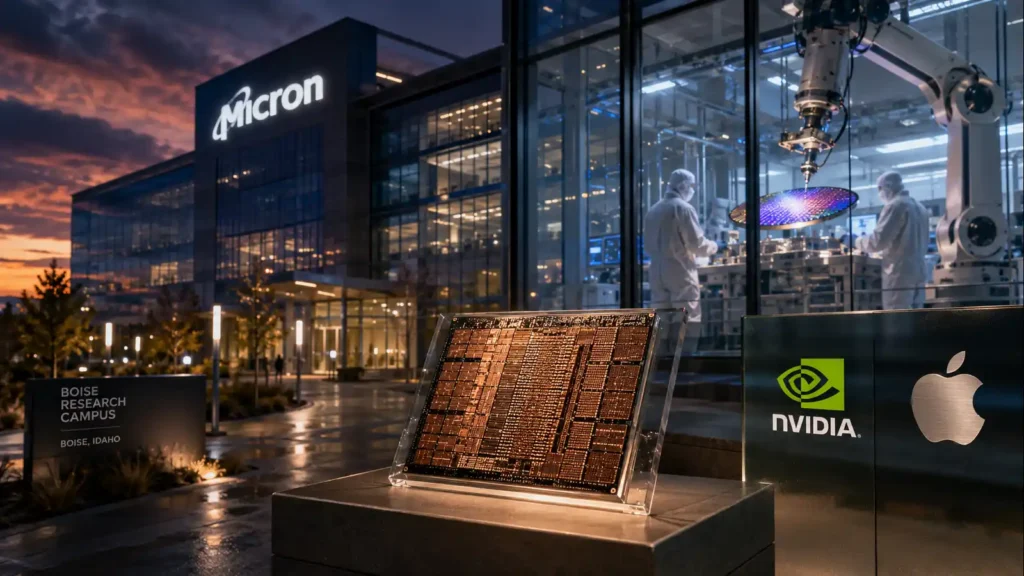
Micron Technology unveiled Micron Research Labs on August 20, 2026, a U.S.-based long-horizon research institution headquartered in Boise, Idaho and backed by a planned $10 billion investment over the next decade. The hub will unite academia, government, startups and industry to pursue memory and compute breakthroughs that Micron says will define the AI era, positioning it as the first dedicated memory research institution of its kind in the United States.
The announcement, made via a GlobeNewswire release from Micron Technology, Inc. (Nasdaq: MU), frames the lab as an extension of the company’s existing U.S. investment strategy.
The move drew immediate public backing from NVIDIA CEO Jensen Huang, Apple CEO Tim Cook, U.S. Secretary of Commerce Howard Lutnick, and White House Office of Science and Technology Policy Director Michael Kratsios, signaling coordinated interest from both the private sector and the federal government in domestic memory research capacity.
What Is Micron Research Labs and Why Was It Announced Now?
Micron Research Labs is a new, U.S.-based research institution anchored on a flagship campus in Boise, Idaho, Micron’s headquarters city. According to the company’s announcement, the lab is designed to pursue breakthroughs “beyond today’s technology roadmaps,” looking past a 10-year horizon rather than the next product generation.
The timing lines up with a period of intense AI-driven demand for memory chips. Micron’s stock has been trading near its 52-week high through mid-August 2026, part of a broader rally across memory makers that analysts have tied to tight DRAM and NAND supply. Against that backdrop, Micron is framing long-horizon research, not just near-term capacity expansion, as the company’s next competitive front.
The $10 Billion Investment, Explained
Micron Research Labs will operate as a connected research network rather than a single building. The flagship campus in Boise anchors the effort, but the planned $10 billion investment will also fund extensive university collaborations, satellite labs positioned around the world, and deep partnerships across the semiconductor ecosystem. According to Micron, the institution is the first dedicated memory research hub of its kind in the United States, built to look beyond a ten-year horizon rather than the next product cycle. Key research areas include critical memory technologies, advanced memory and compute architectures, semiconductor packaging, and future manufacturing processes. The effort builds on Micron’s existing footprint across the United States, Europe, Japan, India, Singapore and Taiwan, linking internal researchers with outside academic and industry partners. Micron says the lab will also train the next generation of memory researchers and technology leaders, extending the work beyond any single product roadmap.
Micron says it anticipates breaking ground on the flagship facility in calendar 2027. Once built, the campus is expected to host hundreds of researchers and convene research conferences, workshops and innovation forums in Boise.
Key Research Areas Inside Micron Research Labs
According to Micron’s announcement, the lab will focus on four core technology domains:
- Critical memory technologies foundational research into DRAM, NAND and next-generation memory types
- Advanced memory and compute architectures new system designs pairing memory more tightly with AI compute
- Packaging chip packaging innovations needed to keep pace with denser, faster AI hardware
- Future semiconductor manufacturing process technology intended to extend beyond current fabrication techniques
Micron says this research agenda builds on 62,000 lifetime patents and is intended to help extend the benefits of AI-driven memory technology into agriculture, healthcare, education and other industries, in addition to data centers.
Micron Research Labs at a Glance
How Does Micron Research Labs Fit Into the Broader AI Infrastructure Race?
Micron Research Labs arrives as capital keeps pouring into AI infrastructure well beyond chip fabrication. Nvidia has separately been investing directly in data center capacity, including a stake in a SoftBank-backed developer aimed at securing chip dominance for OpenAI’s data center buildout, while financial markets have started treating AI infrastructure as its own investable asset class. Micron’s decision to fund a dedicated, decade-plus research institution rather than only expanding fabs reflects a similar logic: memory supply has become as strategically important as GPU supply itself.
That framing matters because compute providers have increasingly flagged memory, not raw processing power, as their binding constraint. Nvidia’s own financial strategy to protect the value of aging GPU fleets has drawn scrutiny as a risky but calculated bet on sustained AI demand, underscoring how tightly memory, compute and capital planning are now linked across the AI hardware stack.
Industry and Government Reaction
The announcement drew immediate, on-the-record support from figures across chipmaking, computing and government. Sanjay Mehrotra, Chairman, President and CEO of Micron Technology, said the decisions made today will determine who leads the AI economy of tomorrow, framing Micron Research Labs as an extension of the more than $250 billion Micron has separately committed to U.S. manufacturing and research and development. NVIDIA founder and CEO Jensen Huang described memory reinvention as one of the great challenges of the AI era. Apple CEO Tim Cook pointed to a two-decade supply relationship with Micron. U.S. Secretary of Commerce Howard Lutnick and White House Office of Science and Technology Policy Director Michael Kratsios both framed the lab as reinforcing domestic semiconductor leadership. Applied Materials, Lam Research, imec, Stanford University and the University of Texas at Austin also issued statements backing the initiative, signaling coordinated support across the chip supply chain, national labs and higher education.
Huang’s statement specifically credited Micron with tackling “one of the great challenges of the AI era.” Lutnick, for his part, said “memory is a core component of America’s technological leadership,” linking the lab to broader federal semiconductor policy goals rather than treating it as a purely corporate R&D announcement.
Where Micron Research Labs Fits in Micron’s Broader Strategy
The new lab is not an isolated move. It follows Micron’s August 13, 2026 launch of the Micron Ventures Paradigm Fund, a $250 million vehicle aimed at investing in early-stage AI companies, and sits alongside Micron’s previously disclosed plan to invest more than $250 billion in U.S. manufacturing and R&D a commitment the company says will support more than 90,000 American jobs. Together, the moves suggest Micron is building both near-term manufacturing capacity and long-horizon research infrastructure at the same time, rather than choosing between the two.
What This Means for Micron’s Position in the Memory Market
Micron describes itself as the only U.S.-based company that both designs and manufactures leading-edge memory, a distinction it is leaning on heavily in the framing of Micron Research Labs. That positioning matters given current market dynamics: memory chips, particularly high-bandwidth memory (HBM) used in AI training and inference, have been in persistently tight supply through 2026, with major customers publicly describing memory allocation as a competitive advantage.
For enterprise buyers and AI infrastructure planners, a dedicated long-horizon research institution signals that Micron expects the current memory supercycle to be structural rather than temporary worth a decade-scale research commitment rather than only additional fab capacity.
Frequently Asked Questions
What is going on with Micron?
Micron unveiled Micron Research Labs on August 20, 2026, a $10 billion, decade-long research institution based in Boise, Idaho. The announcement lands during a period of strong performance for Micron’s core business, with shares trading near 52-week highs amid tight global DRAM and NAND supply and surging AI-driven demand for high-bandwidth memory. The company has also recently launched a $250 million venture fund and continues executing on a previously announced $250 billion-plus U.S. manufacturing and R&D commitment.
Can Micron go to $2,000?
Some Wall Street analysts have set price targets at or above $2,000 for Micron (Nasdaq: MU), including Cantor Fitzgerald and Barclays, according to TipRanks data, with the single highest analyst estimate reaching $2,200. However, the broader analyst consensus average price target sits notably lower, in the roughly $1,500 to $1,570 range according to multiple market-data trackers. Whether Micron reaches $2,000 depends on continued strength in the memory market and is not guaranteed; this is not financial advice, and readers should consult a licensed financial advisor before making investment decisions.
Does Warren Buffett own Micron?
Based on Berkshire Hathaway’s most recent publicly disclosed 13F filing for the quarter ended June 30, 2026, Micron does not appear among Berkshire’s largest reported equity positions, which remain concentrated in Apple, American Express, Bank of America, Coca-Cola and Chevron. Public 13F data does not show Micron as a disclosed Berkshire Hathaway holding as of that filing.
What did Elon Musk say about Micron?
On Tesla’s Q2 2026 earnings call on July 23, 2026, Elon Musk thanked Micron by name for providing Tesla with what he called “a very significant allocation” of memory chips on reasonable terms, while describing memory pricing at the time as unusually steep. Roughly two weeks later, on SpaceX’s August 4, 2026 earnings call, Musk identified memory supply not power or GPUs as the primary constraint on AI compute expansion, citing a wide gap between memory supply growth and AI-driven demand growth.
Where is Micron Research Labs located, and what are Micron’s other fab locations?
Micron Research Labs is headquartered on a flagship campus in Boise, Idaho, the same city where Micron was founded. The lab will connect to Micron’s existing research and technology footprint across the United States, Europe, Japan, India, Singapore and Taiwan.
Key Takeaways
- Micron unveiled Micron Research Labs on August 20, 2026, a U.S.-based research institution in Boise, Idaho backed by a planned $10 billion investment over the next decade.
- The lab will focus on critical memory technologies, advanced memory/compute architectures, packaging, and future semiconductor manufacturing, with groundbreaking planned for calendar 2027.
- NVIDIA, Apple, Applied Materials, Lam Research, imec, Stanford University, UT Austin, the U.S. Commerce Secretary and the White House OSTP Director all issued statements supporting the initiative.
- The announcement builds on Micron’s existing $250 billion-plus U.S. manufacturing and R&D commitment and its recently launched $250 million Micron Ventures Paradigm Fund.
FAQ
What is going on with Micron?
Micron unveiled Micron Research Labs on August 20, 2026, a $10 billion, decade-long research institution based in Boise, Idaho. The announcement lands during a period of strong performance for Micron’s core business, with shares trading near 52-week highs amid tight global DRAM and NAND supply and surging AI-driven demand for high-bandwidth memory.
Can Micron go to $2,000?
Some Wall Street analysts, including Cantor Fitzgerald and Barclays, have set price targets at or above $2,000 for Micron (Nasdaq: MU), with the highest analyst estimate reaching $2,200 according to TipRanks data. The broader consensus average price target is lower, in the roughly $1,500 to $1,570 range across multiple trackers, so a move to $2,000 is not guaranteed. This is not financial advice.
Does Warren Buffett own Micron?
Based on Berkshire Hathaway’s most recent public 13F filing for the quarter ended June 30, 2026, Micron does not appear among its largest reported holdings, which remain concentrated in Apple, American Express, Bank of America, Coca-Cola and Chevron.
What did Elon Musk say about Micron?
On Tesla’s Q2 2026 earnings call on July 23, 2026, Elon Musk thanked Micron for a “very significant allocation” of memory chips on reasonable terms. On SpaceX’s August 4, 2026 earnings call, he named memory supply as the main constraint on AI compute expansion.