
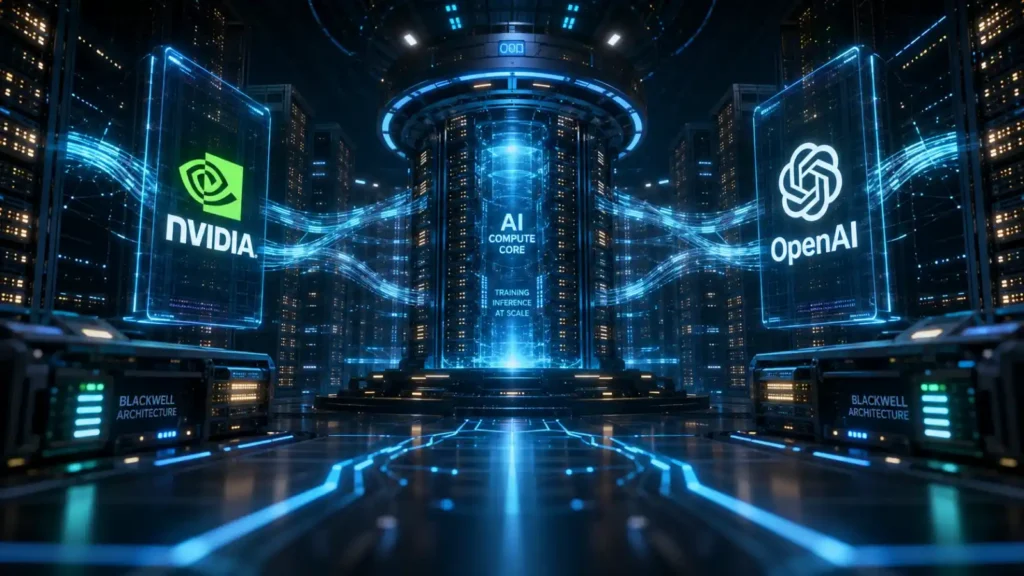
Nvidia investing SoftBank capital marks a pivotal $1.5 billion strategic maneuver to secure its hardware dominance in the next generation of AI compute infrastructure. The chipmaker is injecting funds into a SoftBank-backed data center developer directly responsible for building a massive new facility for OpenAI. This equity investment guarantees that Nvidia’s GPUs will exclusively power the infrastructure, tightly binding the leading AI hardware provider to the industry’s most demanding AI lab. (See also: Stripe Will Reportedly Acquire AI Gateway Startup OpenRouter for $7B+)
The deal underscores a shift from traditional vendor relationships to deeply integrated financial partnerships. As AI models demand exponentially more compute, infrastructure developers need guaranteed funding, while hardware makers need guaranteed deployment pipelines. By financing the data center developer, Nvidia ensures its ecosystem remains the foundational layer for OpenAI’s future model training. (See also: Prompt: Wall Street Is Coming for AI Infrastructure)
This move also highlights a historical full-circle moment. Observers tracking the Nvidia softbank investment trajectory might recall when SoftBank sold its entire Nvidia stake in 2019 for approximately $5.83 billion to fund turnaround efforts. That early sale is now contrasted by Nvidia‘s current strategy of deploying its own capital back into SoftBank’s infrastructure ventures to lock down AI compute capacity.
The Strategic Mechanics of the $1.5B Investment
Nvidia’s $1.5 billion capital injection into the SoftBank data center developer serves as a structural lock-in mechanism for AI hardware deployment. By directly financing the infrastructure layer rather than simply selling chips on the open market, Nvidia guarantees that the forthcoming OpenAI data center will operate exclusively on its proprietary GPU architecture. This strategy mitigates the risk of alternative accelerators or custom silicon penetrating OpenAI’s training pipeline. The investment functions as both a financial subsidy for expensive data center construction and a strategic moat defending Nvidia’s market share against emerging competitors in the AI chip sector. As Wall Street rapidly transforms AI infrastructure into a distinct investable asset class, this direct capital deployment ensures Nvidia captures value across the entire hardware and real estate stack.
How Does This Impact Enterprise AI Deployments?
The financial entanglement between Nvidia and SoftBank signals a tightening of the global AI supply chain, with profound implications for enterprise deployments. When the top AI hardware manufacturer directly funds the data centers housing the top AI models, the broader enterprise market faces reduced flexibility. Smaller enterprises and independent developers may encounter constrained GPU availability as massive portions of new data center capacity are pre-allocated to tier-one clients like OpenAI. This consolidation drives up compute costs and wait times for organizations attempting to scale their own machine learning workloads. Furthermore, this vertical integration strategy creates a high barrier to entry for AI infrastructure startups, as competing data center developers must now match not just hardware procurement, but deep-pocketed vendor financing subsidies. The market is shifting toward fully integrated AI ecosystems, leaving independent operators searching for alternative compute sources. You can see similar consolidation trends in how infrastructure providers like Stripe are reportedly acquiring AI gateway startup OpenRouter to control routing layers.
Historical Context: The SoftBank Nvidia Profit Cycle
The relationship between these two tech giants has evolved dramatically over the past decade. In 2019, SoftBank sold its entire stake in Nvidia for $5.83 billion, a move that yielded a substantial profit at the time but ultimately cost the Japanese conglomerate billions in potential upside as Nvidia’s valuation skyrocketed during the AI boom. Fast forward to the present, and the capital flow has reversed. Nvidia is now leveraging its massive market capitalization to invest back into SoftBank’s infrastructure initiatives. This dynamic illustrates a broader industry trend where hardware providers are acting as financial institutions, using their equity to secure long-term deployment agreements. This strategy mirrors broader industry shifts, such as when Nvidia unveiled a massive financial strategy to fund AI infrastructure buildouts aimed at protecting the residual value of aging GPUs.
Data Center Infrastructure Specifications and Comparisons
To understand the scale of this investment, it is critical to examine the hardware specifications required for a modern OpenAI training cluster. The new SoftBank-developed data centers will be optimized for high-density compute, specifically targeting the thermal and power constraints of next-generation AI accelerators.
Securing the physical real estate and power agreements for facilities capable of hosting 100,000+ GPUs requires billions in upfront capital. Nvidia’s $1.5 billion investment bridges the gap between SoftBank’s data center construction capabilities and the immense financial requirements of OpenAI’s compute roadmap.
The Future of AI Infrastructure Financing
Nvidia’s strategic financing represents a permanent shift in how AI infrastructure will be built and funded moving forward. We are entering an era where hardware vendors cannot rely on organic market demand to absorb their massive production volumes. Instead, they must proactively fund the infrastructure that will house their products. This model significantly raises the barrier to entry for competitors. AMD or Intel cannot simply sell competitive chips to OpenAI; they would need to match Nvidia’s financial willingness to co-fund the data centers themselves. This dynamic will likely accelerate mergers, acquisitions, and joint ventures across the tech sector, as standalone data center operators struggle to compete with vendor-subsidized facilities. The era of independent AI compute is ending, replaced by tightly coupled hardware-real estate-model development ecosystems.
Key Takeaways
- Nvidia is investing $1.5 billion in a SoftBank data center developer to guarantee its GPUs exclusively power a massive new OpenAI facility.
- This strategy shifts vendor relationships from simple hardware sales to deeply integrated financial partnerships, locking out competing chipmakers.
- The deal highlights a historic full-circle moment, reversing the dynamic from when SoftBank sold its Nvidia stake in 2019 for $5.83 billion.
- Enterprise AI deployments may face constrained GPU availability as new data center capacity is pre-allocated to tier-one clients like OpenAI.
FAQ
Why is Nvidia investing $1.5B in a SoftBank data center developer?
Nvidia is investing $1.5 billion to guarantee that its GPUs exclusively power a massive new data center being built for OpenAI. This strategic equity investment secures Nvidia’s hardware dominance and prevents competing chipmakers from penetrating OpenAI’s training infrastructure.
When did SoftBank sell its Nvidia stock, and how much profit did it make?
SoftBank sold its entire stake in Nvidia in 2019 for approximately $5.83 billion. While this generated a profit at the time, it cost SoftBank billions in potential upside when Nvidia’s valuation skyrocketed during the subsequent AI boom.
How does Nvidia’s investment impact the broader AI infrastructure market?
The investment tightens the AI supply chain by tying hardware vendors directly to data center real estate. This creates higher barriers to entry for competitors and may reduce GPU availability for smaller enterprises as capacity is pre-allocated to tier-one clients.