
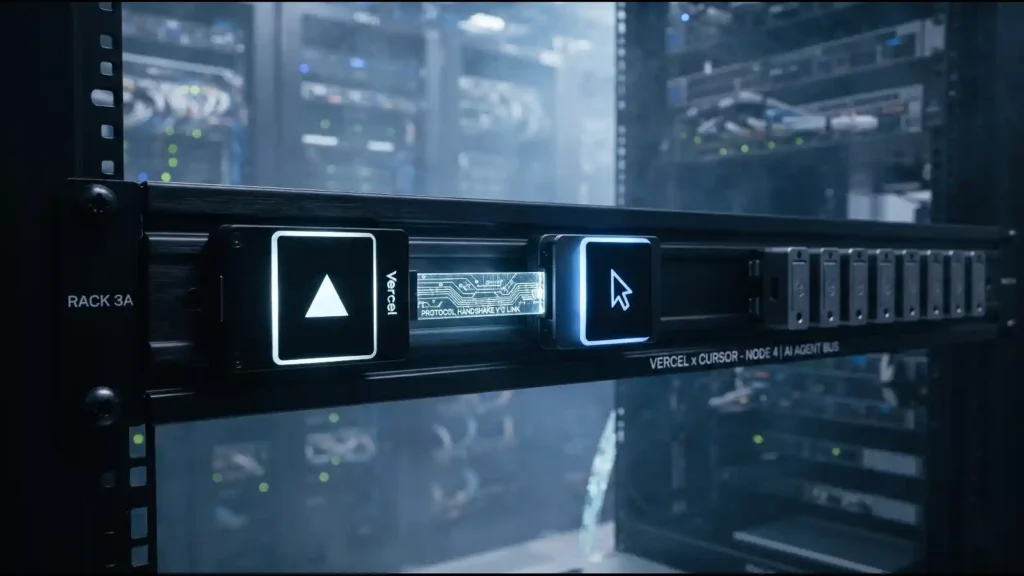
Vercel has added Cursor to the AI SDK harness layer through the official @ai-sdk/harness-cursor adapter, making the cursor available harness accessible through the same HarnessAgent interface used for other coding agents. The integration connects Cursor through the Agent Client Protocol, letting applications change supported agent harnesses without rewriting their core application interface.
The August 27, 2026 release extends a harness lineup that already includes Claude Code, Cline, Codex, Deep Agents, Grok Build, OpenCode, and Pi. Vercel’s announcement positions the harness layer as a common application boundary: developers can keep their surrounding product logic stable while selecting a different coding-agent runtime behind that boundary.
For teams evaluating a Cursor harness SDK integration, the important point is architectural rather than cosmetic. Cursor still runs as Cursor; the AI SDK adapter provides a standardized way to invoke it. That separation can reduce custom integration work, but it does not remove the need to test each agent’s permissions, authentication, repository behavior, and execution characteristics.
What changed in the Cursor available harness integration?
Vercel’s new Cursor adapter turns the AI SDK harness layer into a more practical abstraction for teams that want to run different coding agents behind one application interface. Instead of designing one integration around Cursor and another around Claude Code or Codex, an application can target HarnessAgent and select the harness it needs. For Cursor specifically, the official @ai-sdk/harness-cursor adapter delegates the connection to the ACP-based harness path, which is the key architectural detail behind the release. Cursor’s own ACP documentation describes ACP as a client-server protocol in which the Cursor CLI can run as an ACP server and communicate over standard input and output using JSON-RPC. In practice, that means the AI SDK is not replacing Cursor’s agent runtime. It is standardizing how an application talks to that runtime. The value is portability at the orchestration layer: application logic can stay stable while the selected coding-agent harness changes.
How the adapter stack fits together
The release can be understood as a four-part path rather than a new standalone coding model.
Vercel’s Cursor harness changelog says the adapter uses @ai-sdk/harness-acp under the hood. That design matters because ACP becomes the protocol bridge while HarnessAgent remains the application-facing contract.
Why does a common coding-agent harness matter?
The release matters most for applications that treat coding agents as infrastructure rather than as a single editor feature. A product team may want one agent for a repository task, another for a different workflow, or the ability to change providers as agent capabilities evolve. A shared HarnessAgent interface reduces the amount of application-specific glue required for those choices. That does not make the underlying agents identical: Cursor, Claude Code, Cline, Codex, Deep Agents, Grok Build, OpenCode, and Pi still retain their own runtimes, behaviors, permissions, and tool conventions. The abstraction sits above them. This distinction is important for engineering teams evaluating Cursor harness vs Claude Code, because the AI SDK layer simplifies invocation without erasing operational differences. Teams still need to validate authentication, permissions, sandboxing, repository access, failure handling, and output quality for each harness before treating agent switching as a drop-in production decision.
That broader shift is also visible in Vercel’s growing focus on agent infrastructure. Its AI SDK documentation describes the toolkit as framework-agnostic, while Vercel has separately published guidance for building and running coding-agent harnesses. BriefFlash recently examined a related idea in Nvidia’s AVO agent harness, where memory, tools, feedback, and supervision around the model were central to agent performance.
Cursor harness vs Claude Code: what actually becomes interchangeable?
At the AI SDK boundary, the main thing that becomes interchangeable is the way an application invokes a supported harness. The underlying agents do not become functionally equivalent. Cursor can expose its own agent runtime through ACP, while Claude Code and the other supported harnesses keep their respective execution models.
That means a team can architect the application around one common interface, then evaluate agents according to the job rather than hard-wire the product around one vendor. The benefit is similar to provider abstraction elsewhere in AI development: a stable application layer can make experimentation easier and reduce migration friction.
The trade-off is that abstraction can hide meaningful differences if teams stop testing below the interface. A coding agent may have different permission prompts, filesystem assumptions, tool behavior, context handling, or authentication requirements. Production systems therefore need per-harness evaluation even when the application code uses the same top-level interface.
This is also why agent governance remains important. BriefFlash’s coverage of AgentCore tool-access governance showed how access scopes can become a first-class design concern once agents interact with real enterprise systems.
Which harnesses does the AI SDK layer support?
According to Vercel’s August 27 announcement, the supported set now includes:
- Cursor
- Claude Code
- Cline
- Codex
- Deep Agents
- Grok Build
- OpenCode
- Pi
Vercel also says more harnesses are coming. The practical implication is that the harness layer is developing into a compatibility surface for coding-agent runtimes rather than a one-off adapter for a single tool.
That direction fits a broader pattern in agent software: developers increasingly need to combine models, tools, sandboxes, permissions, and workflow logic without rebuilding the application around every runtime. BriefFlash has also covered how OpenAI’s agent expansion faces a trust test as these systems move into everyday work, reinforcing why operational controls matter as much as model choice.
What does ACP contribute to the Cursor integration?
Cursor documents ACP as a protocol for connecting its agent to external clients. In ACP mode, the Cursor CLI can be started as an agent server, while a client communicates with it through JSON-RPC over standard input and output. Cursor’s documentation also describes session creation, authentication, streamed updates, permission requests, and cancellation within that protocol flow.
For the AI SDK harness layer, ACP provides the bridge that lets Cursor participate without requiring Vercel to redefine Cursor’s internal runtime. The Cursor-specific adapter can sit on top of the general ACP harness adapter, while applications continue to deal with the higher-level HarnessAgent interface.
That layering is the most important technical point in the announcement. It separates three concerns: the application interface, the interoperability protocol, and the actual coding-agent runtime. Teams can therefore reason about integration portability without pretending that every agent behaves the same once execution begins.
What should engineering teams verify before adopting it?
A Cursor available harness example is useful only if it survives the realities of production. Before standardizing on the harness layer, engineering teams should test the parts the common interface cannot guarantee:
- Authentication: confirm how Cursor and every alternative harness receive credentials.
- Permissions: verify how file edits, terminal commands, and approval flows are surfaced.
- Repository access: test workspace paths, branch behavior, and access boundaries.
- Failure handling: define what happens when an agent process exits, stalls, or returns incomplete work.
- Sandboxing: separate untrusted code execution from sensitive application credentials where appropriate.
- Observability: record which harness ran, what tools it used, and what changes it produced.
- Evaluation: compare task completion quality on the same repository and prompts before switching agents in production.
The harness abstraction can lower integration friction, but operational equivalence still has to be demonstrated by the team using it.
What the release signals for coding-agent infrastructure
Cursor joining the AI SDK harness layer is a small API addition with a larger architectural implication. Coding agents are increasingly being treated as swappable runtimes that can sit behind application-controlled orchestration rather than as isolated desktop experiences.
For Vercel, the value of the harness layer is the common boundary. For Cursor, ACP provides a standards-based route into that boundary. For developers, the immediate benefit is the possibility of building one integration surface while retaining the option to run Cursor or another supported coding agent.
The remaining work is operational. Teams still need to decide which harness performs best for each workflow, how permissions are enforced, how agent actions are observed, and where execution should be isolated. The new adapter removes one layer of integration work; it does not remove those engineering decisions.
Key Takeaways
- Vercel’s official @ai-sdk/harness-cursor adapter brings Cursor into the AI SDK harness layer behind the shared HarnessAgent interface.
- The Cursor adapter uses @ai-sdk/harness-acp underneath, with ACP acting as the protocol bridge between the application-facing harness layer and Cursor’s agent runtime.
- The common interface can reduce integration friction across supported coding agents, but teams still need per-harness testing for permissions, authentication, sandboxing, reliability, and output quality.
- The supported harness lineup listed by Vercel includes Cursor, Claude Code, Cline, Codex, Deep Agents, Grok Build, OpenCode, and Pi.
FAQ
What is the cursor available harness in the Vercel AI SDK?
It is Vercel’s official Cursor integration for the AI SDK harness layer. The @ai-sdk/harness-cursor adapter lets applications invoke Cursor through the same HarnessAgent interface used for other supported coding-agent harnesses, while the adapter relies on the ACP harness path underneath.
How does Cursor harness vs Claude Code work in the AI SDK?
The AI SDK gives applications a common HarnessAgent interface, but Cursor and Claude Code remain different underlying agent runtimes. The shared layer can simplify how an application selects or invokes a harness, while authentication, permissions, tool behavior, repository access, and execution characteristics still need to be tested separately.
Does the Cursor available harness announcement include Android support?
No Android-specific support is described in Vercel’s August 27, 2026 announcement. The release concerns connecting Cursor to the AI SDK harness layer through ACP, so Android compatibility should not be inferred from this announcement alone.