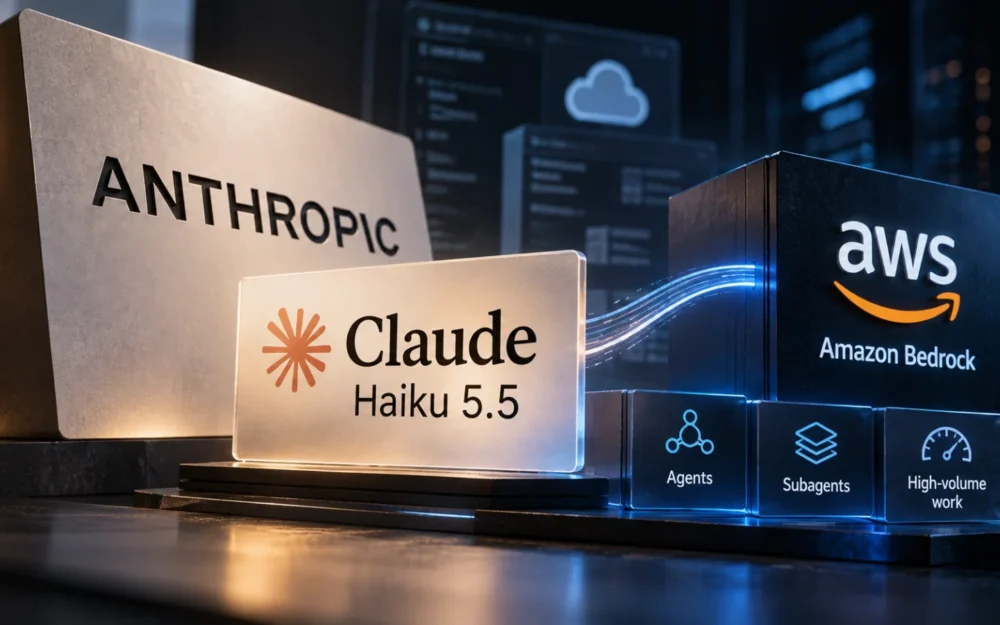


Amazon Web Services published a four-scope framework on August 21, 2026, to govern agent tool access through Amazon Bedrock AgentCore Gateway. The design gives MCP-enabled AI assistants one managed entry point for enterprise tools, then adds identity-aware policy, safety filters, cataloging, private connectivity, audit trails, and regional resilience only as operational risk grows.
The approach is deliberately incremental. AWS recommends beginning with one low-risk tool rather than constructing an enterprise-wide control plane before teams understand their requirements. The four scopes—Connect, Control, Catalog, and Harden—map added infrastructure to specific problems such as credential sprawl, missing audit evidence, tool-registration bottlenecks, public network exposure, or weak disaster recovery.
This is not a new agent model or a benchmark claiming smarter reasoning. It is an access architecture for controlling the actions agents can request. Its value depends on correct identity design, restrictive policies, protected credentials, complete logging, and whether organizations prevent assistants from bypassing the gateway.
Why do enterprises need to govern agent tool access?
The AWS technical guide begins with a common operational failure: every assistant carries its own tool endpoints and backend secrets in a local mcp.json file. Ten assistants connected to five internal APIs create 50 separately maintained credential sets, according to AWS’s example. That arrangement produces five recurring problems: credential sprawl, policy drift, audit gaps, cost opacity, and shadow integrations. Authors Talha Chattha and Mia Chang frame the core audit question as, “Which AI agents have access to customer data, who granted it.” AgentCore Gateway addresses the routing layer by placing one managed endpoint between MCP clients and enterprise targets. AgentCore Identity handles authentication and outbound credentials, while AgentCore Policy evaluates authorization rules. CloudTrail and CloudWatch add evidence about invocations and operational behavior. The gateway does not require teams to move every API into one platform; it centralizes the access path while tools can remain in AWS, SaaS platforms, other clouds, or on-premises environments.
The governance focus connects directly with BriefFlash’s analysis of why agentic AI readiness often trails adoption. Giving an assistant a tool is easy. Establishing who authorized the connection, what arguments it may send, which credentials it uses, and how investigators reconstruct an incident is the harder production problem.
How does the four-scope maturity model work?
Scope 1: Connect one low-risk tool
AWS positions Connect for a pilot of 1–20 users, low-risk tools, and early signs of shadow MCP adoption. A team creates AgentCore Gateway, points its JWT authorizer at an identity provider such as Amazon Cognito, and registers a read-only Lambda target. AgentCore Identity keeps the downstream credential away from individual client configurations. The assistant’s mcp.json stores the gateway URL rather than a production password.
This stage provides an inventory and a consistent audit path, but it is not fine-grained authorization. In AWS’s reference design, any authenticated client can invoke any registered tool. Teams should therefore avoid placing destructive or sensitive targets behind a Scope 1 gateway until stronger rules exist. The official rollout sequence provisions the gateway and target first, distributes configuration next, and then verifies token retrieval, tools/list, tools/call, CloudWatch Logs, and CloudTrail records.
Scope 2: Control identity, parameters, and sensitive data
Control changes the trust model from an authenticated machine to an identified user. A Dynamic Client Registration shim adds MCP clients to the gateway, while Authorization Code with PKCE connects the user to corporate SSO. The access token’s sub claim then represents that user on each request. AgentCore Policy applies Cedar rules using roles, groups, token claims, resources, and tool parameters; a deployment tool, for example, can be limited to a staging environment. AWS advises starting Policy in LOG_ONLY, examining decisions, and moving to ENFORCE after validation. Amazon Bedrock Guardrails can detect prompt attacks and filter personally identifiable information, while Lambda interceptors handle transformations outside native guardrail coverage. For third-party tools, three-legged OAuth obtains user consent. Where a downstream service trusts the same identity chain, On-Behalf-Of exchange produces a scoped token carrying user and agent identity. Logs retain the principal, matched policy, guardrail flag, and latency, creating a more useful audit record.
This stage explains why an MCP endpoint alone is not a governance system. A hosted gateway can reduce local credential handling, as seen in BriefFlash’s coverage of a hosted MCP server, but enterprise control also needs user attribution, parameter restrictions, consent, and defensible deny decisions.
What changes at the Catalog and Harden stages?
Scope 3: Catalog tools without moving them
AWS recommends Catalog when tool-registration tickets become a bottleneck or the gateway must reach other clouds and on-premises systems. The post identifies more than 100 users as a practical signal, not a hard service limit. AWS Agent Registry stores ownership and discovery metadata. A Resources MCP server distributes shared standards and runbooks. Version-controlled manifests can declare allowed groups, environments, and risk tiers, while a continuous integration pipeline validates changes before registering a target.
Cedar remains useful for identity and resource decisions. Open Policy Agent can supplement it when rules require logic such as time windows or a mandatory change-ticket identifier. PrivateLink and Direct Connect provide paths to private or on-premises targets without relocating the underlying workload. Per-tool tags, AWS Budgets, and Cost Explorer can attribute spending to the responsible team. That separation—central governance without infrastructure consolidation—is the model’s main architectural advantage.
Scope 4: Harden a shared production control plane
Harden applies when the gateway serves broad production use and requires private ingress, formal recovery, traffic controls, and lifecycle management. AWS describes the trigger as more than 1,000 users combined with gaps such as public DNS, absent circuit breakers, or no failover. The reference architecture adds CloudFront, a restricted Application Load Balancer, a VPC endpoint, AWS WAF, governance queries, Route 53 health checks, and an active-passive second Region.
The operational details matter. Tools should be idempotent so a retry after DNS failover does not repeat a destructive action. Clients need to handle 429 responses and Retry-After. AWS’s sample checks for tools with no invocations over 30 days, opens a deprecation pull request, and removes the target after 90 days. Those figures are example lifecycle settings, not mandatory platform defaults.
Which targets and authentication methods are supported?
The AgentCore Gateway documentation says the service can transform OpenAPI, Smithy, and Lambda inputs into agent-ready tools. It can also front MCP servers, other agents, HTTP services, and model-routing targets. Incoming callers can use JWT or AWS IAM authentication. The inbound authorization documentation warns that AUTHENTICATE_ONLY and NONE modes do not make an authorization decision; another policy engine, interceptor, or downstream target must enforce access.
Outbound options depend on the target. Gateway can use its IAM role with AWS Signature Version 4, an OAuth client, an API key stored through AgentCore Identity, or no authorization for a public endpoint. AWS notes that SigV4 only works when the destination can verify signed AWS requests. A direct EC2 endpoint or Application Load Balancer does not automatically gain that ability merely because Gateway signs the call.
How much could AgentCore Gateway cost?
AWS gives a reference estimate of approximately $17 per month for 50 developers generating 572,000 total operations. The calculation uses Gateway InvokeTool pricing of $5 per million operations and Policy authorization pricing of $25 per million; Identity is an unconfirmed estimate of around $0 when consumed through Gateway. These figures come from the August 21, 2026 guide and should be checked against the current AgentCore pricing page before budgeting.
The estimate covers Gateway and Policy in that scenario, not every supporting component. Cognito, Lambda, API Gateway, Guardrails, CloudWatch, CloudTrail data events, WAF, PrivateLink, Route 53, cross-Region resources, and network transfer may create separate charges depending on the design. Cost attribution is therefore part of governance, not an afterthought. This is especially relevant when agents gain transaction capabilities, as explored in BriefFlash’s report on AgentCore payment guardrails.
What are the main limitations and security risks?
A central gateway reduces distributed secrets but creates shared critical infrastructure. AWS explicitly notes that when the gateway is unavailable, assistants depending on it are unavailable. Organizations need separate development, staging, and production environments, infrastructure as code, tested recovery, and a decision between one organization-wide gateway or multiple business-unit gateways.
Other boundaries deserve attention:
- Bypass risk: Direct MCP connections remain outside gateway policy unless corporate proxies or endpoint controls block them.
- Policy errors: A poorly written Cedar, OPA, IAM, or interceptor rule can over-permit access or block legitimate work.
- Regional coverage: AgentCore Gateway and Bedrock Guardrails availability varies by AWS Region.
- Logging privacy: AWS warns that some JWT claims, including the subject, can appear in CloudTrail; teams should avoid placing personally identifiable information in that field.
- Credential scope: Central storage does not compensate for long-lived, overprivileged, or unrotated downstream credentials.
- Vendor dependency: Managed integration reduces operational work but ties the control plane to AWS services, APIs, regional availability, and pricing.
The safest adoption path is narrow and observable: begin with a read-only target, validate identity propagation and logs, test policy in non-enforcing mode, and expand only after a specific governance problem appears. That is the strongest part of AWS’s framework. It treats governance as a sequence of measurable controls rather than a one-time platform purchase.
Key Takeaways
- AWS’s four-scope model progresses from Connect to Control, Catalog, and Harden only when a concrete governance or scale problem appears.
- AgentCore Gateway centralizes the access path without requiring APIs, SaaS tools, or on-premises systems to move into one infrastructure stack.
- Identity, Cedar policies, Guardrails, delegated OAuth, audit logs, private networking, and failover address different risks and should not be treated as interchangeable controls.
- The gateway reduces credential sprawl, but bypass paths, policy mistakes, regional availability, supporting-service costs, and shared-infrastructure outages still require active management.
FAQ
What is Amazon Bedrock AgentCore Gateway?
AgentCore Gateway is a managed AWS service that provides one entry point for agentic traffic. It can expose APIs, Lambda functions, MCP servers, other agents, HTTP services, and model routes while coordinating inbound authentication, target credentials, authorization policies, observability, and auditing.
Does AgentCore Gateway replace existing enterprise tools?
No. The gateway centralizes discovery, authentication, routing, policy, and auditing while targets can remain in AWS, SaaS platforms, another cloud, or an on-premises environment. PrivateLink, Direct Connect, OAuth, API keys, IAM, and passthrough targets support different connection patterns.
Should every organization implement all four maturity scopes?
No. AWS recommends starting with a low-risk tool in Scope 1 and advancing only when specific needs arise. Small pilots may not require a registry, multi-Region failover, or complex ABAC, while production deployments handling sensitive actions may need those controls earlier.