

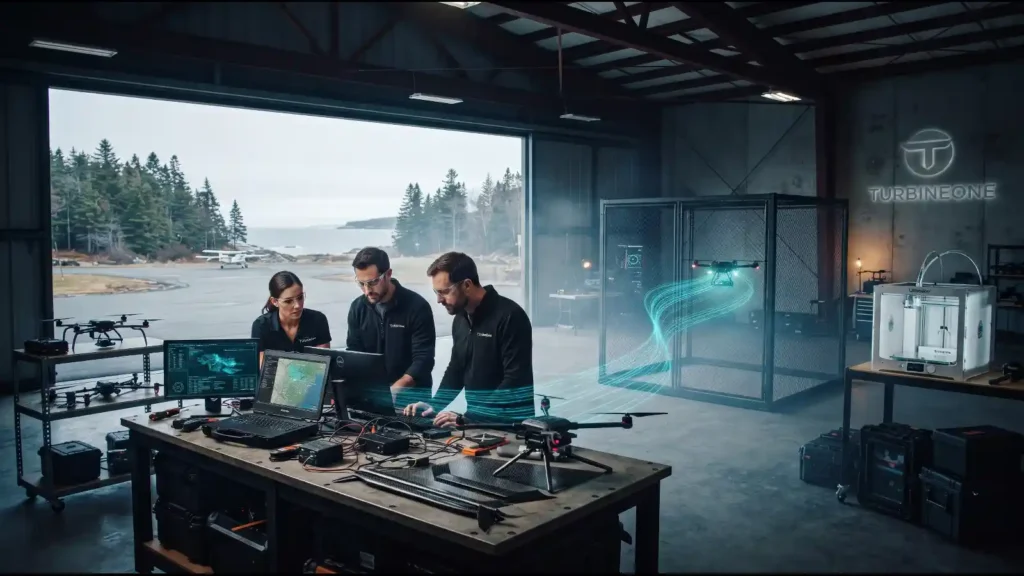
TurbineOne opens MachineWorks in Old Town, Maine, as a new hub for edge AI, autonomous systems, 3D manufacturing, and rapid defense prototyping. Opened August 27, 2026, the facility expands the company’s U.S. footprint and gives engineers a dedicated place to connect software development with physical testing near aerial and maritime environments.
TurbineOne says it expects to invest an initial $275,000 in the operation. The company also says it is executing a nearly $99 million U.S. Army contract, while local reporting identifies the award as a $98.9 million Department of Defense contract secured in 2025. No facility size, hardware inventory, production target, or performance benchmark was disclosed.
What is T1 MachineWorks in Maine?
T1 MachineWorks is TurbineOne’s new engineering and experimentation facility in Old Town, Maine. The company says engineers will use it to adapt AI models locally, integrate autonomy software across platforms, prototype hardware hardware through 3D manufacturing, and test aerial or other defense systems. This matters because software for autonomous platforms cannot be evaluated only as code: sensors, processors, airframes, power limits, communications links, and physical behavior must work as one system. The location near the University of Maine and aerial and maritime test environments is intended to shorten that integration loop. TurbineOne has not published the building’s square footage, compute infrastructure, drone production capacity, model benchmarks, or testing schedule. The announcement therefore establishes the facility’s mission and planned capabilities, but not measurable gains in speed, cost, reliability, or operational performance. Those omissions matter when comparing engineering ambition with operational delivery.
Why does TurbineOne emphasize edge-first AI?
Edge-first AI runs inference and mission software on hardware near the operator or sensor instead of depending continuously on a remote cloud. In defense settings, that design can preserve access to perception and decision-support tools when bandwidth is constrained, communications are disrupted, or latency makes a distant service impractical. It also creates engineering trade-offs. Tactical devices have limited compute, memory, power, cooling, and storage, so models may need compression, hardware-specific optimization, controlled update paths, and careful evaluation against changing sensor data. TurbineOne says its software can be deployed and adapted on tactical hardware across connected and disconnected environments, but the MachineWorks announcement provides no processor specifications, model sizes, accuracy results, or resilience tests. The facility should therefore be understood as development infrastructure for tackling edge constraints, not proof that a particular autonomy system has already met a defined military performance threshold.
That constraint-driven work is related to broader low-power edge AI research and recent efforts to make compressed models preserve capability. T1 MachineWorks adds a physical systems layer by bringing model adaptation, autonomy code, sensors, and prototype airframes into one location.
What will engineers build and test at the facility?
The company announcement identifies autonomous systems, cross-platform autonomy software, 3D manufacturing, rapid prototyping, and aerial platforms as planned work areas.
Bangor Daily News reported that the warehouse will be used to manufacture and test drones, including lower-cost systems intended for military training. CTO Matt Amacker said the company needs physical aircraft to test autonomy software and help military users practice defending against drones. The report also described an earlier improvised “drone tank” built with netting in Amacker’s backyard; the Old Town warehouse provides a larger indoor environment while the company pursues outdoor-testing licenses.
This changes the development workflow from a primarily distributed software effort into a tighter loop:
- Adapt an AI model for the intended sensor and tactical hardware.
- Integrate the model with autonomy and platform-control software.
- Build or modify a physical prototype using available materials.
- Test behavior in a contained environment and record failures.
- Revise software or hardware before broader outdoor testing.
The sequence is an editorial reconstruction of the announced capabilities, not a published TurbineOne testing protocol.
Why did TurbineOne choose Old Town, Maine?
TurbineOne cites four advantages: proximity to the University of Maine, local manufacturing partners, technical talent, and access to aerial and maritime environments. The facility sits in Old Town’s airport business park, according to Bangor Daily News, giving the company an industrial space connected to relevant test conditions.
Chief Growth Officer Jamie De Coster told local station WABI that Maine’s willingness to help build and solve problems drew the company to the state. Maine Department of Economic and Community Development Commissioner Michael A. Duguay characterized the project as an innovation-driven investment that could strengthen links to the state’s research ecosystem.
The initial $275,000 commitment is modest compared with large defense manufacturing plants. MachineWorks appears designed first as an experimentation and prototyping hub rather than a disclosed mass-production site. That distinction matters: rapid iteration can support engineering progress, but it does not establish manufacturing scale, supply-chain resilience, or a sustained local employment impact.
How does MachineWorks fit TurbineOne’s expansion?
T1 MachineWorks follows TurbineOne’s May 2026 opening of T1 Edgeworks in Chantilly, Virginia. Edgeworks serves as the company’s headquarters and an R&D and demonstration center near the U.S. defense and intelligence community. The Maine site has a more physical emphasis, combining autonomy software with manufacturing and testing.
This two-site structure can connect customer feedback in Virginia with build-and-test work in Maine. TurbineOne has not disclosed how teams, budgets, data, or approval authority will be divided between the locations.
What does the Army contract establish?
TurbineOne’s release says the company is executing a nearly $99 million U.S. Army contract and that its technology is deployed across the U.S. military. Bangor Daily News reported a $98.9 million Department of Defense contract secured in 2025. The public materials reviewed for this article do not provide the full award record, ceiling structure, obligated amount, performance period, or percentage of the contract connected to MachineWorks.
The figure should therefore be read as reported contract value, not as MachineWorks funding or guaranteed revenue for the Maine operation. The only investment specifically attached to the new site in the announcement is the planned initial $275,000.
What remains unconfirmed?
- The facility’s square footage, equipment inventory, staffing level, and opening production capacity.
- Which AI models, processors, sensors, drone platforms, or autonomy standards will be tested.
- Quantified targets for latency, recognition accuracy, communications resilience, cost, or deployment time.
- The timetable and regulatory approvals for outdoor aerial or maritime testing.
- How much of the reported Army contract is obligated or directly related to work in Maine.
TurbineOne opens MachineWorks with a clear engineering thesis: defense AI must be tested as part of a physical system under real operating constraints. The Maine hub gives the company dedicated space to connect software, autonomous hardware, manufacturing, and operator training. Its impact will become measurable only when TurbineOne publishes testing outcomes, production data, field evaluations, or contract milestones tied to the facility.
Key Takeaways
- TurbineOne opened T1 MachineWorks in Old Town, Maine, on August 27, 2026, for edge-AI, autonomy, hardware, and drone experimentation.
- The company plans an initial $275,000 investment and selected the location for university access, manufacturing links, and aerial and maritime testing environments.
- Local reporting says the airport-business-park warehouse will manufacture and test lower-cost drones for autonomy development and military training.
- No facility size, staffing total, compute specification, model benchmark, production target, or outdoor-testing schedule has been disclosed.
FAQ
What is T1 MachineWorks?
T1 MachineWorks is TurbineOne’s new defense-technology engineering and experimentation hub in Old Town, Maine. It is intended for edge-AI model adaptation, cross-platform autonomy software, 3D manufacturing, rapid prototyping, and testing of aerial and other autonomous systems.
How much is TurbineOne investing in Maine?
TurbineOne says it expects to make an initial $275,000 investment in its Old Town operation. The company has not disclosed the facility’s total long-term capital budget, annual operating cost, or production capacity.
Why is edge AI important for defense missions?
Edge AI can run on hardware near an operator or sensor, reducing dependence on continuous cloud connectivity. That can be useful where bandwidth is limited or communications are disrupted, although the hardware must still manage constraints involving compute, memory, power, cooling, storage, security, and model updates.