
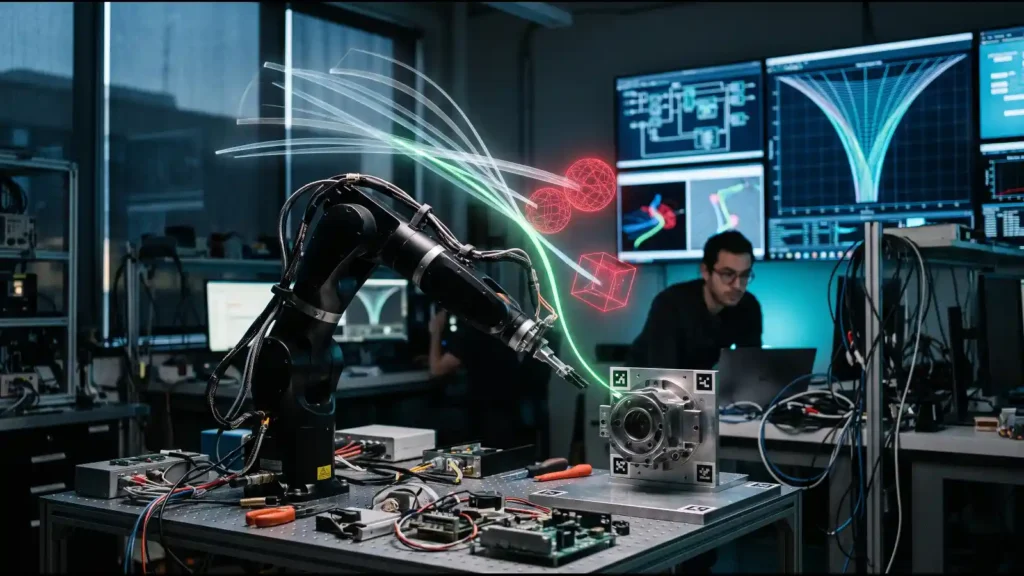
MIT researchers have built a new algorithm called HardFlow that lets pretrained generative AI models satisfy hard, nonnegotiable safety requirements without retraining, according to a paper MIT published on September 14, 2026. The method targets a specific failure mode in high-stakes applications: generative models that get close enough on nearly every task, when close enough is not an option, such as a robot arm that might collide with a coworker or a control system that has to stay inside strict physical limits.
The work comes from lead author Zeyang Li, a mechanical engineering graduate student at MIT's Laboratory for Information and Decision Systems, co-author Kaveh Alim, a graduate student in the Institute for Data, Systems, and Society, and senior author Navid Azizan, an associate professor across both departments and a LIDS principal investigator. Their paper, "HardFlow: Hard-Constrained Sampling for Flow-Matching Models via Trajectory Optimization," was peer-reviewed and published this week in IEEE Transactions on Pattern Analysis and Machine Intelligence, with a preprint also posted to arXiv.
Quick Take
- MIT researchers built HardFlow, an algorithm that makes pretrained generative AI models satisfy strict safety or physical constraints on their final output, without retraining the model.
- Across four simulated benchmark tasks, including robotic manipulation and maze navigation, HardFlow met its required constraint on every trial while outperforming six rival methods on solution quality.
- Every result reported so far comes from simulation. No lab outside MIT has independently reproduced the benchmark comparisons, and most outside coverage simply reposts MIT's own release.
The Details
Generative models built on diffusion or flow matching, the architecture behind tools like Stable Diffusion and FLUX, build an output gradually, nudging random noise toward a finished result step by step. The standard way to force that output to obey a hard rule is projection-based sampling, which checks and corrects every intermediate step along the way. MIT's team argues that approach boxes the model in, since forcing compliance at every step can stop it from finding a better final answer.
HardFlow instead reframes the problem using tools from optimal control. It treats the small adjustments a model makes at each generation step as controllable inputs, then solves for the sequence of adjustments that steers the process toward an output satisfying the constraint, checking compliance only at the very end. Because it works on top of an already-trained model, HardFlow can be applied at deployment time without retraining anything.
The team tested HardFlow against six existing methods across four tasks: a simulated robotic arm reaching for objects while avoiding obstacles (the D3IL benchmark), maze navigation (Maze2D), controlling the boundary conditions of a physical process, and text-guided image editing. Across all four, HardFlow satisfied its constraint on every trial while outperforming the other methods on solution quality, and its computation time matched or beat most competitors. In the robotic-arm test specifically, HardFlow found collision-free paths that were also the fastest route to the target, while most rival methods either collided with obstacles or took longer paths.
Why It Matters
I have read enough "solves AI safety" claims over the years to know the gap between a clean benchmark and something that survives a real deployment. What makes this one worth tracking is the mechanism, not the framing: HardFlow is a deployment-time wrapper for models people already run, not a new model that needs its own adoption cycle. If it holds up, it addresses a real bottleneck for anyone trying to put diffusion or flow-matching models into robotics or process control, a space where enterprises are already being told to take AI safety seriously well beyond the model layer.
The caveat matters just as much. Every benchmark in the paper, robotic manipulation, maze navigation, physical process control, and image editing, ran inside a simulator, and MIT's release does not report results on physical hardware or a production system. Peer review at IEEE Transactions on Pattern Analysis and Machine Intelligence checks methodology and presentation, not whether an outside team can reproduce the numbers. As of this piece publishing, no lab outside MIT has independently rerun the comparisons.
What to Watch
Two things worth tracking. First, whether an outside group replicates the results, especially the claim of meeting constraints on every single trial across all four tasks. Second, whether HardFlow generalizes past geometric and physical constraints toward the fuzzier, harder-to-formalize safety rules that matter for language model outputs, since the paper does not test that case. MIT's team says a future version could let the underlying model update alongside the constraint-enforcement step, which would be the clearer signal this is moving past a controlled benchmark.
Claims of a model being its safest version yet deserve the same scrutiny, which is exactly what played out with OpenAI's safety claims for GPT-6 Astra earlier this year.
Key Takeaways
- MIT's HardFlow algorithm enforces hard safety and physical constraints on generative AI outputs without retraining the underlying model.
- In simulated tests, HardFlow satisfied its required constraint on every trial across four tasks, beating six existing methods on solution quality.
- All results are simulation-only so far, and no outside lab has independently reproduced MIT's benchmark comparisons.
- The paper, led by Zeyang Li and Navid Azizan, is peer-reviewed and published in IEEE Transactions on Pattern Analysis and Machine Intelligence.
FAQ
Can you give me an example of a safety-critical system?
Aircraft flight control systems, autonomous vehicle collision avoidance, medical infusion pumps, nuclear plant control systems, and industrial robots working near people on a factory floor are all common examples. MIT's HardFlow research uses a robotic arm avoiding obstacles as its test case for this category.
What does "safety critical" mean?
A system, task, or component is safety-critical when its failure or error could cause death, injury, significant property damage, or serious environmental harm. In these systems, an output that is merely close to correct is not acceptable, which is the exact gap HardFlow is designed to close for generative AI models.
What are safety-critical tasks?
Safety-critical tasks are ones where a system must satisfy strict, nonnegotiable requirements every time, with no tolerance for near misses. Examples from MIT's research include a robot path-planning around obstacles and a control system staying within the physical boundaries of a process.
What is a safety-critical item?
A safety-critical item is a specific part, component, or piece of software whose failure could directly lead to injury, death, or major equipment loss. Industries like aviation and medical devices formally classify these items and subject them to stricter design and certification requirements than non-critical components.