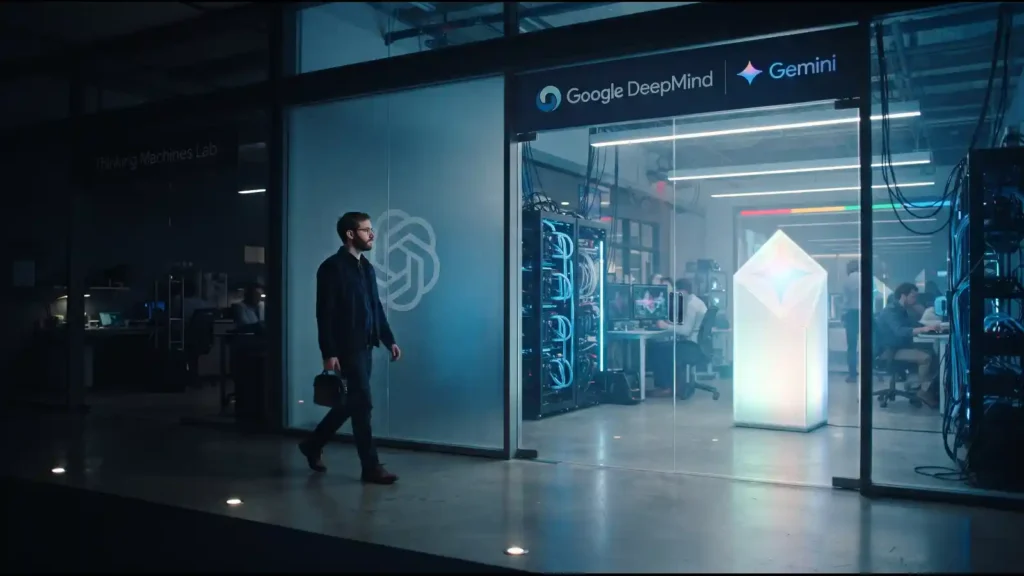
Barret Zoph, the former Thinking Machines Lab co-founder and CTO, is joining Google DeepMind as vice president of research after a brief return to OpenAI. Announced on August 26, 2026, the move puts the Barret Zoph Thinking Machines story inside Google’s Gemini effort, focused on reinforcement learning and post-training.
The appointment is a return, not a first chapter. Zoph spent six years at Google Brain before moving to OpenAI, later helped create Thinking Machines with Mira Murati, and returned to OpenAI in January 2026. He left again in June after five months. Google has not disclosed his reporting line, team size, compensation, or a project schedule beyond the role announcement.
What has Google and Barret Zoph confirmed?
The confirmed record is narrower than some headlines suggest. Zoph announced on X that he is joining Google DeepMind and will work on reinforcement learning, commonly shortened to RL, and post-training. Reuters reported that his title is vice president of research. Google also told The Wall Street Journal that it expects his expertise to contribute to Gemini.
What does the Barret Zoph Thinking Machines move mean?
Google is hiring a researcher whose experience spans model research, post-training leadership and enterprise commercialization. Zoph said he would be “working on RL and Post-Training,” while a Google spokesperson said the company expects him to bring that expertise to Gemini. That wording matters. Reinforcement learning and post-training happen after base-model pretraining and help shape how a system follows instructions, uses tools, handles feedback and performs on targeted tasks. The appointment therefore points toward model behavior and product readiness, not only exploratory research. Yet the exact mandate remains undisclosed: Google has not named the models, teams, budgets, benchmarks or delivery dates attached to Zoph’s role. It is reasonable to infer that his work will touch Gemini because Google said so, but not that he controls the entire Gemini roadmap. This distinction separates the confirmed appointment from speculation about Google’s wider organizational plans.
That focus fits a wider push to turn research models into dependable products. BriefFlash has separately examined Google’s agent-led biomarker research and the way DeepMind alumni are building research agents, two examples of how model capability increasingly meets applied workflows.
How did Zoph move from Thinking Machines to Google?
Zoph left OpenAI in October 2024 to co-found Thinking Machines Lab with former OpenAI CTO Mira Murati. He served as the startup’s CTO until January 2026, when the company said it had parted ways with him. Later reporting described the departure as a firing, while Zoph disputed how the sequence was characterized; the underlying disagreements are not fully documented in public. He then returned to OpenAI with Luke Metz and Sam Schoenholz. The Verge reported that Zoph led enterprise AI sales and left after five months in June. His Google DeepMind appointment was announced on August 26. The facts establish rapid movement across three frontier AI organizations, but they do not establish why he chose Google, what employment terms were offered, or whether his short second OpenAI stint was designed as a temporary assignment. Those points remain unconfirmed.
The sequence also explains why the “Barret Zoph leaves Thinking Machines” query needs careful treatment. TechCrunch’s updated account says he was fired, but public accounts differ on the circumstances. A responsible summary can report the ouster without presenting disputed allegations as settled fact.
Why is Barret Zoph’s research record relevant?
Zoph’s earlier work helps explain Google’s emphasis on RL and post-training. His research biography says he worked on large sparse language models, MUM, AutoML and neural architecture search at Google Brain. At OpenAI, he led post-training research covering alignment, tool use, evaluations, search and multimodality. The page is useful as a research archive, although its job description is outdated and should not be used to determine his current employer.
His published record predates the current generative AI cycle. A 2017 paper with Quoc V. Le used reinforcement learning to search for neural-network architectures. A later NASNet paper reported 82.7% top-1 and 96.2% top-5 ImageNet accuracy, with 28% less computational demand than the comparison model used by the authors. Those are historical paper results, not Gemini benchmarks, but they show a long-running connection between Zoph’s work, automated model design and reinforcement learning. Readers searching for “Barret Zoph Google Scholar” can also find his publication profile through the Scholar link on his personal research page.
What could his Google role change for Gemini?
The near-term significance is organizational. Google gains an executive who has worked across foundational research, post-training and enterprise adoption. Post-training teams often translate broad model capability into instruction following, tool behavior, evaluation performance and production safeguards. Zoph’s recent enterprise role may also give him practical context about what companies need before deploying AI systems.
That does not guarantee a particular Gemini release or benchmark improvement. Google has announced no model version, launch date or performance target tied to the hire. The best evidence-based interpretation is that DeepMind is strengthening the layer between pretrained models and usable systems. That challenge also appears in OpenAI’s agent adoption test, where capability alone does not resolve questions about trust, usability and governance.
What remains unknown?
- Google has not disclosed Zoph’s reporting line, team size, budget or start date.
- Neither Google nor Zoph has identified a specific Gemini model or product deadline connected to his work.
- Public reporting does not settle every disputed detail surrounding his exit from Thinking Machines Lab.
- No reliable source reviewed for this article confirms Barret Zoph’s net worth, salary, age, wife or other private family details. Search estimates should not be treated as facts.
The appointment is still meaningful without filling those gaps with guesses. Google DeepMind has confirmed the role, Zoph has stated his technical focus, and Google has tied that expertise to Gemini. The next reliable signal will be a named research program, published paper, model card or product release that shows how his new team’s work reaches users.
Key Takeaways
- Barret Zoph has joined Google DeepMind as vice president of research after leaving OpenAI in June 2026.
- Zoph says his work will focus on reinforcement learning and post-training; Google has connected that expertise directly to Gemini.
- His career includes six years at Google Brain, two OpenAI periods and a co-founder and CTO role at Thinking Machines Lab.
- Google has not announced a specific Gemini model, benchmark target, reporting line or release schedule tied to the appointment.
FAQ
Who is Barret Zoph?
Barret Zoph is an AI researcher and executive who has worked at Google Brain, OpenAI and Thinking Machines Lab. He co-founded Thinking Machines with Mira Murati and served as CTO, previously led post-training research at OpenAI, and has now joined Google DeepMind as vice president of research. His published work includes neural architecture search, AutoAugment, SpecAugment and other machine-learning research.
What will Barret Zoph do at Google DeepMind?
Zoph says he will work on reinforcement learning and post-training. Google has said it expects that expertise to contribute to Gemini. The company has not disclosed his exact team, reporting line, model assignments, budget or delivery schedule.
Why did Barret Zoph leave Thinking Machines Lab?
Thinking Machines said it parted ways with Zoph in January 2026, and subsequent reporting described his exit as a firing. Zoph disputed how the sequence and reasons were portrayed. Because the public accounts do not fully agree, the safest conclusion is that he was ousted after internal disagreements, while the complete circumstances remain contested.