
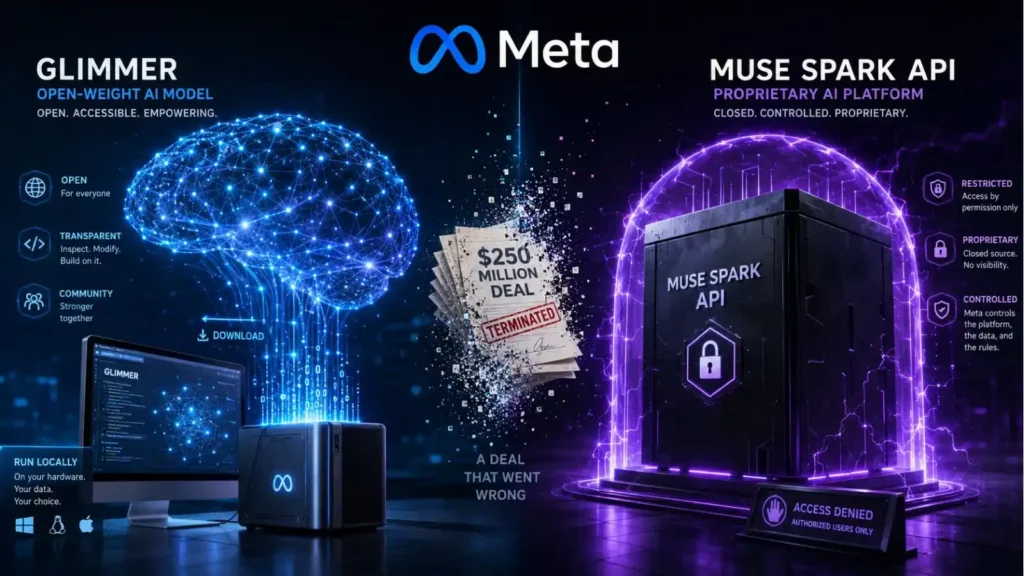
Meta released Glimmer this week, an open-weight artificial intelligence model that anyone can download and run on their own hardware. This release sharply contrasts with Muse Spark, Meta’s more powerful model that remains locked behind its proprietary APIs. The launch landed alongside a public letter from CEO Mark Zuckerberg arguing that AI should be “for everyone” rather than controlled by a handful of elite labs. This strategic push represents a major pillar of metas open 250m approach to dominating the AI landscape.
However, the celebratory rollout of open-weight models was quickly overshadowed by reports of a $250 million deal gone very wrong. The collapse of this massive financial agreement highlights the intense volatility and high stakes of the current AI talent war. While Meta attempts to position itself as the champion of democratized AI, the underlying financial maneuvers required to maintain that leadership are proving highly complex.
The juxtaposition of these two events reveals the dual-track strategy driving the industry today. On one hand, companies are racing to release accessible foundational models to capture developer mindshare and enterprise adoption. On the other hand, they are spending unprecedented sums to secure top-tier researchers. As detailed in a recent Equity podcast discussion, the gap between public altruism and corporate deal-making has never been wider.
Key Takeaways
- Meta released Glimmer, an open-weight AI model available for local hardware execution, contrasting its locked API model, Muse Spark.
- Mark Zuckerberg published a letter advocating for universal AI access, framing metas open 250m strategy as a public good.
- A reported $250 million talent deal collapsed, underscoring the volatile financial dynamics of the AI sector.
- The dual release of open and closed models signals a tiered approach to enterprise and developer market capture.
The Glimmer Release and Zuckerberg’s Open AI Mandate
Meta officially entered the next phase of its open-source AI strategy with the launch of Glimmer. Unlike proprietary systems that require users to pay for API access, Glimmer is an open-weight model. This means developers and researchers can download the model weights and run the system locally on their own hardware configurations. This local execution capability provides significant advantages for data privacy, custom fine-tuning, and offline enterprise applications.
The release was accompanied by a strongly worded letter from Mark Zuckerberg, who argued that artificial intelligence should be “for everyone” rather than tightly controlled by a small consortium of elite corporate labs. This philosophical stance directly challenges competitors like OpenAI and Google, which heavily restrict access to their most advanced model weights.
However, Meta is not abandoning proprietary technology. The company simultaneously maintains Muse Spark, a more powerful AI model that remains strictly accessible via Meta’s own APIs. This tiered approach allows the company to capture the open-source developer community while retaining exclusive control, and monetization potential, over its highest-performing architectures.
The $250M Deal Gone Wrong
While Meta promotes the democratization of AI, the financial realities of maintaining top-tier talent have caused significant friction. Recent reports highlight a $250 million deal that has gone very wrong, illustrating the precarious nature of AI talent acquisitions. The situation underscores the volatile intersection of corporate financing and individual researcher valuations. The metas open 250m narrative is therefore split between software democratization and closed-door financial battles.
The broader industry context reveals that companies are paying unprecedented premiums for AI engineers. The phrase “Meta hires AI engineer for $250 million” has circulated as a benchmark for the extreme valuations placed on top talent. The reported deal collapse serves as a cautionary tale for the sector, demonstrating that massive financial packages do not always guarantee smooth acquisitions or long-term retention. (See also: Microsoft Slashes Coding Model Prices to Stay Competitive in AI Cloud Market)
Strategic Implications for Small Businesses and Developers
The release of Glimmer has immediate implications for the developer ecosystem, but it also ties into Meta’s long-term commercial strategy. By providing an open-weight model, Meta effectively crowdsources its research and development. Developers who build upon Glimmer identify edge cases, security vulnerabilities, and novel applications that Meta can later integrate into its proprietary systems.
Furthermore, this strategy aligns with Zuckerberg’s meta small business initiatives. By lowering the barrier to entry for AI deployment, Meta positions itself as a critical infrastructure provider for small to medium-sized enterprises. Learn more about Meta Small Business AI integration strategies. When small businesses adopt open-weight models like Glimmer, they often rely on Meta’s cloud infrastructure and developer tools to manage and scale those models.
The talent acquisition side of the equation also impacts this ecosystem. Researchers like Matt Deitke, who have been central to Meta’s open-source AI projects, are highly sought after. The collapse of the $250 million deal highlights the internal pressures Meta faces in retaining the architects of its open-source strategy. Discover how leading AI researchers are compensated across the industry.
Technical Specifications and Market Positioning
Meta’s decision to segment its AI offerings into open-weight and API-locked tiers reflects a sophisticated understanding of market demands. Glimmer targets the research community, privacy-conscious enterprises, and independent developers. Muse Spark targets enterprise clients willing to pay a premium for state-of-the-art inference capabilities without the overhead of managing physical hardware.
This bifurcated approach allows Meta to hedge its bets. If the industry trends heavily toward open-source adoption, Meta is perfectly positioned as the primary provider of foundational open-weight models. If the market shifts back toward proprietary, API-driven revenue streams, Meta retains Muse Spark as a highly competitive commercial asset. The metas open 250m strategy covers both ends of the market spectrum.
The Future of Open-Weight AI
The events of the past week clarify the trajectory of the artificial intelligence industry. Open-weight models are no longer side projects; they are core components of major tech companies' strategic roadmaps. Meta’s aggressive push with Glimmer forces competitors to justify their closed-system approaches to an increasingly skeptical developer community.
Simultaneously, the collapse of high-value talent deals proves that the financial infrastructure supporting these AI initiatives is still highly unstable. Companies are willing to gamble hundreds of millions of dollars on individuals, but those bets do not always pay off. As the market matures, the balance between open-source democratization and aggressive corporate consolidation will continue to define the sector. (See also: Meta Reverses Course: Embracing Open-Weights with Muse Glimmer)
Key Takeaways
- Meta released Glimmer, an open-weight AI model, contrasting its proprietary Muse Spark API model.
- Mark Zuckerberg published a letter arguing that AI should be accessible to everyone, framing metas open 250m strategy as a public good.
- A reported $250 million talent deal collapsed, highlighting the volatile financial dynamics of the AI sector.
- The dual release strategy allows Meta to capture both open-source developers and enterprise API clients.
FAQ
What is the difference between Meta's Glimmer and Muse Spark models?
Glimmer is an open-weight AI model that developers can download and run on their own local hardware. Muse Spark is a more powerful, proprietary model that remains locked behind Meta's APIs, requiring users to access it through Meta's cloud infrastructure.
Why did Mark Zuckerberg release a letter about open AI?
Mark Zuckerberg's letter argued that artificial intelligence should be 'for everyone' rather than controlled by a handful of elite labs. This positions Meta as a champion of democratized AI, directly challenging competitors that keep their model weights and architectures strictly proprietary.
What happened with the $250 million deal gone wrong?
Reports indicate that a $250 million deal associated with AI talent acquisition collapsed. This highlights the extreme volatility of the current AI talent war, where companies are offering unprecedented financial packages to secure top researchers, but those deals do not always reach successful completion.