
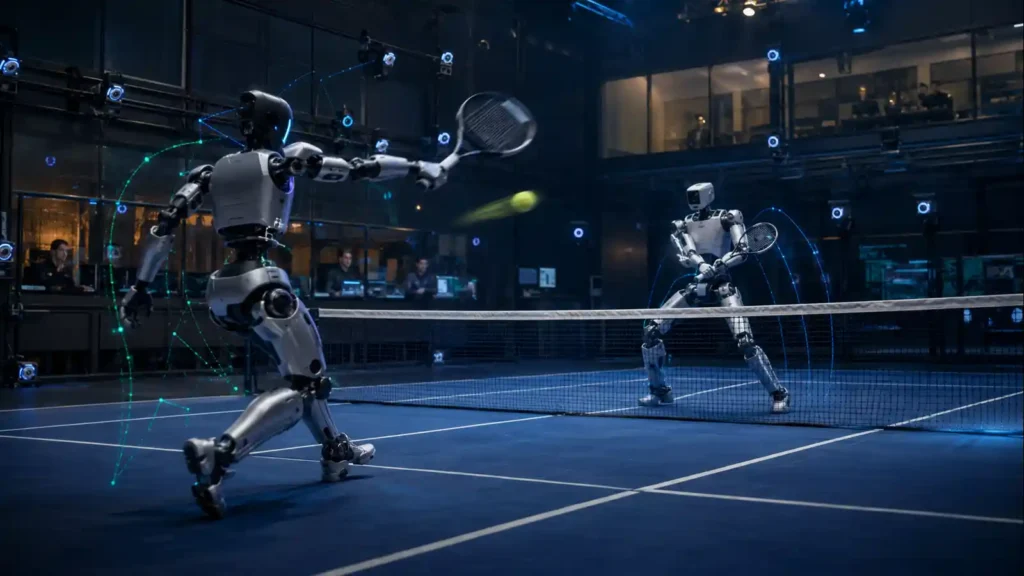
Two days after releasing HiPHI, Noitom Robotics and researchers from Shanghai AI Laboratory, Dobot Robotics, and Shanghai Jiao Tong University unveiled AdaPT on August 21, 2026. The framework teaches Unitree G1 and Dobot Atom humanoid robots to reproduce professional tennis rally and serving styles on physical hardware.
AdaPT combines broadcast footage of Rafael Nadal, Roger Federer, and Novak Djokovic with high-precision athlete motion capture. It separates stylistic motion planning from low-level tracking, then adapts execution speed to incoming ball trajectories and hardware limitations. The team also demonstrated serving outside a motion-capture environment using camera-based ball detection and consumer trackers.
The result is a credible physical-AI research demonstration, not an autonomous replacement for a professional player. Tests used controlled equipment, a reduced court, motion capture for most evaluations, and limited trials. The paper nevertheless provides code, quantitative comparisons, two robot embodiments, and a clear account of the remaining sim-to-real gap.
What happened two days after releasing HiPHI?
AdaPT separates style generation from physical execution. First, the researchers recovered player motions from broadcast clips with GVHMR, converted them into SMPL body motion, and retargeted them to robot bodies using GMR. Because video estimates can produce impossible wrist angles or unstable poses, the pipeline corrects the motion before training. A low-level tracker then learns to follow reference poses at randomized execution speeds. Above it, a planner observes the robot and predicted ball trajectory, selects a motion latent, and adjusts speed so the stroke can meet the incoming ball. Rallying uses an MVAE motion generator because returns vary widely. Serving uses a residual tracker that modifies racket control around toss variation, plus a keyframe reward weighted 50 times more heavily around the deepest backswing. This division helps preserve recognizable technique without forcing one policy to solve style, balance, interception, and timing at once.
The AdaPT research paper says the system learned styles associated with Rafael Nadal, Roger Federer, and Novak Djokovic from public broadcast footage. A fourth style came from professional motion capture. Each video clip was about two seconds long and labeled by player, stroke, spin, contact timing, and, for serves, ball-release timing.
How did HiPHI contribute to AdaPT?
HiPHI supplies broad motion priors; AdaPT adds tennis-specific precision. The public HiPHI release contains 617.5 hours captured from 132 performers at 90 Hz with sub-millimeter marker tracking. It divides into 371.8 hours of whole-body motion and 245.7 hours of human-object interaction, organized across 214 Frame-LU units and 22 semantic frames. Noitom says AdaPT’s motion foundation was pre-trained on part of the wider HiPHI series, including a relevant public subset and the commercially licensed HiPHI-MOV corpus. The tennis project then used 21.5 hours covering six athlete styles and seven stroke or serve types, drawn from broadcast video and professional motion capture. That sequence matters: broad pre-training teaches reusable balance and coordination patterns, while focused post-training supplies racket timing, footwork, toss mechanics, and player-specific technique. The release does not quantify exactly how many HiPHI hours or sequences entered AdaPT training.
Dr. Lei Han, Noitom Robotics’ chief of research and development, summarized the training order in the company announcement: “We pre-trained the motion foundation on part of the HiPHI-series data and post-trained it on high-precision capture of professional athletes.”
What hardware and compute did the researchers use?
The policies were trained with PPO across 4,096 parallel simulation environments on four Nvidia RTX 4090 GPUs. Both policy and value networks used three-layer multilayer perceptrons. The main physical tests used a 1.35-meter Unitree G1 carrying a 23-inch junior racket mounted at a 25-degree wrist offset.
The physical setup matters when interpreting “professional-style tennis.” The robots imitate recognizable stroke mechanics, serve motions, and footwork, but the research does not show a regulation match played autonomously on a full court. The main rally evaluation used a ball-feeding machine, reflective tennis balls, a smaller court, and motion capture for precise localization.
How well did AdaPT perform on real robots?
The strongest evidence is the paper’s controlled evaluation, not the promotional video. In a real-robot ablation, AdaPT reached a 56% rally hit rate, compared with 16% for Vid2Player3D and 34% when either the adaptive planner or adaptive tracker was removed. Across player styles, AdaPT’s real forehand and backhand hit rates were 44% and 56% for Nadal, 64% and 48% for Federer, and 48% and 48% for Djokovic.
These are author-reported results from a 14-page preprint, not independent replication. They are also more nuanced than a blanket claim of superiority. DeepMimic produced a higher Nadal-style serve success rate, while AdaPT led on the Federer and Djokovic styles and was designed to balance task completion with motion fidelity.
Why is professional style more than a visual effect?
For a humanoid, a tennis style encodes the timing of torso rotation, weight transfer, backswing, racket acceleration, contact, and recovery. A controller trained only to touch the ball can exploit shortcuts that look unlike human technique or break balance under a different toss. AdaPT’s decoupled planner and tracker try to prevent that collapse by keeping style generation separate from low-level stabilization.
This is the same physical-AI challenge facing broader humanoid deployment. BriefFlash’s coverage of LG’s Nvidia-powered humanoid examines the hardware and foundation-model path toward commercial robots, while the enterprise readiness gap shows why impressive autonomy demonstrations still need governance, evaluation, and reliable operating processes.
What are AdaPT’s main limitations?
The authors acknowledge that the system still relies mainly on motion capture for robot-root and ball positioning. Camera perception introduces more localization noise and timing jitter, especially after the ball bounces. The trajectory model also ignores spin and uses gravity plus constant aerodynamic drag, which simplifies real tennis physics.
Other practical limits include:
- a reduced Tennis 10s court rather than a regulation court;
- a ball launcher for repeatable rally trials;
- 25 trials per rally region and 15 trials per serving model;
- reflective material added to tennis balls in the capture arena;
- no published safety metrics for unrestricted human competition; and
- no independent reproduction of the reported results yet.
The public code is important, but the GitHub repository currently describes the released training code as the first stage of adaptive serve tracking. Researchers may therefore need additional assets, data, calibration, and hardware-specific engineering to reproduce the complete demonstration.
What happens after the HiPHI and AdaPT releases?
Noitom presented AdaPT as the first proof of concept in a wider program for professional athletic skills. The immediate technical questions are whether the approach transfers beyond two robot bodies, whether vision-only rallying can match motion-capture performance, and whether longer exchanges remain stable without planning drift.
AdaPT is scheduled for discussion around RO-MAN 2026 in Fukuoka from August 24 to 28. Its larger contribution may be methodological: broad motion pre-training followed by high-precision specialist data, then adaptation for a particular body and environment. That recipe could apply to industrial manipulation, rehabilitation, performance capture, and other tasks where motion quality matters as much as task success.
Key Takeaways
- AdaPT transfers professional rally and serving styles from broadcast video and motion capture to the Unitree G1 and full-size Dobot Atom humanoids.
- The motion foundation used part of the HiPHI series before tennis-specific post-training, although Noitom did not disclose the exact pre-training subset.
- A real-robot ablation reported a 56% rally hit rate for AdaPT versus 16% for Vid2Player3D, while serve results varied by player style.
- The system still depends heavily on motion capture, controlled ball feeds, simplified trajectory physics, and hardware-specific engineering.
FAQ
What is Noitom Robotics’ AdaPT system?
AdaPT stands for Adaptive Motion Planning and Tracking. It is a hierarchical framework that learns professional tennis styles from broadcast video and motion capture. A high-level planner generates style-consistent motion and adapts its speed, while a low-level tracker executes the movement on physical humanoid robots.
How did HiPHI help train the tennis robots?
Noitom says AdaPT’s motion foundation was pre-trained on part of the HiPHI series, including a relevant subset of the 617.5-hour public HiPHI dataset and data from the larger licensable HiPHI-MOV corpus. The team then added high-precision professional-athlete captures and tennis footage. The exact number of HiPHI hours used for AdaPT was not disclosed.
Can AdaPT play a complete professional tennis match?
No. AdaPT demonstrates professional-style rally strokes and serves, including multi-rally and human-versus-robot examples, but the published evidence does not show a complete autonomous match on a regulation court. Most evaluations used a Tennis 10s court, a ball-feeding machine, reflective balls, and motion-capture localization.
Are AdaPT and HiPHI open to researchers?
The public HiPHI dataset is available free for research on Hugging Face, with commercial licensing handled separately. AdaPT’s official GitHub repository uses the Apache-2.0 license, but it currently describes the released training code as the first stage of adaptive serve tracking. Reproducing the entire system may require additional data, calibration, and robot-specific components.