
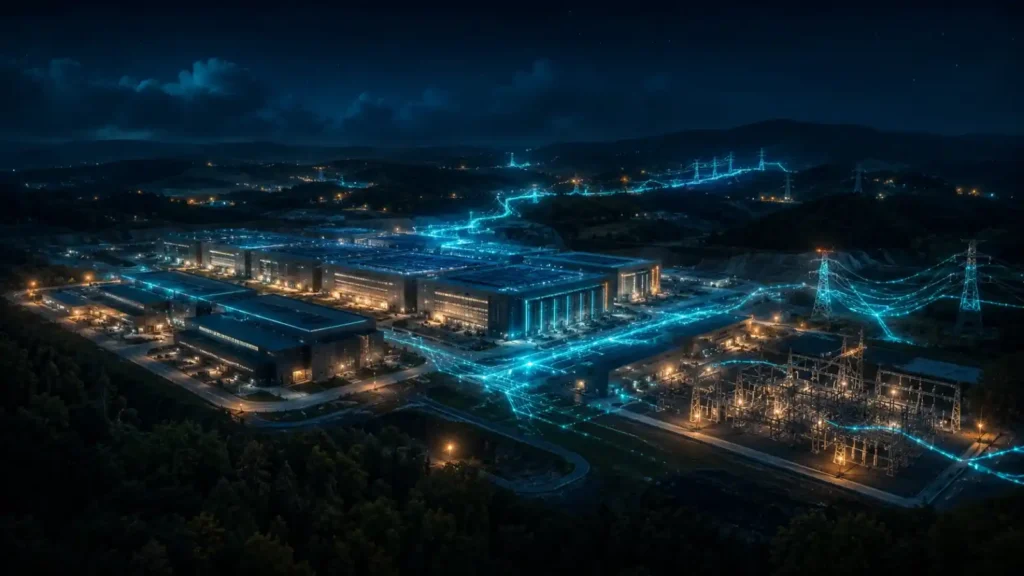
OpenAI joins the PORTS-Pike project, officially committing to a massive infrastructure buildout that will secure up to 8 gigawatts of IT capacity and support thousands of jobs across Southern Ohio. Announced on August 17, 2026, the strategic partnership with SB Energy positions the AI lab at the center of one of the largest technology campus developments in North America. The move directly addresses the insatiable compute requirements of next-generation foundation models. (See also: Anthropic shares more details about how Claude’s new watermarks will work)
The announcement signals a structural shift in how leading AI labs secure compute, moving beyond traditional cloud provider leases to direct investments in dedicated power generation and data center real estate. For OpenAI, securing 8 gigawatts of capacity provides a multi-year runway for training increasingly parameter-dense models requiring unprecedented energy density. The PORTS-Pike site, already backed by NVIDIA's guaranteed technology commitments, offers the rare combination of massive grid access and regional economic incentives.
Local and state economic development estimates project the partnership will create thousands of direct construction and operational jobs, alongside secondary employment surges in logistics and facility maintenance. As the Wall Street AI infrastructure investment trend accelerates, this development cements Southern Ohio as a critical node in the global AI supply chain.
What Is the PORTS-Pike Project and Why Does OpenAI Need It?
The PORTS-Pike project is a large-scale, multi-tenant technology campus development spearheaded by SB Energy, located in Southern Ohio. The region has become a focal point for hyperscale data center construction due to its proximity to reliable power grids, favorable tax incentives, and geographic resilience to natural disasters. SB Energy has committed to paying the full cost of all necessary grid upgrades and new transmission infrastructure, removing the traditional utility bottleneck that delays AI compute deployments by years.
For OpenAI, the calculus is straightforward: foundation model scaling laws show no sign of plateauing. Training architectures approaching multiple trillion parameters require clusters operating at hundreds of megawatts simultaneously. Securing 8 gigawatts of dedicated IT capacity ensures OpenAI can operate outside the constrained availability pools of traditional public cloud providers. This direct infrastructure ownership model provides absolute control over hardware refresh cycles, network topology, and power utilization effectiveness (PUE) optimization.
How Does the New Architecture Compare to Legacy Cloud Solutions?
The shift from leased cloud capacity to purpose-built, gigawatt-scale campuses represents a fundamental architectural pivot. Legacy cloud deployments often share power and cooling resources across disparate enterprise tenants, leading to unpredictable performance throttling. The PORTS-Pike model dedicates 100% of the site's power generation to OpenAI's compute workloads, enabling highly deterministic training schedules.
As detailed in OpenAI's builder's guide to GPT-5.6, next-generation model training requires strict environmental controls to prevent gradient destabilization. Purpose-built facilities can maintain ambient temperatures within 0.5-degree variance across entire server halls, a feat architecturally impossible in retrofitted legacy data centers.
The Economic Engine: Job Creation and Community Investment
The economic impact on Southern Ohio is staggering. SB Energy's grid upgrade commitment ensures the site will not compete with residential power needs, a critical factor in community relations. The project will directly support thousands of jobs, spanning high-voltage electrical engineering, structural construction, and long-term data center operations.
Southern Ohio's workforce development boards are collaborating with OpenAI to establish specialized training pipelines for AI hardware technicians and facility operators. This proactive educational investment aims to mitigate the severe talent shortage in high-density power distribution, a specialized field previously dominated by heavy manufacturing.
Strategic Implications for the AI Hardware Supply Chain
NVIDIA has already guaranteed the PORTS-Pike technology campus a priority allocation of its next-generation data center GPUs. This guarantee is a critical de-risking factor for OpenAI. Without confirmed silicon allocations, a gigawatt-scale data center is merely an empty warehouse.
The partnership highlights a broader industry consolidation where only a handful of organizations possess the capital, strategic partnerships, and infrastructure leverage to operate at the frontier of AI development. As explored in Nvidia's $500B plan for aging GPUs, hardware manufacturers are increasingly bending their financial models to secure multi-year anchor tenants like OpenAI.
Will OpenAI's Compute Demands Outpace Grid Generation?
The 8-gigawatt demand raises legitimate concerns about regional power generation capacity. SB Energy's commitment to funding grid upgrades includes investments in localized renewable energy generation and battery storage systems, reducing the campus's reliance on fossil fuel peaker plants. This architectural choice aligns with OpenAI's stated sustainability targets, ensuring the compute footprint does not trigger regulatory backlash over carbon emissions.
Furthermore, the integration of advanced liquid cooling systems directly to the silicon chip level—similar to thermal management solutions being developed by AI-driven materials startups—will reduce the facility's water consumption by an estimated 40% compared to standard evaporative cooling towers.
Key Takeaways
- OpenAI has committed to securing up to 8 gigawatts of IT capacity at the PORTS-Pike technology campus in Southern Ohio.
- SB Energy is fully funding all grid upgrades and new transmission infrastructure, bypassing traditional utility delays.
- The project is estimated to create over 5,000 jobs in construction, engineering, and long-term data center operations.
- NVIDIA has guaranteed priority silicon allocations to the campus, ensuring the infrastructure will be fully utilized upon completion.
FAQ
What is the PORTS-Pike project?
The PORTS-Pike project is a massive, multi-gigawatt technology campus development in Southern Ohio spearheaded by SB Energy. It is designed to provide dedicated IT infrastructure for hyperscale AI workloads, with OpenAI joining as the anchor tenant.
How many jobs will the OpenAI PORTS-Pike project create?
The project is expected to support thousands of jobs in Southern Ohio, including over 5,000 direct roles in high-voltage electrical engineering, structural construction, and long-term data center facility operations.
Why does OpenAI need 8 gigawatts of power?
Training next-generation, trillion-parameter foundation models requires unprecedented compute density. Securing 8 gigawatts of dedicated IT capacity ensures OpenAI can operate massive GPU clusters outside the constrained availability of traditional public cloud providers.