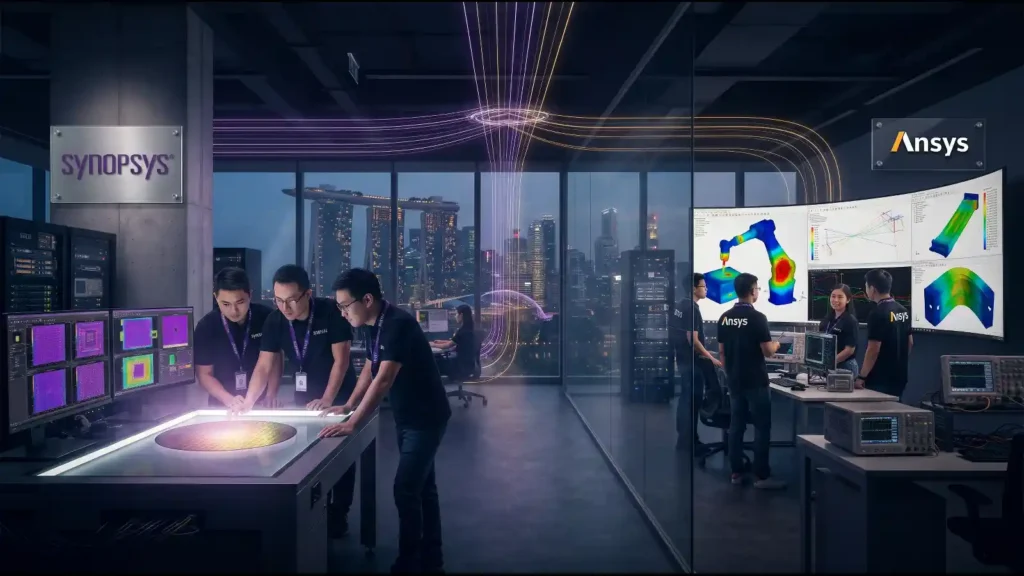
On August 28 and September 22, 2026, Synopsys will hold two Singapore forums focused on AI-powered engineering: SNUG Singapore and Simulation World Singapore. The events connect semiconductor design, verification, advanced packaging and multiphysics simulation, giving engineers and industry leaders a shared view of how AI is changing product development from silicon to complete systems.
SNUG Singapore 2026 will concentrate on chip implementation, signoff, verification and analog or mixed-signal design. Simulation World Singapore 2026 will extend that discussion into fluids, mechanics, electronics, optics, software, systems and industry use cases. Both are one-day, in-person events.
The program is timely because Synopsys completed its acquisition of Ansys in July 2025. That combination places electronic design automation, semiconductor IP and engineering simulation inside one company, but the performance figures used to promote its AI tools remain vendor claims or project-specific results rather than universal benchmarks.
What are the Synopsys AI-powered engineering events?
Synopsys is using the two Singapore events to connect stages of engineering that companies have often managed with separate teams and software. SNUG begins at the silicon level, where engineers implement designs, close timing, verify behavior and prepare complex chips for manufacture. Simulation World moves outward to the physical product, examining how electronics interact with heat, fluids, structures, optics, embedded software and system requirements. That sequence reflects Synopsys' strategy after acquiring Ansys: combine chip design, intellectual property, simulation and analysis from silicon to systems. The events are not product launches, and Synopsys has not announced a new AI model for either conference. They are technical forums built around keynotes, customer presentations, tutorials and case studies.
That is a strategic claim, not proof that every engineering workflow benefits equally. The useful question for attendees is where AI can reduce repeated search, optimization or test work while leaving safety, signoff and design accountability with qualified engineers.
How do SNUG Singapore and Simulation World compare?
The scale figures come from the Synopsys media alert supplied to BriefFlash. They describe the planned programs and should not be treated as audited attendance totals before the events take place.
What will SNUG Singapore 2026 cover?
SNUG Singapore carries the theme "Re-engineering the Future of Silicon." The media alert lists four tracks: Design Implementation, Signoff, Verification Continuum, and Analog/Mixed-Signal Design and Simulation. Mike Ellow, Synopsys' chief revenue officer, and Shitalkumar Joshi, a Synopsys senior director, are scheduled to deliver keynotes. The attachment also identifies participation from Intel, MediaTek, Meta Silicon, MaxLinear and Silicon Labs.
The technical value sits in the workflow detail. AI-assisted electronic design automation can search design spaces, recommend floorplans, prioritize tests, identify coverage gaps and support root-cause analysis. Synopsys' AI chip-design overview describes tools for digital implementation, analog design, verification, system architecture and semiconductor manufacturing. The page markets up to 30% productivity gains and development cycles accelerated by 5X, but it does not establish one test method that applies across every chip, node or engineering team. Those figures should therefore be attributed to Synopsys, not presented as an industry-wide result.
The Singapore agenda also fits a wider local research push. BriefFlash recently covered the STMicroelectronics and NUS HELIX lab, a four-year effort focused on memory-centric and low-power edge AI hardware. Together, the lab and SNUG illustrate how Singapore is linking academic research, chip engineering and commercial design workflows.
What will Simulation World Singapore 2026 examine?
Simulation World, hosted by Ansys as part of Synopsys, shifts from chip implementation to complete products and systems. The program includes three product tracks covering Fluids and Mechanical, Electronics and Optics, and Software and Systems. Its industry sessions address defense, mobility and transportation, electronics and semiconductors, and industrial and energy applications.
Speakers named in the alert include Surya Bhattacharya of A*STAR's Institute of Microelectronics, Professor P. S. Lee of the National University of Singapore, representatives from AWS, Anthony Dawson of Ansys and Padmesh Mandloi of Ansys. The official Simulation World event page says AI-augmented simulation can enable predictions that are 10X to 1000X faster and more accurate. The page does not publish the workloads, baselines or error measures behind that broad range, so readers should treat it as a promotional claim rather than a general performance guarantee.
Why are chip design and multiphysics simulation converging?
Advanced chips can no longer be evaluated only as isolated blocks of logic. Multi-die packages, high-density interconnects and greater power demands create thermal, mechanical, electromagnetic and reliability constraints that can affect the finished system. A design may meet an electronic target yet fail when heat, packaging stress or optical behavior is considered.
Synopsys' acquisition of Ansys is intended to join those domains. Similar integration pressures are driving major investment in AI memory research as chipmakers confront bottlenecks that span architecture, materials, manufacturing and software.
What does AI contribute to these workflows?
- Search and optimization: Explore many design options against power, performance, area or physical constraints.
- Verification support: Prioritize productive tests, identify unreachable coverage targets and surface likely root causes.
- Reduced-order simulation: Approximate selected physical behaviors faster after training against validated simulation data.
- Engineering assistance: Retrieve documentation, summarize results and recommend next steps while experts retain approval.
- Cross-domain analysis: Connect chip behavior with thermal, mechanical, optical or system-level consequences.
What evidence exists for AI-assisted verification?
Synopsys has published a project-specific example from an NVIDIA presentation at SNUG Silicon Valley 2024. In one Project C experiment, Synopsys reports that adding VSO.ai produced 33% more functional coverage in the same number of test runs while cutting the regression suite by 5X. Its summary across three related chip projects says the combined verification techniques achieved up to 33% better functional coverage with regression compression ranging from 2X to 7X. These figures are useful because they name the workload context, tools and baselines more clearly than a broad marketing range. They still should not be generalized to every design: the results came from NVIDIA verification projects and combined AI with test grading, formal unreachability analysis and other methods. The evidence supports a narrower conclusion—AI can improve test selection and coverage efficiency when integrated into a disciplined verification process—not that it can independently verify a chip.
This distinction resembles BriefFlash's analysis of how an AI harness affects agent performance: workflow design, tools, feedback and supervision can matter as much as the underlying AI component.
Why is Singapore central to the program?
Singapore is more than a convenient conference location. The Singapore Economic Development Board says the country attracted more than S$30 billion in semiconductor investment from 2022 through 2025 and now produces one in 10 of the world's chips and one in five semiconductor-equipment units. The government also announced S$800 million for semiconductor R&D under its RIE2030 plan, with emphasis on areas including advanced packaging and photonics.
That concentration of manufacturing, research institutes, universities and multinational companies gives Synopsys a relevant regional audience for both events. SNUG addresses how chips are designed and verified; Simulation World examines how those chips operate inside complex products. The combined program turns the phrase "silicon to systems" into a practical sequence rather than a corporate slogan.
What should readers watch after the events?
The strongest post-event evidence would be specific customer workloads, clearly defined baselines and measured changes in engineering time, coverage, accuracy, compute use or design quality. Readers should also watch how Synopsys integrates Ansys data and workflows, where human approval remains mandatory, and whether AI recommendations can be traced back to validated engineering models. The Singapore conferences can show the direction of travel, but customer evidence will determine how much of the promised productivity survives real production constraints.
Key Takeaways
- SNUG Singapore on August 28 focuses on AI-assisted chip design, implementation, signoff and verification, with more than 300 attendees planned.
- Simulation World Singapore on September 22 extends the discussion into multiphysics, digital engineering and complete-system development.
- The two-event structure reflects Synopsys' completed Ansys acquisition and its strategy to connect silicon design with physical-system simulation.
- Synopsys publishes promising AI performance examples, but broad speed claims require workload-specific baselines and should not be treated as universal guarantees.
FAQ
What is SNUG Singapore 2026?
SNUG Singapore 2026 is Synopsys' one-day user conference for semiconductor engineers, customers and technology leaders. It takes place on Friday, August 28, 2026, at PARKROYAL on Beach Road. The planned program covers design implementation, signoff, verification, and analog or mixed-signal design and simulation, with 16 customer presentations and eight Synopsys tutorials listed in the media alert.
What is Simulation World Singapore 2026?
Simulation World Singapore 2026 is an Ansys and Synopsys engineering conference scheduled for Tuesday, September 22, 2026, at Hilton Singapore Orchard. Its sessions cover multiphysics simulation, digital engineering, electronics, optics, software, systems and industry applications across mobility, defense, semiconductors, industrial operations and energy.
How is AI used in semiconductor design and engineering simulation?
AI can help engineers search design options, optimize power-performance-area trade-offs, prioritize verification tests, identify coverage gaps and create faster approximations of selected simulation workloads. These systems support engineering decisions; they do not remove the need for validated models, specialist review, safety checks or final signoff.
Is Ansys part of Synopsys?
Yes. Synopsys completed its acquisition of Ansys on July 17, 2025. Synopsys positioned the combination as a way to connect silicon design and intellectual property with engineering simulation and analysis across complete products and systems.