
BAG Ventures Fund I has reportedly closed at $11.3M, according to a report dated 30 September 2026. The firm is reportedly led by two Google alumni and is positioned around backing AI startups that enterprises will actually pay for.
The stakes are modest in dollars but specific in idea. A fund built around enterprise willingness to pay is a bet that the next AI winners sell to businesses, not to consumers chasing novelty. This piece tests that thesis against what is actually known about the fund, which is very little.
What did BAG Ventures announce with Fund I?
BAG Ventures announced the close of a first fund worth $11.3M to invest in AI startups. BriefFlash has not confirmed the announcement independently, and every detail in this article rests on one report, so we treat it as reported, not verified.
The pitch, as reported, is that the firm backs AI startups which enterprises will actually pay for. That is a filter on customers, not on technology. The question it asks of any startup is whether a business will sign a contract, not whether the demo impresses.
Fund I means this is the firm’s first fund. There is no earlier portfolio to judge, so investors in it are backing the founders’ judgment rather than a track record. We would treat any description of the fund as a leader or as notable for its size as unsupported at this point.
What does an $11.3M first fund actually buy?
An $11.3M fund can write a limited number of modest checks, and less money reaches startups than the headline suggests. Venture funds usually set aside part of their capital for management fees and for follow on investments. A commonly cited convention is an annual management fee around 2 percent over a fund’s life.
The table below is illustration only. It applies that convention over ten years to the reported fund size. BAG’s actual terms have not been disclosed.
| Item | Amount | Status |
|---|---|---|
| Fund I size | $11.3M | Reported |
| Fees at 2 percent a year for 10 years (about 20 percent) | About $2.26M | Illustrative arithmetic, general convention |
| Left to invest | About $9M | Illustrative, before any follow on reserves |
| Separate AI agent infrastructure round (Restate) | $20M | Reported in a headline only |
Reserves for follow on rounds would shrink that $9M further, and we do not know how BAG plans to split it. The split matters because a fund that keeps little in reserve cannot support its companies when they raise again.
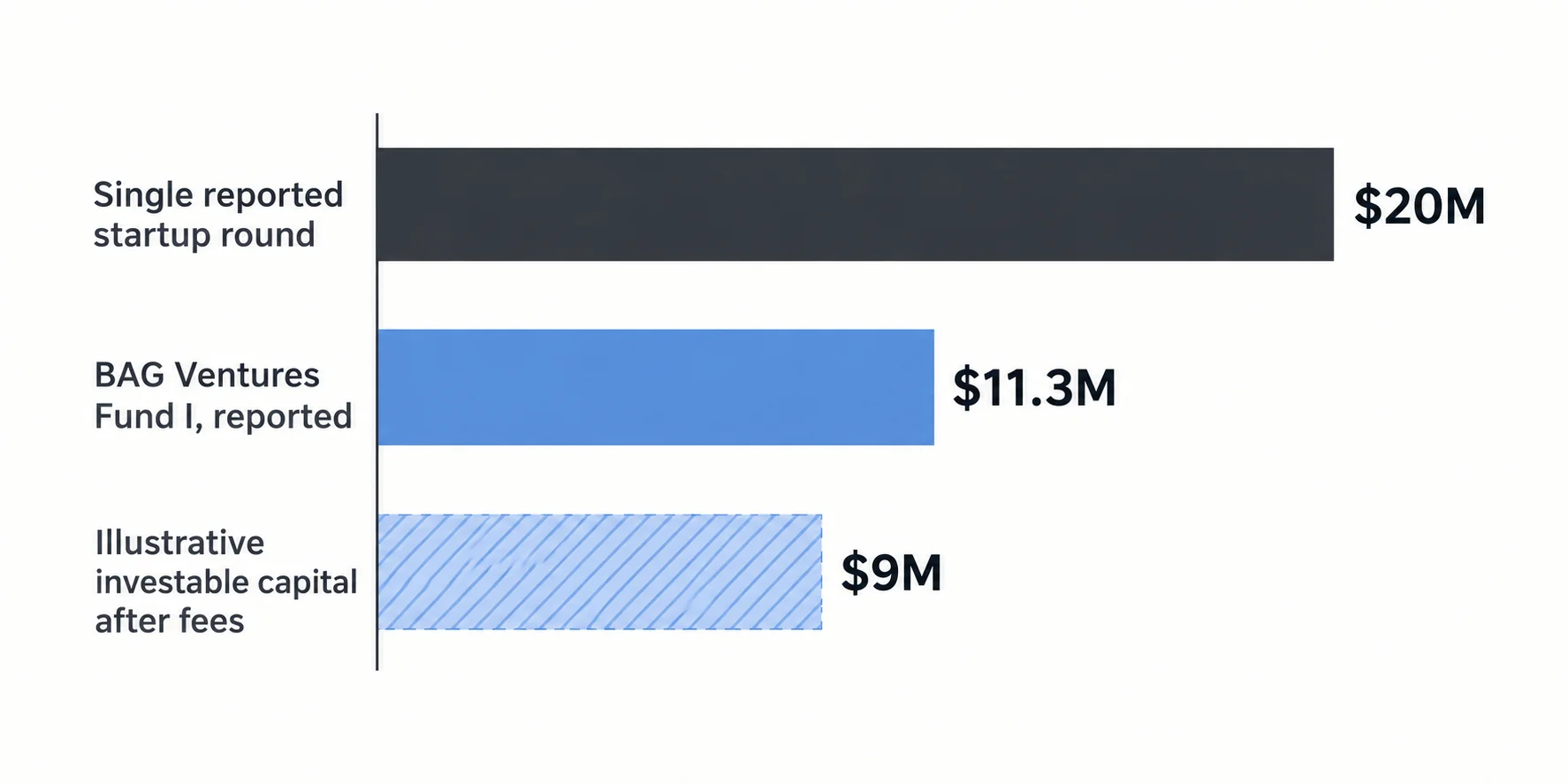
For scale, a separate report dated the same day puts Restate’s raise at $20M, described as durable infrastructure for AI agents. If accurate, that one round is about 1.8 times the size of this entire fund ($20M divided by $11.3M). We have only a headline for that round, so read it as a rough scale check and nothing more.
None of this makes a small fund weak. A small fund can be nimble at the earliest stages. But with limited capital it may struggle to follow on in later rounds, which matters to a founder who hopes an existing investor will lead or extend the next raise.
Is the fund focused on enterprise AI or on everything AI?
That is unclear, because the reporting describes the fund two ways. One framing is narrow: AI startups that enterprises will actually pay for. The other is broad: investing in all things AI. Both come from the same outlet, so we read this as an open question about how focused the fund really is, not a contradiction with a clear winner.
Which layers of the AI stack the fund targets is also not defined. Our inference is that an enterprise filter could be a practical way for a small fund to narrow a very wide category. Our confidence is low, because we have no portfolio or stage information to test it against.
Does the enterprise will pay thesis hold up?
It is a reasonable filter but still a hypothesis, not an outcome. Many AI products that enterprises trial never convert to paid contracts. That is why a pilot is a weak signal and a signed, renewed contract is a strong one.
The available reporting offers no customer demand data for BAG’s thesis. Founders who previously worked at a large tech company may have useful networks, but nothing we hold shows how that translates into deal flow. We would want to see first investments, and whether those companies have paying customers, before crediting the pitch.
What do we not know yet about BAG Ventures?
The list of unknowns is longer than the list of facts. Until the firm or its backers publish more, these gaps stay open:
- Portfolio companies, first investments and check size ranges
- Stage focus (pre seed, seed or later) and geography
- The limited partners and how the fund was raised
- What the firm means by its position in the AI stack
- Any evidence of enterprise demand behind the thesis
- How the fund compares with others of similar size
The names and Google roles of the two founders are also not given in the material we hold, so we do not describe them.
Who should care, and what should they do?
Founders raising early AI rounds are the most directly affected. If your product sells to businesses and has paying customers, the stated thesis suggests BAG may be worth a conversation. Ask early about stage, check size and whether the fund reserves money for follow on rounds, since those answers decide how useful the money is.
Angel and seed investors should watch the first announced investments. They will show whether the fund writes small early checks or aims later, and whether its portfolio matches the narrow pitch or the broad one. Our read is that the portfolio, not the fund size, will tell readers whether this fund matters.
Readers following AI funding should keep the scale in view. One startup round reported the same day is larger than this entire fund, which shows how a first fund sits next to the capital individual AI companies now raise.
Frequently asked questions
Who is behind BAG Ventures?
BAG Ventures is reportedly led by two Google alumni and has reportedly closed an $11.3M Fund I to invest in AI startups. The available reporting does not name the founders or describe their roles at Google, so BriefFlash does not either. The details rest on a single report and have not been independently confirmed.
How big is an $11.3M venture fund in practice?
It is small. As illustration using common industry conventions, a 2 percent annual fee over ten years would leave roughly $9M to invest before follow on reserves. That is general arithmetic, not BAG’s disclosed terms. A separate report puts one AI agent infrastructure round at $20M, larger than this whole fund.
What stage of startups will BAG Ventures invest in?
That has not been disclosed in the available reporting. There is no stated stage focus, geography, check size range or list of portfolio companies. Until the firm publishes those details or announces first investments, it is unclear whether Fund I targets pre seed, seed or later stage AI startups.
Why do investors say enterprises will pay for AI when many pilots stall?
Investors use paying customers as a filter because pilots alone prove little. Many AI products that enterprises trial never convert to paid contracts, so the claim that enterprises will pay is a hypothesis, not an outcome. Signed and renewed contracts are the stronger evidence, and no such demand data has been offered for BAG’s thesis.