

ElevenLabs, the AI voice startup, has reportedly doubled its valuation to $22 billion through a $300 million employee tender co-led by Wellington and T. Rowe Price, according to reports on 30 September 2026.
The ElevenLabs 22 billion valuation is the number most readers will see, but the structure of the deal is the more useful half of the story. A tender is typically a sale of existing shares by current holders, not a company raising new money. That difference decides how much weight the headline can carry.
What is behind the ElevenLabs 22 billion valuation?
A $300 million employee tender, reportedly co-led by Wellington and T. Rowe Price. Three facts have been reported: the $22 billion valuation, the $300 million size, and the two co-leads. The valuation is described as a doubling of the company’s previous level.
We have seen no announcement or filing from ElevenLabs in the material available to us, so nothing here is company confirmed. Every row in the table below is reported unless marked otherwise, and the last two rows are our own arithmetic, not reported figures.
| Figure | Status | Note |
|---|---|---|
| $22 billion valuation | Reported | Described as a doubling |
| $300 million tender | Reported | Employee tender |
| Wellington and T. Rowe Price | Reported | Co-leads of the tender |
| About $11 billion prior valuation | Implied by our arithmetic | Not reported, do not quote as fact |
| About 1.4 percent of valuation | Derived by us | $300 million divided by $22 billion |
What is an employee tender offer, and how does it differ from a funding round?
An employee tender is typically a transaction in which investors buy existing shares from current holders, such as employees. A funding round issues new shares and puts cash into the company. In a tender, the sellers get liquidity; in a round, the company gets capital.
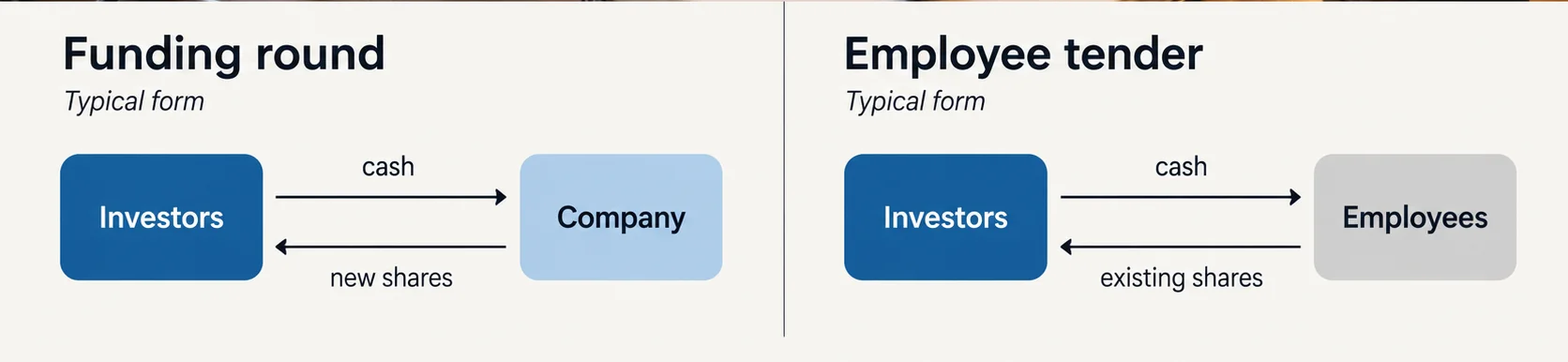
How this particular deal works has not been reported, so we cannot say whether ElevenLabs itself receives any proceeds. In its typical form, a tender does not add cash to the company’s balance sheet, which is why calling this a $300 million raise would be wrong.
There is also a pricing difference. A tender price is set between holders and buyers in a secondary transaction, and it may not match what a primary round would set on the same day. Neither is more real than the other, but they answer different questions: what a block of shares sells for, versus what the business can raise.
Does a $300 million tender support a $22 billion price?
Partly, and the limits show up in the arithmetic. $300 million is about 1.4 percent of $22 billion (our calculation, not a reported figure). A small slice of the company changed hands, so the valuation rests on limited volume.
Two points push the other way. Having Wellington and T. Rowe Price co-lead is a positive signal about demand for the shares. No terms have been reported, though, so we will not attribute stakes, fund details or purchase sizes to either.
Our read, held with moderate confidence: the number shows buyers and sellers agreed on a price for a limited block of shares. It does not show what the whole company would fetch, and it says nothing about revenue.
What do we not know yet?
Four gaps stop anyone from testing this valuation against the business:
- The previous valuation, which would confirm that the doubling is accurate.
- Any ElevenLabs revenue, growth or customer figures, none of which appeared in the reporting.
- Whether the company itself receives any proceeds, and how many employees could sell.
- Any change to pricing for users. Nothing on pricing has been reported, so a higher valuation should not be read as a sign of one.
Who is affected by the tender?
The reported deal touches three groups, and the reasoning differs for each.
- Employees: a tender typically offers a chance to sell shares. Who sold, how much, and on what terms has not been reported.
- Competitors in voice AI: a reported doubling gives investors a reference point for pricing the category. One tender is a thin benchmark, so we would not treat it as a market verdict.
- Builders who use the platform: a valuation is not revenue and does not by itself change product terms. Keep judging the tool on its product, pricing and reliability.
What should readers watch for next?
Before drawing a bigger conclusion, wait for three things: a revenue figure, a confirmed prior valuation, and a primary round priced near $22 billion. Any one of them would tell us more than the headline does.
The same caution applies elsewhere on today’s desk. The claims around Meta’s Muse agent and the dispute over its permissions are also reported but not independently tested, and separating the claim from the evidence helps there too.
Frequently asked questions
What is an employee tender offer?
An employee tender offer is typically a transaction in which investors buy existing shares from current holders such as employees. Unlike a funding round, it does not usually issue new shares or add cash to the company. The sellers get liquidity, and the price sets a valuation marker for the company.
Did ElevenLabs raise new money?
Not in the way the headline suggests. ElevenLabs reportedly reached a $22 billion valuation through a $300 million employee tender, which is a share sale by existing holders. Whether the company itself receives any proceeds has not been reported, so it should not be described as a $300 million raise.
Who led the ElevenLabs tender offer?
Wellington and T. Rowe Price reportedly co-led the $300 million employee tender that put the AI voice startup ElevenLabs at a $22 billion valuation. No terms, stakes or fund details have been reported, so the size of each investor’s purchase is unknown.
What was the ElevenLabs valuation before this deal?
The prior figure has not been reported. The deal is described as doubling the ElevenLabs valuation to $22 billion, which implies roughly $11 billion by simple arithmetic. That number is an implication, not a reported figure, and it should not be quoted as the company’s previous valuation.