

The stepwise intrinsic rewards paper, listed on arXiv as Stepwise Intrinsic Rewards for Reasoning in Large Language Models, targets a specific weakness in how reasoning models are trained. Many reinforcement learning setups reward only the final answer, and the abstract says that cannot reveal which intermediate steps earned the credit.
Only the abstract is available to the desk, and it is cut off, so there are no results to report. This piece explains the problem, maps the neighboring papers that appeared in the same arXiv update listings the desk reviewed on September 28, 2026, and separates what the authors claim from what anyone has shown.
What problem do stepwise intrinsic rewards address?
They address rewards that are too blunt. According to the abstract, reinforcement learning is a widely used way to improve reasoning in large language models and vision-language models, but sparse binary outcome rewards score only final correctness and cannot identify which intermediate steps contributed to it.
In plain terms, a model is rewarded when its output is judged good, and training nudges it toward whatever earned the reward. An outcome reward resembles marking a maths exam only on the final number while ignoring the working. A model can reach a correct answer by a flawed route, and a final answer only reward cannot tell the difference. That is general background, not a finding of the paper.
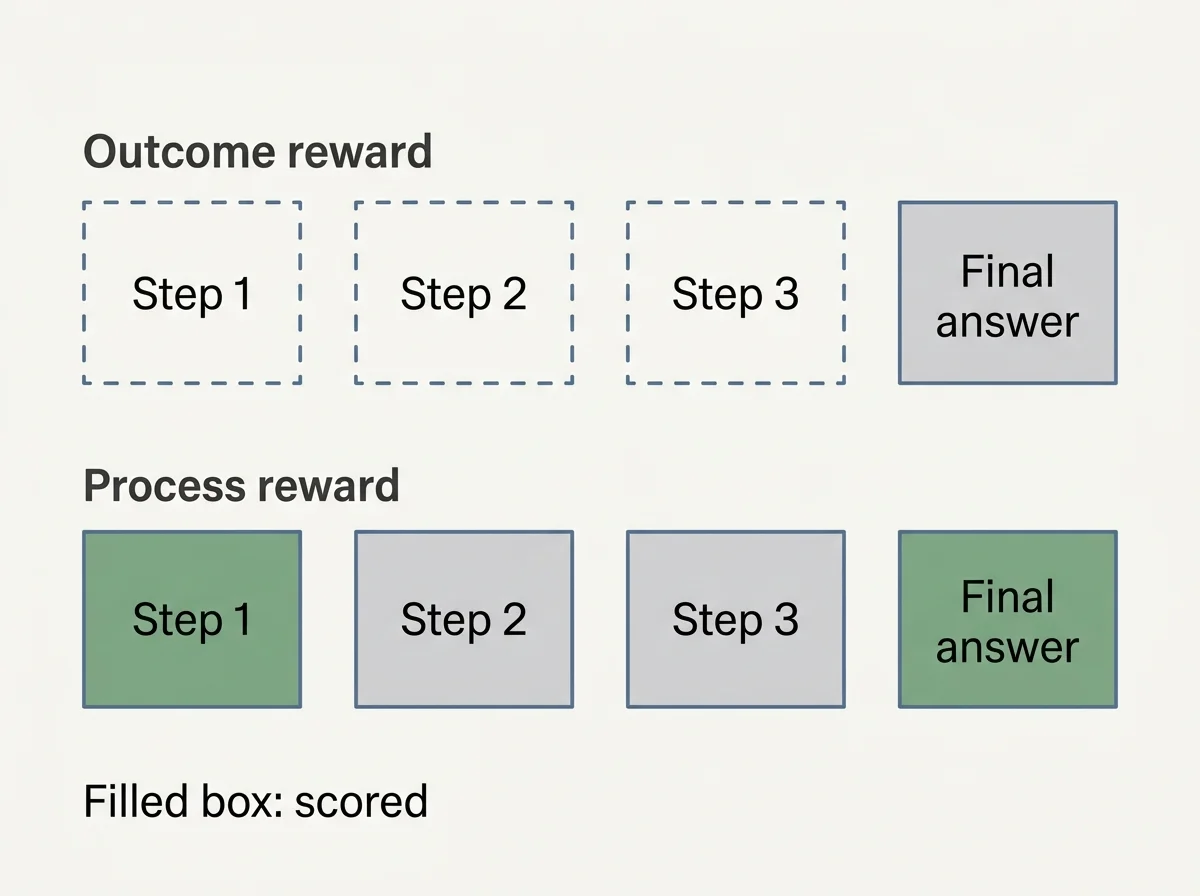
Why does the multimodal case add a second problem?
For tasks that mix images and text, the abstract says outcome rewards may reward answers driven by linguistic priors rather than visual evidence. Linguistic priors means the model guesses from language patterns instead of looking at the image. My reading is that a lucky guess would then earn the same reward as real visual reasoning, though the paper’s own evidence for this is not in the material available.
Why do process reward models need annotations?
The usual fix carries a cost. The abstract says process reward models densify supervision but usually require process annotations. An annotation is a label attached to training data, and here it means a judgment on individual reasoning steps instead of a single check on the final answer. Step level labels are expensive because someone or something must assess every step.
Beyond that point the abstract is cut off, so BriefFlash will not say what other requirement it lists. The word intrinsic in the title suggests a reward signal that does not depend on external step labels, but that is an interpretation of the title only. No description of how the reward is computed is available, and this article will not guess.
What else appeared in the same arXiv listings?
Reasoning papers clustered in those listings, and read together they show where research effort is going. The table lists each abstract’s named problem and what the desk can say about results.
| Paper | Problem its abstract names | Results in the material available |
|---|---|---|
| Stepwise Intrinsic Rewards for Reasoning in Large Language Models | Outcome rewards cannot identify which steps contributed | None |
| Self-Play Search Distillation for Large Language Model Reasoning | Reasoning data scarcity from low quality synthetic data and costly human labeling | None |
| Skip the Talk, Re-Focus on Vision | Existing methods typically generate explicit chain of thought | None |
| Estimating and Orthogonalizing Unknown Pre-training Gradients | Catastrophic forgetting in continual fine tuning | None |
| BioEVAL | Existing benchmarks emphasize factual recall | None |
Skip the Talk, Re-Focus on Vision says existing reasoning segmentation methods typically generate explicit chain of thought, meaning reasoning written out step by step. Its title points to latent reasoning, which keeps that reasoning internal. Readers who want the safety angle on reasoning that is not visible in text can read OpenAI’s new reasoning technique and the safety concerns around it.
Other papers in the same listings check model behavior instead of improving it. Attribution Bias in Large Language Models introduces AttriBench, motivated by LLMs supporting search, where crediting content to its original authors is critical. RupeeBias audits demographic bias in Indian economic guidance from LLMs.
One further paper is titled Evaluation is All You Need: Strategic Overclaiming of LLM Reasoning Capabilities Through Evaluation Design. Only the title is available, so nothing is reported about its method or findings. The title alone suggests evaluation practice for reasoning claims is under scrutiny.
What do the abstracts not show?
None of the abstracts available carry benchmark numbers, model names or datasets, and no authors or institutions are named in the material. The authors’ claims about their own method have not been verified by anyone else. The four listings carrying the headline paper are arXiv category feeds for a single paper, so this rests on one primary source, and arXiv papers are preprints posted before peer review.
Exact submission or revision dates are not in the material, and the papers carry different arXiv identifiers, so read them as items in update listings, not as one day’s releases. A cluster of papers shows research interest. It does not show that the problem is solved or that any lab or product uses this approach.
What should readers watch next?
Watch for full results, the models and datasets tested, and independent replication of any claim. My read is that the more useful signal will be whether labs describe their reward design in public. For a look at how one lab builds reasoning models today, see how IBM built its Granite 4.2 reasoning models.
Frequently asked questions
What is the difference between an outcome reward and a process reward?
An outcome reward scores only whether the final answer is correct. A process reward scores intermediate reasoning steps. According to the stepwise intrinsic rewards abstract, outcome rewards cannot identify which steps contributed to a correct result, while process reward models add denser supervision but usually require process annotations.
What does intrinsic mean in stepwise intrinsic rewards?
The abstract available does not define it. The title suggests a reward signal that does not depend on external step labels, but that is an interpretation of the title only. How the reward is computed, and what results it achieves, are not described in the material available as of September 28, 2026.
Does this research change how today’s reasoning models behave?
There is no evidence that it does. The available abstract reports no results, models or datasets, and nothing shows that any lab or product uses stepwise intrinsic rewards. It is a research direction from a preprint, so any effect on models people use today is unestablished.
Is the stepwise intrinsic rewards research peer reviewed?
Not as far as the material shows. The paper is listed on arXiv, a preprint server where papers appear before peer review, and the authors’ claims about their own method have not been verified by anyone else. Treat its claims as the authors’ own until results are replicated independently.