

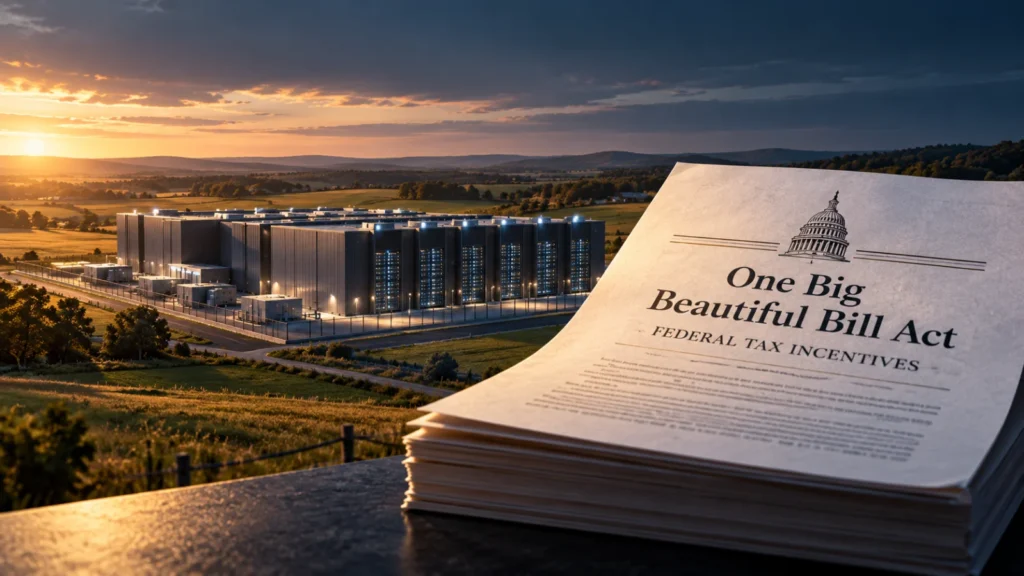
Data center projects in rural areas could be eligible for major federal tax benefits starting next year under the One Big Beautiful Bill Act, according to a report. The same report says some hyperscalers do not appear eager to take the money. That is the whole rural data center tax break story as reported so far: two conditional claims from a single outlet.
The reporting is thin on mechanics. It gives no dollar amount, no definition of rural, no eligibility threshold and no date beyond next year. BriefFlash has not seen the statute text, so this article separates what is reported from what is unknown, then lays out the questions that would decide whether the incentive moves any siting decision. Those questions are our reasoning, not reporting.
What is reported about the rural data center tax break?
Two things, and both are hedged. First, data center projects in rural areas could be eligible for major tax benefits starting next year under the One Big Beautiful Bill Act. Second, some hyperscalers reportedly do not seem eager to use those benefits.
The wording matters. Could be eligible is conditional, and nothing in the reporting confirms that any project will qualify. The language about hyperscalers reads as an impression rather than a stated corporate position, and the companies involved are not named.
We have one outlet’s reporting and no statute text or agency guidance, so the mechanics are unconfirmed. Any specific figure attributed to this break, from any source, should be treated as unverified until the underlying text is public.
What is a hyperscaler, and why is data center siting a policy question?
A hyperscaler is a very large cloud and AI infrastructure operator, a company that runs data centers at a scale few other organizations match. This section is general context from BriefFlash, not reporting.
Siting becomes a policy question because of what a large facility involves. AI-scale buildouts mean heavy capital spending, large tracts of land, substantial electricity demand and a meaningful addition to a local tax base. Governments at every level have reasons to want, or to steer, where that investment lands. A federal incentive aimed at rural areas would be one way to influence that choice.
Rural sites carry general trade-offs. Land is often easier to find, but power access, network connectivity and local acceptance can be harder to secure than in established data center markets. For a sense of the capital involved, BriefFlash has covered chip and financing arrangements around OpenAI data centers. Demand is also not limited to AI training, as a report on a planned quantum computer deployment inside an Equinix data center shows. None of this is a finding about any specific rural project.
Why would a hyperscaler not want a tax benefit?
The reporting does not say, so any answer is speculation. What it describes is some large operators appearing lukewarm about a benefit aimed at projects like theirs, and that gap is the most interesting detail in the story.
As labeled general reasoning, three possibilities are worth keeping in mind. A benefit can come with conditions that a company judges not worth meeting. The qualifying locations may not match where an operator needs capacity. Or a tax benefit may rank below power and network access in a decision that turns on many factors. None of these is a reported explanation, and the real reason could be something else entirely.
Five questions that decide whether the break changes where data centers go
This is BriefFlash’s decision framework. Each question has to be answered before the incentive can be said to shape a siting choice, and the reporting answers none of them.
- What does the benefit attach to? Whether it covers construction, equipment, operations or something else determines who gains and by how much.
- When does it start? The reporting says next year, but a start date alone does not say how projects already under way would be treated.
- What conditions come with it? Requirements attached to a benefit can decide whether it is usable at all.
- Do power and network access exist at rural sites? A site without enough of either cannot easily use an incentive.
- How do local communities respond? Local acceptance can slow or stop a project regardless of federal policy.
The consequences differ by reader. Rural local officials would want the definition of rural and the conditions first, because those determine whether their region is in scope at all. Investors in infrastructure should watch whether named operators say anything about using the benefit, since a stated plan is stronger evidence than a reported impression. Industry watchers should resist reading the benefit as a map of future sites until power and connectivity are accounted for.
What do we not know yet?
Most of the practical detail is missing. BriefFlash cannot currently state any of the following:
- The size of the benefit, how it is calculated and what spending it attaches to
- The definition of rural and any eligibility threshold
- Which hyperscalers are hesitant, and why
- What conditions or catches come with the benefit
- Whether power, connectivity and local acceptance in rural areas offset the incentive
- How the benefit compares with the way siting decisions are made today
The first thing to watch is the law’s own text, along with any official guidance that defines its terms. After that, watch whether any large operator says publicly that it plans to claim the benefit, or that it does not. Until both appear, the careful reading is that rural projects could benefit, and that the size of the effect is unknown.
Frequently asked questions
What does the One Big Beautiful Bill Act have to do with data centers?
Reportedly, under the One Big Beautiful Bill Act, data center projects in rural areas could be eligible for major tax benefits starting next year. BriefFlash has not seen the statute text, so the mechanics, size and conditions are unconfirmed. Eligibility is conditional, and nothing confirms that any specific project will qualify.
Which data centers could qualify as rural?
That is not known. The reporting BriefFlash has seen gives no definition of rural and no eligibility threshold. Until the law’s text or official guidance defines the term, any claim that a particular site or region qualifies should be treated as unverified.
When would the tax benefits begin?
Reportedly, the benefits could start next year. The reporting gives no calendar year, deadline or phase-in schedule, so exact timing is unconfirmed. How projects already under construction would be treated is also not stated.
Why would a hyperscaler not want a tax benefit?
The reporting says only that some hyperscalers do not seem eager to use it, without naming them or giving reasons. As general reasoning, not reported fact, conditions attached to a benefit, a mismatch with where capacity is needed, or other siting factors could each play a part.
Will this change where AI data centers get built?
It is too early to say. A tax benefit is one input alongside land, power, network connectivity and local acceptance. If the reported lukewarm response from some large operators is accurate, the incentive alone may not decide siting, but the reporting does not settle that.