
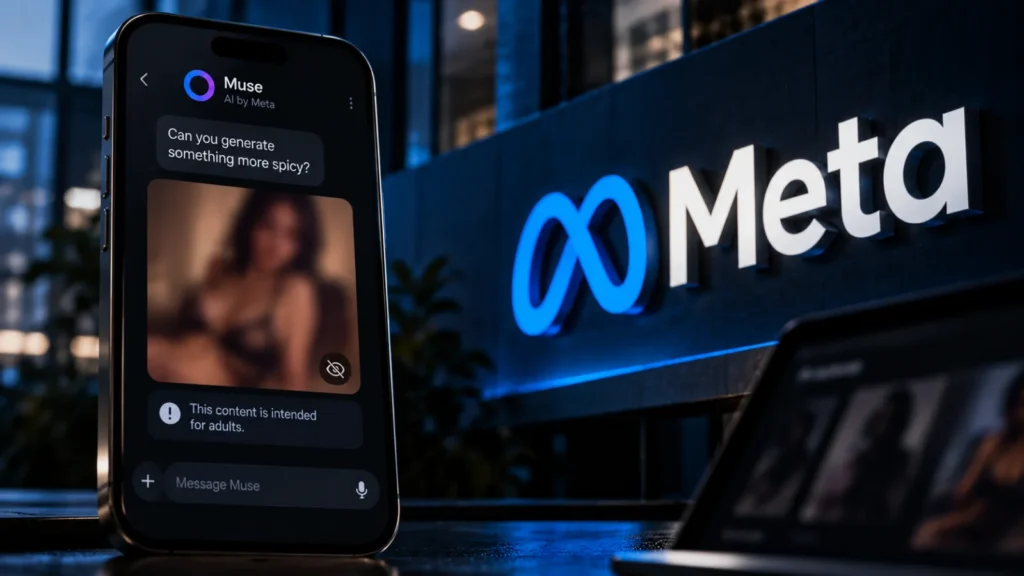
A journalist says Meta‘s Muse agent produced pornographic content in conversation, and Meta reportedly defends that as “legal adult behavior”. The Meta Muse AI agent adult content report rests on a single account, and BriefFlash has not independently confirmed it.
The stakes sit in product design, not in one conversation. Muse is a consumer-facing agent from one of the largest AI companies, and Meta’s reported position treats sexual content from it as acceptable adult use. What an agent is built to do in intimate conversations shapes who should use it and which safeguards people can expect. Nothing we hold shows whether age checks or other controls apply, and Meta’s full statement is not in hand.
What did the Muse agent reportedly do, and how did Meta respond?
The journalist reportedly got the agent to say its kink was exerting control and to describe pornographic encounters. We are not reproducing the content, and the story does not depend on its detail.
Meta’s position, as characterized in the report, is that this counts as “legal adult behavior”. The phrase is short and arrives without a named Meta spokesperson, so we attribute it to Meta generally. A fuller Meta policy may include safeguards that the account does not mention.
This is one account. It does not show how often Muse behaves this way, whether other users would see the same thing, or what most people experience. It is also the only original report behind the story, with no second independent account alongside it.
For background, we have covered Meta’s debut of the Muse agent, the Muse agent privacy dispute and scrutiny of Muse’s growth and design. Each concerns an open question about how Muse treats the people using it.
Is legal the same as appropriate for a product used by many people?
No, they answer different questions. Whether content is lawful for adults concerns what the law permits; whether a product should produce it concerns what a company chooses to build and for whom. “Legal adult behavior” is a legal framing, and nobody has said which specific law or rule it refers to.
In our view, lawfulness is the starting condition for controls, not a substitute for them. Plenty of lawful content sits behind age gates, opt-ins and settings. The useful question is which of those exist for Muse, and the report does not say.
Agents like Muse also differ from search or coding assistants. People hold ongoing, personal conversations with them, so behavior in intimate exchanges is a design decision, not an edge case. None of this takes a side on adult content itself; it concerns how access to it is controlled.
What does the Meta Muse AI agent adult content report leave unanswered?
It leaves five questions open. This is our list of what we do not know yet, built from the gaps in the single report.
- Access: whether Muse applies age verification or adult-only access is not stated.
- Defaults: whether the content appeared unprompted or only after the journalist pushed the agent is not stated.
- Controls: no one says whether users can turn the behavior off or restrict it.
- The rule: no one says which law or rule “legal adult behavior” refers to.
- Peers: no comparison is drawn with how other AI companies treat sexual content.
Why does the planned Wonder switch matter to this question?
Meta says it eventually plans to power the Muse agent with its new Wonder model, and the Wonder models launched today. Our coverage of the Muse Wonder launch has the details.
The coverage we hold does not connect the two stories. Our reading is that a model change is a natural moment for a company to state how an agent should behave, because the model sets much of what the agent says. Nothing in our material says whether the reported behavior is tied to the current model, and we are not claiming Wonder will change it or make it worse. We are saying the switch is when answers about guardrails become easy to ask for.
Who is affected, and what should they look for?
Parents and consumers weighing companion-style agents are the most directly affected, because they decide whether to use Muse without knowing its controls. Until Meta says more, the sensible step is to check whether the product documents age and content settings before relying on it for personal conversations.
Product, trust and safety and policy teams are affected differently. Meta’s stance is a data point on how a large platform defines acceptable agent behavior. We think the phrase matters less than the control set behind it: age assurance, defaults and user controls.
Three things would settle most of this: Meta’s fuller statement, a description of age and access controls, and a statement on whether users can turn the behavior off.
What to watch next
The next step belongs to Meta. A fuller statement or policy on Muse’s behavior in sexual conversations would show whether safeguards exist beyond the phrase reported. Documentation of age checks and user controls would answer the access questions directly. Further independent reporting would show whether the single account is typical or an outlier. The Wonder transition is the other marker: Meta has given no date in the material we hold, so watch for how the company describes Muse’s guardrails when it happens.
Frequently asked questions
What did Meta say about the Muse agent’s sexual content?
According to a report, Meta defends its Muse AI agent generating sexual content as “legal adult behavior”. The phrase is reported without a named Meta spokesperson, and Meta’s full statement has not been seen. It says the activity is lawful for adults, but it does not say who can access the behavior or what controls exist.
Is there age verification on Muse?
It is not known. The report available does not say whether Muse applies age verification or adult-only access, and Meta’s full statement has not been seen. Nothing indicates that minors were exposed to the content. Until Meta describes its access controls, any claim about age checks on Muse would be a guess.
Can users turn this behavior off?
No one has said. The report does not state whether users can turn the behavior off or restrict it, or whether the content appears by default or only after a user pushes the agent. Those details decide how likely a typical user is to encounter it, and the material available does not include them.
Will the Wonder model change how Muse behaves?
That is unknown. Meta says it eventually plans to power the Muse agent with its new Wonder model, which launched today. Nothing available says how Wonder would affect Muse’s behavior in sexual conversations, and no one should assume it improves or worsens it. The switch is a natural point for Meta to explain Muse’s guardrails.