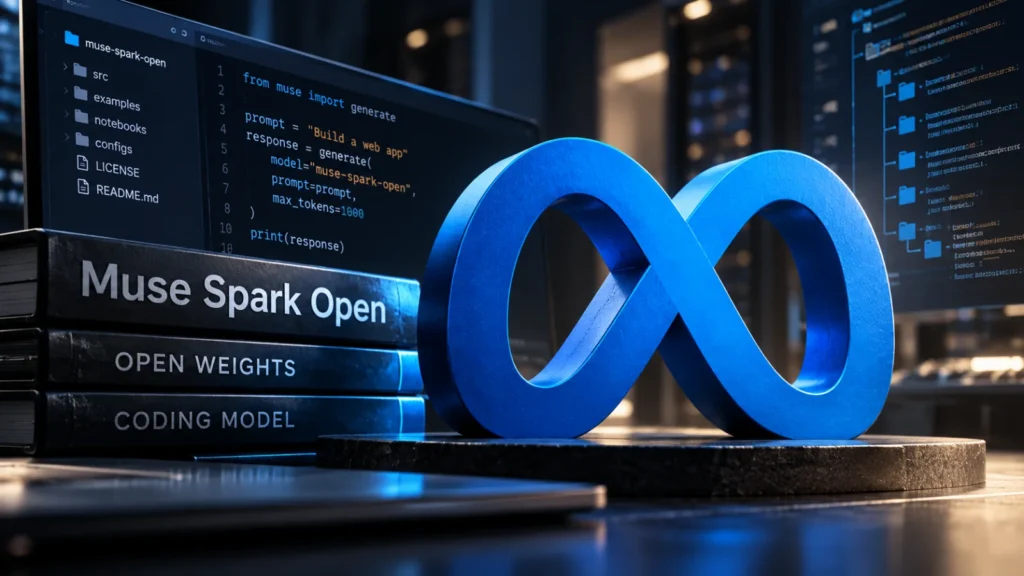
Meta has released Muse Spark Open, an open-weight model described as coding-optimized, and launch material followed from Amazon, NVIDIA and a third-party launch post. Meta published its own announcement post titled “Muse Spark Open” on its research site, but BriefFlash has only that title, so the details below come from partner posts.
NVIDIA’s technical post reportedly describes the model as having 816 billion total parameters, 42 billion active parameters and a 1 million token context window. No license terms, benchmark scores or hardware requirements appear in the launch material we have, so “open-weight” is the accurate label and “frontier” remains a claim.
What is Muse Spark Open and where can developers get it?
Muse Spark Open is an open-weight model from Meta that Amazon and NVIDIA both describe as coding-optimized. Amazon says it is now available in SageMaker JumpStart, which it calls the machine learning hub of SageMaker AI and which serves as a catalog for deploying models inside customer cloud accounts.
NVIDIA separately published a technical post on scaling agentic coding workflows with the model on its GB300 NVL72 systems. Those are rack-scale data center machines, not developer workstations, which already hints at the intended audience.
The Amazon listing also reportedly says the model was trained on real developer workflows such as multi-file refactors and long debugging. That is a single sentence and the text we have is cut off, so we treat it as a vendor description, not a verified detail.
The labels differ across posts. NVIDIA and Amazon say coding-optimized, while a separate launch post calls it a frontier multimodal mixture-of-experts model. That is a difference in framing, not a factual conflict, but the material does not say whether the model accepts anything besides text, and we do not adopt “frontier” without benchmarks.
What do 816B total and 42B active parameters mean?
They mean the model is large to store but comparatively light to run for each token. In a mixture-of-experts design, the model holds many specialist sub-networks and routes each token through only a few of them. Compute per token tracks the 42 billion active parameters, while storage tracks the full 816 billion.
By our arithmetic, 42 billion of 816 billion is about 5 percent of the parameters in use at a time. These are specifications reportedly taken from a partner post, not performance results. A 1 million token context window means the model can take in a very large amount of text, such as big parts of a codebase, in one request; nothing in the coverage shows how well it uses that space.
Who can realistically run Muse Spark Open?
Cloud users and rack-scale buyers can; most individual developers probably cannot. The numeric precision of the released weights is not stated, so the table below is BriefFlash illustration, not a stated requirement.
| Assumption | Bytes per parameter | Weights alone |
|---|---|---|
| Lower precision | 1 | about 816 GB |
| Higher precision | 2 | about 1.6 TB |
That is storage for the weights only, before any memory the running model needs. On those numbers, local use looks unrealistic for most developers, though the coverage mentions no quantized variants that could change the picture. Enterprise teams on a cloud platform and buyers of rack-scale systems are the more plausible audience, which fits the GB300 NVL72 post.
For scale, Nvidia’s 120B Nemotron 3.5 Super VL, an open model for agents released the same day, is described as a 120-billion-parameter model. Its architecture is not stated, so the two are not like-for-like, but the size gap shows how different the entry points are.
Is Muse Spark Open really open, and what is still unknown?
Not yet demonstrably. Open-weight means the trained weights can be downloaded; open source also implies a permissive license and, usually, open training code and data. No license appears in the coverage, so BriefFlash does not call this open source, and a license that restricts commercial use or large deployments would change who benefits.
What we do not know yet:
- The license, and whether commercial use is allowed
- Benchmark scores, a comparison set or any independent test of coding quality
- Hardware requirements, quantized variants and the precision of the released weights
- SageMaker JumpStart pricing and instance requirements
- What “multimodal” means for this model, if it applies at all
- How it relates to Meta’s other Muse models, and why Meta is releasing weights now
NVIDIA and Amazon are distribution partners with commercial reasons to promote the release, and neither post is an independent evaluation. For engineering leads, the sensible order is to read the license first, then wait for independent coding results before budgeting for hardware.
For teams deciding whether it is worth evaluating at all, the practical test is narrow. Confirm the license permits the intended use, confirm the weights fit the infrastructure already budgeted, and run a small trial on your own codebase before relying on any vendor description of quality.
Meta’s earlier Muse launches offer a pattern to keep in mind. Meta’s Muse Wonder launched with capability claims but no benchmarks, and our report on the Muse AI agent covers what stayed unproven there. We make no assumption that Muse Spark Open is the same model as either.
Frequently asked questions
Is Muse Spark Open actually open source?
Not on the evidence available. It is described as open-weight, meaning the trained weights are downloadable, but no license appears in the launch coverage BriefFlash has. Open source usually implies a permissive license and often open training code and data. Until the license is read, commercial use and large deployments should be treated as unconfirmed.
Can I run Muse Spark Open locally?
Probably not on typical developer hardware. The model reportedly has 816 billion parameters, and BriefFlash’s illustrative arithmetic puts the weights alone at roughly 816 GB at 1 byte per parameter or 1.6 TB at 2 bytes. The released precision, any quantized variants and the hardware requirements have not been confirmed.
What does 816B total and 42B active parameters mean?
In a mixture-of-experts model, many specialist sub-networks are stored but only a few handle each token. Reportedly, 816 billion parameters must be stored while 42 billion are active at a time, about 5 percent. Compute per token tracks the active figure, but the full weights still have to be held.
Where can developers get Muse Spark Open today?
Amazon says it is available in SageMaker JumpStart, its catalog for deploying models inside customer cloud accounts. NVIDIA has published a technical post on running it on GB300 NVL72 systems, a separate launch post exists, and Meta has an announcement on its research site. Pricing and instance requirements have not been reported.
How is Muse Spark Open different from Meta’s other Muse models?
That is not yet clear. BriefFlash has covered Muse Wonder and the Muse AI agent, but nothing in the launch material explains how Muse Spark Open relates to them, or whether a closed Muse Spark exists. It should not be assumed to be the same model as Muse Wonder.