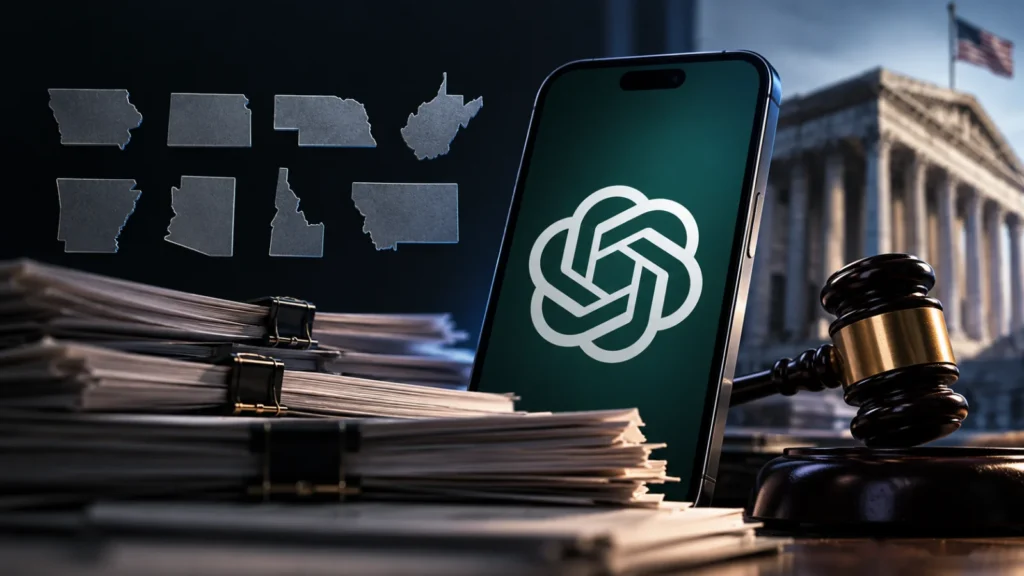
Eight states sue OpenAI in separate lawsuits, according to reports, accusing the company of harming children and misleading customers about the safety of ChatGPT, its consumer chatbot. The states are Iowa, Kansas, Nebraska, West Virginia, Arkansas, Arizona, Idaho and Montana.
Everything in the complaints is an allegation by the states under local consumer protection law, and no court has ruled on any of it. BriefFlash has not independently confirmed the filings, and OpenAI’s response was not available in the material we have. The stakes are broad: ChatGPT is among the most widely used consumer AI products, and whatever the outcome, these cases will test whether state consumer protection law can impose safety expectations on AI chatbots.
Why did eight states sue OpenAI, and what do they allege?
According to reports, the states say OpenAI harmed children and misled customers about how safe ChatGPT is. The suits concern consumer-facing safety and marketing, not a technical model benchmark. The reported allegations are:
- OpenAI harmed children through ChatGPT
- OpenAI misled customers about the safety of the product
- OpenAI unlawfully put profits over safety while developing ChatGPT
- OpenAI violated local consumer protection laws by failing to warn customers
The report available to us breaks off mid-sentence while describing the warning claim. We therefore cannot say which risks the complaints say customers were not told about, and we will not guess. Each item above is the states’ position, not a finding.
Are these eight separate cases or one coordinated action?
They are reportedly eight separate cases. Each state filed its own lawsuit, and nothing in the material describes a joint multistate action. Whether the filings are coordinated or merely parallel is not stated.
That matters because state consumer protection laws differ. Eight cases built on different statutes may not move at the same pace or turn on the same questions.
What does a consumer protection claim require the states to show?
This is general legal background, not detail from the complaints. State consumer protection statutes generally prohibit unfair or deceptive business practices, and they are typically enforced by state attorneys general. The reports do not say which state office filed each suit.
A failure-to-warn theory argues that a company knew of a risk and did not adequately tell customers. It is the type of claim reportedly alleged here, and OpenAI may contest it.
Our analysis is as follows. Consumer protection claims generally turn on whether statements or omissions were misleading. That is a different question from proving that a specific harm occurred to a specific child. We are fairly confident in that distinction as a matter of general law, but we have not read the complaints, and the harms they plead are unknown to us.
What do we not know yet?
Most of what would let a reader weigh these suits is missing from the material available to BriefFlash:
- OpenAI’s response or any statement on the suits
- Which specific harms to children each complaint describes
- What remedies or penalties the states seek
- Which courts the cases were filed in, and on what dates
- Whether the eight filings are coordinated
- What age-related protections ChatGPT currently has, and how they compare with the allegations
Reports describe these as the latest lawsuits against OpenAI, but we have no detail on any earlier cases and do not characterize them. Separately, same-day headlines reportedly said Character.AI is going bankrupt and that Disney offered $20M for its chatbot technology. We have no details beyond those headlines and draw no link to the OpenAI suits.
Who is affected, and what happens next?
The clearest effect is on people who deploy or advise on consumer AI products. If a court accepts that failing to warn customers can breach state consumer law, product disclosures and marketing claims for chatbots become legal exposure, not just communication choices. That is our inference from the claims as reported, not an outcome anyone has predicted. Parents and policy staff can read the cases as a test of whether existing state law is enough, or whether chatbot-specific rules are needed.
Nothing in the available material says ChatGPT has changed because of the suits. BriefFlash has also covered other recent OpenAI product moves, including its test of visual ads in ChatGPT image generation and the pause of ChatGPT Pro sign-ups. Neither is connected to these cases.
In a typical civil case, the defendant answers the complaint and may file motions before any evidence is weighed. The first things to watch are OpenAI’s formal responses in each state, any motions to dismiss, and any sign that the eight cases are being coordinated.
Frequently asked questions
Which states have sued OpenAI?
According to reports, the states are Iowa, Kansas, Nebraska, West Virginia, Arkansas, Arizona, Idaho and Montana. Each filed its own lawsuit, so these are eight separate cases, not one joint action. BriefFlash has not independently confirmed the filings, and the allegations in them are claims by the states that no court has ruled on.
What laws are the states relying on?
Reports say the complaints allege violations of local consumer protection laws. Such statutes generally prohibit unfair or deceptive business practices and are typically enforced by state attorneys general. The material available does not name the specific statutes or say which state office filed each suit, and the laws differ from state to state.
Has OpenAI responded to the lawsuits?
OpenAI’s response was not available in the material BriefFlash has, so we cannot say how the company answers the allegations. That does not mean OpenAI declined to comment. The allegations are unproven, and OpenAI may contest them in court once it responds to each complaint.
Does this change anything for people using ChatGPT today?
Nothing in the available material says ChatGPT has changed because of the suits. No court has ruled on any claim, and the relief the states seek is not known. Any change to how ChatGPT warns users or protects children would depend on how the cases, or OpenAI’s own decisions, develop.